
Statement outlining results, risks and significant changes in operations, personnel and programs
1. Introduction
This quarterly financial report should be read in conjunction with the Main Estimates and any Supplementary Estimates approved in a given year by the date of this report. It has been prepared by management as required by section 65.1 of the Financial Administration Act and in the form and manner prescribed by Treasury Board (TB). This quarterly financial report has not been subject to an external audit or review.
1.1 Authority, Mandate and Programs
Natural Resources Canada (NRCan) works to improve the quality of life of Canadians by ensuring that our natural resources are developed sustainably, providing a source of jobs, prosperity, and opportunity, while preserving our environment and respecting our communities and Indigenous peoples.
Further details on NRCan’s authority, mandate and programs can be found in Part II of the Main Estimates.
1.2 Basis of Presentation
This quarterly financial report has been prepared by management using an expenditure basis of accounting. The accompanying Statement of Authorities includes NRCan’s spending authorities granted by Parliament, and those used by NRCan are consistent with the Main Estimates, Supplementary Estimates (A), and budget adjustments approved by TB up to June 30, 2026. This quarterly report has been prepared using a special purpose financial reporting framework designed to meet financial information needs with respect to the use of spending authorities.
The authority of Parliament is required before money can be spent by the Government. Approvals are given in the form of annually approved limits through appropriation acts, or through legislation in the form of statutory spending authority for specific purposes.
NRCan uses the full accrual method of accounting to prepare and present its annual unaudited departmental financial statements that are part of the departmental results reporting process; however, the spending authorities voted by Parliament remain on an expenditure basis.
2. Highlights of Fiscal Quarter and Fiscal Year-to-Date Results
This Departmental Quarterly Financial Report reflects the results as of June 30, 2026, which include Main Estimates and Supplementary Estimates (A) for which full supply was released as well as TB approved adjustments. The details presented in this report focus on and compare the first quarter results of 2026-2027 with those of 2025-2026.
2.1 Authorities
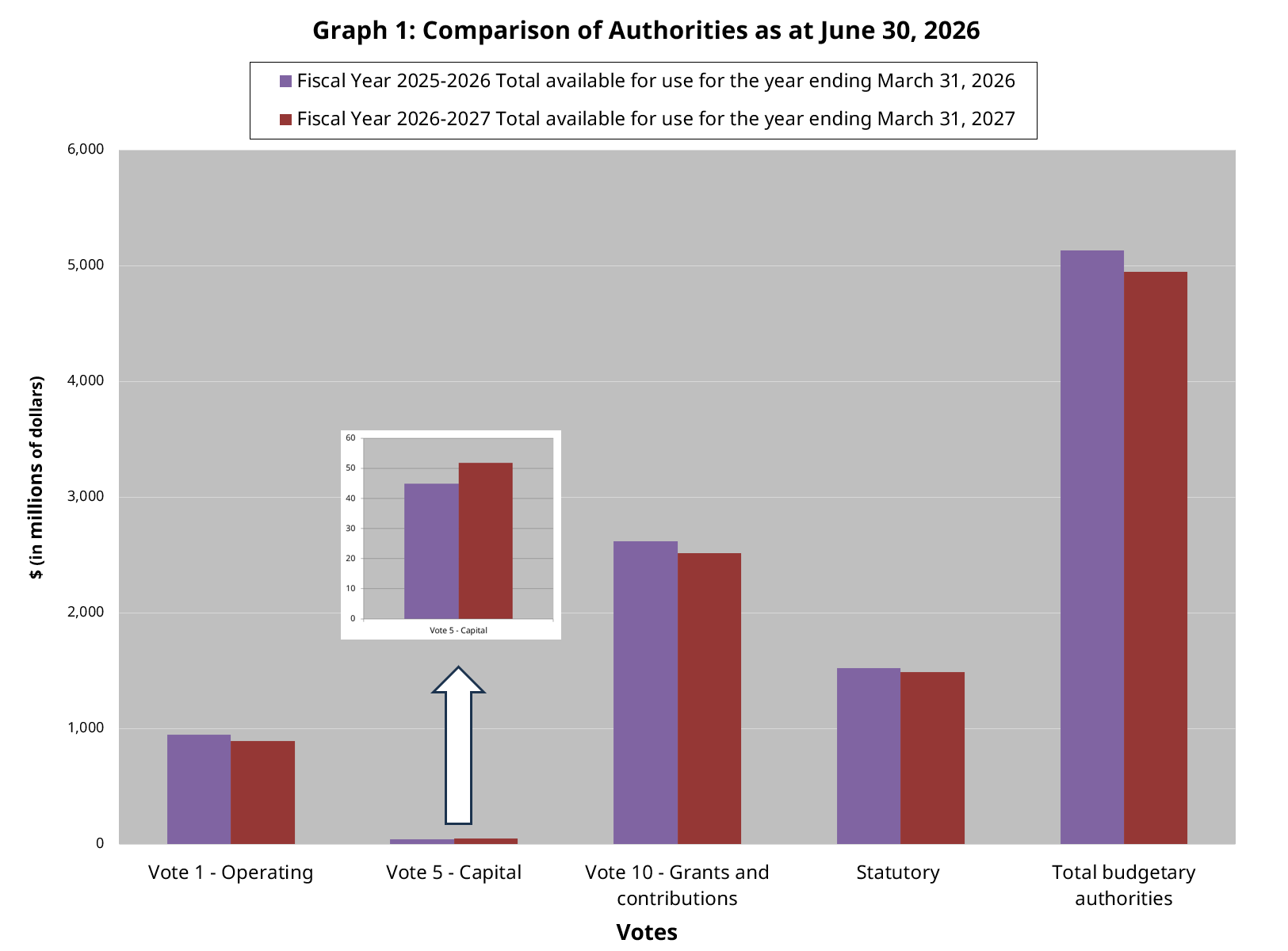
As per Table 1, presented at the end of this document, and on Graph 1 below, as at June 30, 2026, NRCan has authorities available for use of $4,947.4M compared to $5,132.6M in 2025-2026, for a net decrease of $185.2M or 3.6%.
Text version
Graph 1: Comparison of Authorities as at June 30, 2026
| (In millions of dollars) | Fiscal Year 2025-2026 Total available for use for the year ending March 31, 2026 | Fiscal Year 2026-2027 Total available for use for the year ending March 31, 2027 |
|---|---|---|
| Vote 1 - Operating | 944 | 894 |
| Vote 5 - Capital | 45 | 52 |
| Vote 10 - Grants and contributions | 2,621 | 2,513 |
| Statutory | 1,523 | 1,488 |
| Total budgetary authorities | 5,133 | 4,947 |
The decrease of $185.2M in authorities in 2026-2027 compared to 2025-2026 is mainly explained by the decrease within the Vote 10 grants and contributions, Vote 1 operating expenditures, and Statutory authorities as well as the net effect of smaller fluctuations within Vote 5 capital expenditures as per the following:
| Total available for use for the year ending March 31, 2026 | 5,132,577 |
| Vote 1 - Operating | |
| Critical Minerals | 14,438 |
| Comprehensive Land Claims | 11,117 |
| All other net decreases less than $10M individually | (75,615) |
| Sub-total Vote 1 - Operating | (50,060) |
| Vote 5 - Capital | |
| Critical Minerals | 9,375 |
| Canadian Data Receiving Infrastructure | (5,795) |
| All other net increases less than $3M individually | 3,358 |
| Sub-total Vote 5 - Capital | 6,938 |
| Vote 10 - Grants & Contributions | |
| Biofuels Production Incentive Program | 186,000 |
| Critical Minerals | 173,537 |
| Smart Renewables & Electrification Pathways | 150,629 |
| Fighting & Managing Wildfires (FMWCC) | 69,983 |
| Forest Sector Competitiveness programs | 55,082 |
| Clean Energy for Rural and Remote Communities | (31,879) |
| Electricity Pre-Development | (43,645) |
| Clean Fuels Fund | (112,560) |
| Greener Homes | (527,457) |
| All other net decreases less than $20M individually | (26,899) |
| Sub-total Vote 10 - Grants & Contributions | (107,209) |
| Statutory | |
| Newfoundland Offshore Petroleum Resources Revenue Fund (Forecasts are revised annually based on projected oil & natural gas production levels, prices, exchange rates and operator's costs) |
(43,316) |
| All other net increases | 8,487 |
| Sub-total Statutory | (34,829) |
| Total decrease from previous year due to year-over-year changes | (185,159) |
| Total available for use for the year ending March 31, 2027 | 4,947,418 |
2.2 Budgetary Expenditures by Standard Object
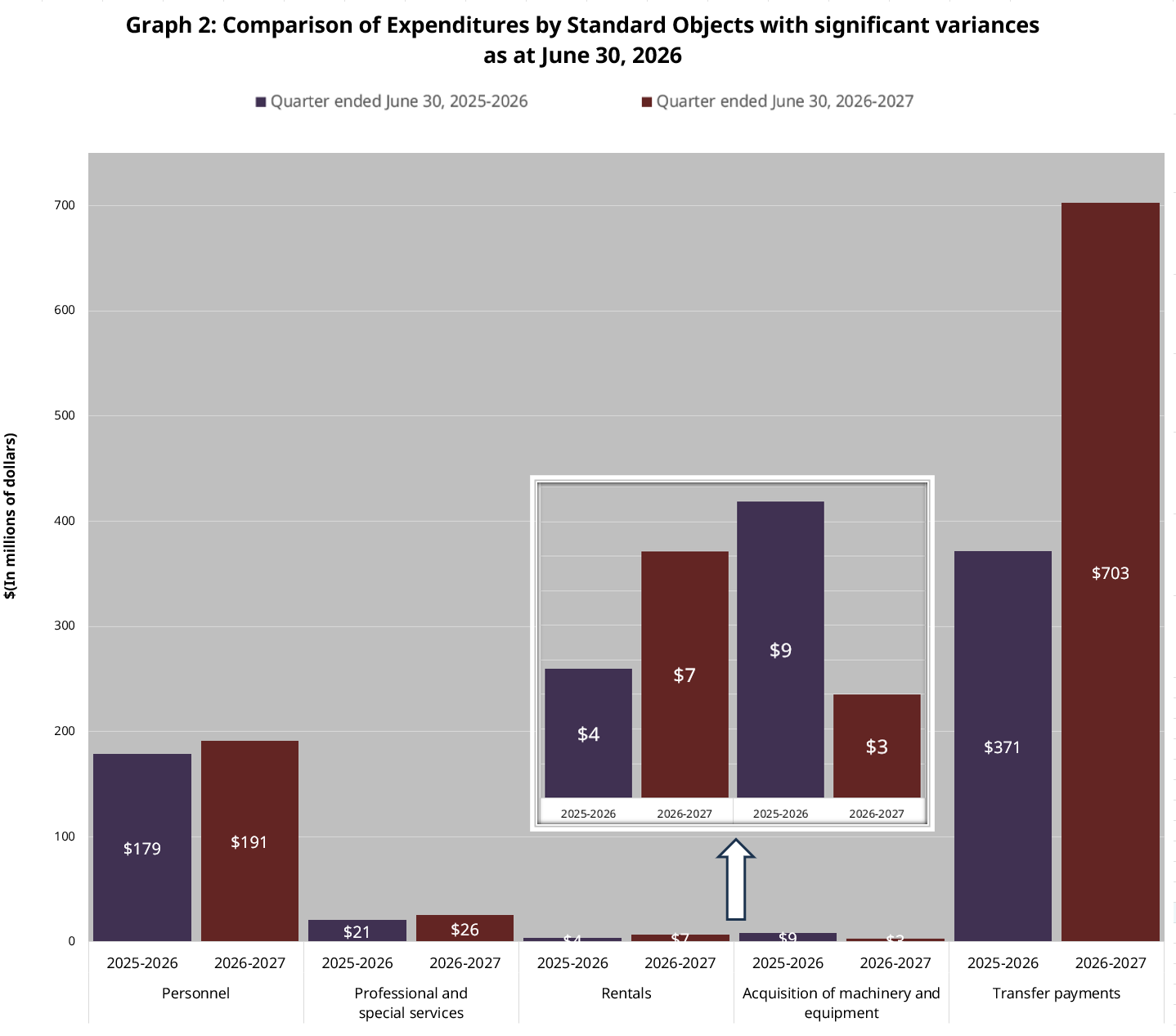
The spending for the quarter ending June 30, 2026 amounts to $938.8M or 19.0% of total funding available for the fiscal year, compared to $594.3M or 11.6% for the same quarter last year. The increase of $344.5M in spending is mainly related to an increase in expenditures for transfer payments in the first quarter of 2026-2027 compared to the same type of expenditures in the first quarter of 2025-2026. Further analysis has been done on standard objects with significant expenses, as noted in Graph 2 below. Table 2 at the end of this document presents the spending for all standard objects.
Text version
Graph 2: Comparison of Expenditures by Standard Objects with significant variances as at June 30, 2026
| (In millions of dollars) | Quarter ended June 30 |
|
|---|---|---|
| Personnel | 2025-2026 | 179 |
| 2026-2027 | 191 | |
| Professional and special services | 2025-2026 | 21 |
| 2026-2027 | 26 | |
| Rentals | 2025-2026 | 4 |
| 2026-2027 | 7 | |
| Acquisition of machinery and equipment | 2025-2026 | 9 |
| 2026-2027 | 3 | |
| Transfer payments | 2025-2026 | 371 |
| 2026-2027 | 703 |
| Standard Object | Explanation | Variance between 2026-2027 and 2025-2026 Q1 expenditures |
|---|---|---|
| Personnel | The variance is mainly due to departmental transfers for Energy Innovation Program (EIP) occurring earlier this year and the costs of separation entitlements from workforce adjustments. | 12,194 |
| Professional and special services | The variance is mainly due to departmental transfers for Energy Innovation Program (EIP) and payments to Justice Canada for legal services occurring earlier this year. | 4,729 |
| Rentals | The variance is mainly due to timing of the rental of an icebreaker as part of the United Nations Convention on the Law of the Sea (UNCLOS) 2026 Canada-Sweden Arctic Ocean expedition | 3,391 |
| Acquisition of machinery and equipment | The variance is mainly due to the changes in the classification of operating costs incurred by Offshore Wind Predevelopment Programs to professional and special services this year and timing delays related to vote net revenue and capital spending. | (5,587) |
| Transfer Payments | The variance is mainly due to increased statutory payments to the province of Newfoundland and Labrador for offshore activity and increased payments for Fighting and Managing Wildfires in a Changing Climate (FMWCC), Forest Sector Competitiveness, 2 Billion Trees and Oil to Heat Pump programs offset by reduced payments for the Canada Greener Homes Initiative. | 331,631 |
| All Other Standard Objects | Minor increases and decreases within different standard objects. | (1,816) |
| Total Variance | 344,542 | |
3. Risks and Uncertainties
Uncertainty continues to affect the global economy, contributing to inflation, supply chain disruptions, and shifting global market dynamics. Despite these challenges, Canada’s GDP and employment rate have remained relatively steady throughout Q4 2025-2026. In this context, NRCan’s most significant financial and operational risks in the short term are continued geopolitical volatility, major project delivery pressures, climate‑driven natural hazards, targeted cyber threats, as well as program and workforce realignment from expenditure restraint. NRCan is taking proactive steps to manage these risks and to support the sustainable development and economic contribution of Canadian energy and natural resource sectors.
In response to economic pressure and heightened global uncertainty, including ongoing conflicts in the Middle East, NRCan continues to advance initiatives that enhance natural resource sectors’ resilience and competitiveness. This includes responding to trade volatility and targeted tariffs on exports by reducing reliance on single markets and deepening collaboration with dependable like-minded partners, such as in the Indo-Pacific and Europe. NRCan supported the development of the new National Electricity Strategy, Powering Canada Strong: A National Strategy for an Electrified Canadian Economy, to strengthen Canada’s energy security, support domestic electrification, and reduce vulnerability to market shocks. Further, NRCan collaborates with other government departments, including the department of Finance and Global Affairs, to develop strong, fiscally responsible, and risk-informed strategies to protect and strengthen Canada’s resource sectors. For example, the department has advanced the Forest Sector Transformation initiative, attracting investment, modernizing operations, and stabilizing the sector to protect jobs and support communities nationwide. An additional $500 million has been committed over three years, starting in 2026-2027, to renew and expand forestry programs and further diversify market opportunities.
NRCan also continues close collaborations with provinces and territories, Indigenous groups, as well as other partners and stakeholders to streamline regulatory processes and advance major project timelines, building a strong, sustainable and sovereign economy for all Canadians. Through the First and Last Mile Fund, for example, the department supports strategic mining and infrastructure development projects that secure critical minerals value chains, expand market opportunities, and foster long-term investment. Similarly, collaborations through the Regional Energy and Resource Tables continue to accelerate high-potential clean growth projects and cutting-edge technologies that support Canada’s transformation to a low-carbon economy. Meanwhile, NRCan continues to adopt high-performance codes to enhance sustainability and competitiveness in the building sector, supporting climate action by reducing emissions and energy consumption. The department also maintains wildfire and flood maps that support emergency preparedness to protect communities, industry, and ecosystems in the event of hazardous climate-related incidents.
NRCan remains committed to reconciliation by strengthening Indigenous partnerships and participation in natural resource sectors. This includes implementing measures under the UN Declaration on the Rights of Indigenous Peoples Act and advancing the Indigenous Natural Resource Partnerships Program to ensure equitable participation and economic benefit from natural resource projects. Guided by the principles of inclusion, diversity, equity, and accessibility, along with Gender-based Analysis Plus, the department continues to advance Canadian leadership in natural resource management while upholding a commitment to our shared values of respect for people and the environment.
The department has developed an AI Strategy to support responsible adoption of artificial intelligence, consistent with Treasury Board Secretariat (TBS) expectations, and is enhancing departmental security through a modernized Departmental Security Plan and Cybersecurity Strategy. Following the GC Enterprise Cyber Security Strategy, NRCan has adopted a modernized operating model centered on risk-based decision-making, as well as defence, and will continue to implement an integrated plan to respond to Canada’s Digital Ambition. This approach supports our departmental resilience by safeguarding the confidentiality and availability of our digital services in a rapidly evolving threat landscape.
NRCan continues to strengthen its risk management capabilities and effectiveness to better support decision‑making, coordination, and priority setting. The department is taking steps to promote consistent methodologies across departmental risk processes, including taking part in the TBS’ second annual Risk and Compliance Process. This whole-of-government exercise supports Deputy Heads in fulfilling their legislative and Treasury Board policy accountabilities through effective controls, practices, and risk management. Further, through a Deputy Minister-led initiative, the department is working to streamline risk management processes for greater efficiency while maintaining appropriate levels of oversight and accountability. NRCan continues to implement mitigation strategies to manage financial and operational risks associated with Workforce Adjustments, ensuring that cost‑containment efforts do not result in increased downstream pressures, reduced service quality, or unintended impacts on timely and effective service delivery to Canadians.
As outlined in the 2027-2030 Corporate Risk Profile (CRP), the department is monitoring the following four strategic risks and five operational risks:
Strategic risks
- Geopolitical Context
- Regulatory Complexity
- Reconciliation
- Natural Resource Science & Innovation
Operational risks
- Financial Management
- Workplace Wellness & Culture
- Cybersecurity
- Security & Business Continuity
- Infrastructure & Assets
Relating primarily to factors external to the Department, strategic risks affect the department’s ability to deliver on its mandate, while operational risks relate to internal activities and administration that support the department’s projects and program deliverables. NRCan will closely and routinely monitor and update these key corporate risks to inform leadership on risk status, supporting business continuity and strategic future planning, while continuing to support Canadians and our natural resource sectors in 2026-2027 and beyond.
4. Significant Changes in Relation to Operations, Personnel, Programs
The following significant changes occurred during the first quarter of 2026-2027:
- Veronica Ramrattan joined NRCan as Assistant Deputy Minister (ADM), Strategic Policy & Innovation (SPI), effective May 21, 2026.
- Her Excellency the Governor General in Council, on the recommendation of the Prime Minister, under paragraph 2(a) of the Public Service Rearrangement and Transfer of Duties Act, transfers from the Department of Natural Resources to the Department of Employment and Social Development the control and supervision of that portion of the federal public administration in the Department of Natural Resources known as the Sustainable Jobs Secretariat, effective May 1, 2026.
- Further to the Comprehensive Expenditure Review undertaken as required by the passing of Budget 2025, NRCan is proceeding with position reductions as planned and is currently on track to meet the reductions target of approximately 807 positions by 2028-2029.
No other significant change in relation to operations, personnel or programs occurred during the first quarter of 2026-2027.
Original signed by:
Jeffrey Labonté
Acting Deputy Minister
August 18, 2026
Date signed
Ottawa, Canada
Original signed by:
Grace Chennette
A/ Chief Financial Officer
August 14, 2026
Date signed
Ottawa, Canada
| (in thousands of dollars) | Fiscal Year 2026-2027 | Fiscal Year 2025-2026 | ||||
|---|---|---|---|---|---|---|
| Total available for use for the year ending March 31, 2027* | Expended during the quarter ended June 30, 2026 |
Year-to-date used at quarter-end | Total available for use for the year ending March 31, 2026** | Expended during the quarter ended June 30, 2025 |
Year-to-date used at quarter-end | |
| Vote 1 - Net Operating Expenditures | 894,170 | 210,399 | 210,399 | 944,230 | 198,160 | 198,160 |
| Vote 5 - Capital Expenditures | 51,864 | 2,438 | 2,438 | 44,926 | 3,275 | 3,275 |
| Vote 10 - Grants and Contributions | 2,513,284 | 229,615 | 229,615 | 2,620,493 | 177,433 | 177,433 |
| Statutory Payments | ||||||
| Minister of Natural Resources – Salary and motor car allowance | 106 | 26 | 26 | 102 | 17 | 17 |
| Contributions to employee benefit plans | 93,433 | 23,065 | 23,065 | 86,261 | 21,565 | 21,565 |
| Contribution to the Canada/Newfoundland Offshore Petroleum Board | 14,028 | 7,051 | 7,051 | 14,028 | 7,014 | 7,014 |
| Contribution to the Canada/Nova Scotia Offshore Petroleum Board | 5,047 | 2,116 | 2,116 | 4,156 | 2,078 | 2,078 |
| Payments to the Nova Scotia Offshore Revenue Account | - | - | - | - | 1 | 1 |
| Payments to the Newfoundland Offshore Petroleum Resource Revenue Fund | 1,375,335 | 464,097 | 464,097 | 1,418,651 | 184,722 | 184,722 |
| Geomatics Canada Revolving Fund | 151 | - | - | (270) | - | - |
| Spending of amounts equivalent to proceeds from disposal of surplus moveable crown assets | - | - | - | - | - | - |
| Total Statutory Payments | 1,488,100 | 496,355 | 496,355 | 1,522,928 | 215,397 | 215,397 |
| Total Budgetary Authorities | 4,947,418 | 938,807 | 938,807 | 5,132,577 | 594,265 | 594,265 |
* Total available for use includes only authorities available for use and granted by Parliament at quarter-end through the Main Estimates and Supplementary Estimates (A), for which full supply was released, as well as TB approved adjustments.
** Total available for use includes only authorities available for use and granted by Parliament at quarter-end through the Main Estimates, for which full supply was released, as well as TB approved adjustments.
| (in thousands of dollars) | Fiscal Year 2026-2027 | Fiscal Year 2025-2026 | ||||
|---|---|---|---|---|---|---|
| Total available for use for the year ending March 31, 2027* | Expended during the quarter ended June 30, 2026 |
Year-to-date used at quarter-end | Total available for use for the year ending March 31, 2026** | Expended during the quarter ended June 30, 2025 |
Year-to-date used at quarter-end | |
| Budgetary Expenditures: | ||||||
| Personnel | 662,233 | 191,284 | 191,284 | 651,797 | 179,090 | 179,090 |
| Transportation and communication | 21,430 | 2,681 | 2,681 | 22,318 | 2,733 | 2,733 |
| Information | 29,276 | 3,125 | 3,125 | 30,015 | 2,991 | 2,991 |
| Professional and special services | 207,973 | 25,646 | 25,646 | 238,501 | 20,916 | 20,916 |
| Rentals | 25,851 | 7,137 | 7,137 | 28,710 | 3,745 | 3,745 |
| Repair and maintenance | 7,141 | 709 | 709 | 9,271 | 864 | 864 |
| Utilities, materials and supplies | 36,223 | 2,969 | 2,969 | 42,409 | 2,987 | 2,987 |
| Acquisition of land, buildings and works | 19,109 | 1,699 | 1,699 | 8,948 | 1,407 | 1,407 |
| Acquisition of machinery and equipment | 58,635 | 2,994 | 2,994 | 69,370 | 8,581 | 8,581 |
| Transfer payments | 3,907,694 | 702,879 | 702,879 | 4,057,328 | 371,248 | 371,248 |
| Other subsidies and payments | 9,165 | 2,301 | 2,301 | 10,640 | 3,228 | 3,228 |
| Total Budgetary Expenditures | 4,984,730 | 943,424 | 943,424 | 5,169,307 | 597,790 | 597,790 |
| Less: Total Revenues Netted Against Expenditures | 37,312 | 4,617 | 4,617 | 36,730 | 3,525 | 3,525 |
| Total Net Budgetary Expenditures | 4,947,418 | 938,807 | 938,807 | 5,132,577 | 594,265 | 594,265 |
* Total available for use includes only authorities available for use and granted by Parliament at quarter-end through the Main Estimates and Supplementary Estimates (A), for which full supply was released, as well as TB approved adjustments.
** Total available for use includes only authorities available for use and granted by Parliament at quarter-end through the Main Estimates, for which full supply was released, as well as TB approved adjustments.