
Table of contents
Details
- Publication date:
April 8, 2026 - Author(s):
Natural Resources Canada - ISBN:
978-0-660-99100-9 - GC Catalogue Number:
M134-80/2026E-PDF
- Introduction
- Background
- Summary of comments
- What’s next?
- Appendix I: DO Regulations – Discussion Paper (2018)
- Appendix II: DO Regulations – Policy Discussion Paper (2025)
Introduction
In 2019, the Canadian Energy Regulator Act (CERA) established the Canada Energy Regulator (CER or Regulator) through Bill C-69. The CER provides regulatory oversight over the full lifecycle of federal energy infrastructure including pipelines that cross interprovincial and international borders, international and designated interprovincial power lines, and most offshore renewable energy projects.
The CERA created a modern governance structure for the Regulator, including a Commission composed of independent commissioners whose role is to make recommendations and decisions regarding federally regulated infrastructure projects throughout the project’s lifecycle. A Board of Directors provides governance of the Regulator including the provision of strategic direction and advice to the Regulator. A Chief Executive Officer (CEO) is responsible for the management of the Regulator’s day-to-day business and affairs.
Through the CERA, the majority of the CER’s powers, duties, and functions are carried out by the Commission. The CERA provides authority for the Government of Canada to create regulations that would specify certain administrative and technical decisions that would be carried out by “designated officers” of the CER. The CEO of the CER is responsible for appointing designated officers and apportioning their work.
Designated officers would have an important role in the modern governance structure of the CER, contributing to the efficient implementation of its responsibilities. Chiefly, conferring certain tasks on designated officers would reduce administrative burden on the Commission, allowing it to focus on matters of broad political and economic import. Designated Officers are considered best practice in regulatory frameworks, for example under the Nuclear Safety and Control Act, which explicitly assigns certain Commission duties to designated officers, and the Canada Oil and Gas Operations Act, where designated officers exercise operational regulatory authorities.
A discussion paper was published online in 2018 during Engagement Phase I as part of a broader consultation on the creation of the CER and the passing of Bill C-69. The paper included five discussion questions to guide feedback, and it is presented in Appendix I. Feedback on the paper emphasized the need for decision-making boundaries between the Commission and designated officers, with strong support for retaining Commission authority over decisions involving Indigenous rights. While designated officers were accepted for routine, technical, or administrative tasks, comments received consistently called for transparent criteria, Indigenous engagement, and safeguards to ensure institutional integrity and accountability.
A second discussion paper was published in 2025, during engagement Phase II, which included a summary of the approach to the proposed regulations and questions to guide public feedback (see Appendix II). In general, the feedback offered was positive, with most of the responses highlighting that the regulations would improve regulatory certainty and efficiency, accelerate timelines, and enhance Canada’s competitiveness. Suggestions often focused on providing a clearly defined scope of delegation, a comprehensive list of decision types eligible for delegation, establishing public facing timelines and service standards, ensuring designated officers are qualified and trained, and implementing clear escalation protocols with Commission oversight.
This Engagement Summary Report (the Report) was prepared to reflect the feedback received during Engagement Phase I in 2018 and Engagement Phase II in 2025. It captures the diversity of perspectives shared throughout the process. While the Report does not address every individual comment, Natural Resources Canada (NRCan) has sought to acknowledge the range of viewpoints expressed.
Background
The Designated Officer Regulations
NRCan is undertaking engagement about the proposed Designated Officer Regulations (DO Regulations) under the CERA. NRCan is committed to ensuring that its work, and the decisions it makes, are informed by diverse input from people across Canada. Engagement on federal regulatory development initiatives is informed by the Government of Canada’s Cabinet Directive on Regulation, which calls for meaningful consultation and engagement with Indigenous Peoples and impacted stakeholders throughout the development, management, and review of regulations.
This Report summarizes the comments received during public engagement in Phase I and Phase II.
Engagement Phase I
During the initial development of the DO Regulations in 2018, NRCan and CER undertook a broad and inclusive consultation process to gather input from stakeholders and partners. This process was designed to ensure transparency, accountability, and responsiveness to the diverse interests affected by the proposed regulations.
In 2018, a discussion paper on proposed DO Regulations was posted on NRCan’s website to solicit input from interested parties. This was part of a broader consultation surrounding the creation of the CER and the passing of Bill C-69 (An act to enact the Impact Assessment Act and the Canadian Energy Regulator Act, to amend the Navigation Protection Act and to make consequential amendments to other acts) more broadly. At that time, a public notice about the upcoming discussion paper was posted, and letters to specific Indigenous representatives were mailed, seeking input on the paper.
Indigenous partners were issued notification of the discussion paper a month before it was published. This was sent to an Indigenous engagement list developed through the Canadian Environmental Assessment Agency (CEAA - now the Impact Assessment Agency of Canada) and NRCan, with National Energy Board (NEB – succeeded by the Canada Energy Regulator) review, which included over 300 Indigenous organizations, groups and communities across Canada. This also included the NEB's list of Indigenous communities and groups with an interest in certain of the NEB's regulated infrastructure. The notification contained an offer to meet to discuss Bill C-69 and the regulations.
The discussion paper was published online, and submissions of comments were accepted from October 15 to November 28, 2018. In total, NRCan received 17 written submissions from a wide range of respondents, including industry associations, companies, and Indigenous groups/representatives. These submissions were posted publicly in the language of their submission. In addition to written feedback, NRCan and the CER conducted three workshops with 27 NEB staff members, the CER’s predecessor, during Fall 2018 to gather input. These sessions provided internal perspectives on the practical implications of delegating decision-making authority. In addition, NRCan led four teleconferences, in which 17 industry groups took part in and provided comments.
Engagement Phase II
In addition to the feedback gathered during NRCan's 2018 public engagement on the DO Regulations, a new round of open public engagement was conducted between December 17, 2025, and January 30, 2026, in English and French. The goal was to reach a broad audience and gather diverse public input.
The engagement was prompted through LinkedIn, Facebook, and the Public Consultations and Engagement page on the Government of Canada website, as well as via the Let’s Talk Natural Resources Canada platform. To encourage participation, those who submitted comments through the 2018 engagement process, as well as industry associations and Indigenous organizations, were informed about this additional engagement opportunity through email and were reminded to participate closer to the closing date. Table 1 provides a summary of engagement activities across channels, including email distribution, page views, and public responses.
Public participation was facilitated through the Let’s Talk Natural Resources Canada webpage, which served as the key platform for hosting the informational material and collecting input. All engagement channels directed individuals to this webpage, where they could access background information (i.e., latest discussion paper and NRCan’s Forward Regulatory Plan) on the proposed DO Regulations and details on how to participate. Interested parties were invited to register for a Let’s Talk Natural Resources Canada account and submit their feedback by responding to these four engagement questions:
- Which organization do you represent?
- What changes, if any, would you suggest to the way the regulations define which powers, duties and functions of the Commission are technical or administrative in nature?
- What changes, if any, would you suggest to the way the regulations define which circumstances in which the powers, duties, and functions are to be exercised or performed only by designated officers?
- Do you have any other comments on the proposed regulations?
As an alternative to online participation, respondents were given the option to submit written feedback through email. These engagement methods were designed to provide accessible opportunities for Indigenous partners, the public, and any other interested stakeholders to share their perspectives prior to the January 30, 2026, deadline.
As a result of the Phase 2 Engagement activities, a total number of 14 responses were received. This included six submissions received through the Let’s Talk Natural Resources Canada platform and eight written responses received via email.
Table 1: Summary of Engagement Activities Across Channels, Including Email Distribution, Page Views, and Public Responses
Engagement channel |
Count |
|---|---|
Email (sent) |
132 (x2 with follow-up) |
LinkedIn (views) |
1353 |
Facebook (views) |
8362 |
Public Consultations and Engagement Webpage (views) |
542 |
Let’s Talk Natural Resources (views) |
298 |
Total written responses submitted |
14 |
Summary of comments
Engagement Phase I
What we heard
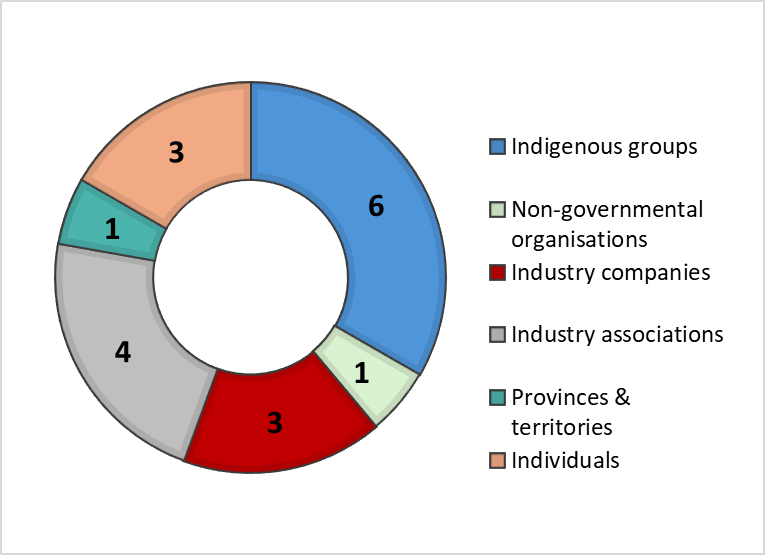
During the Phase 1 engagement period, we heard from 61 respondents through written submissions, teleconferences, and workshops. In total, 17 written submissions were received from Indigenous Nations, communities, societies and organizations, think tanks, industry, and other interested parties, as shown in Figure 1. Beyond written feedback, NRCan hosted four teleconferences, during which 17 organizations participated and provided comments. NRCan and the NEB also held three workshops with 27 NEB staff members to review the discussion paper and gather their feedback. For a complete list of the participants that provided feedback, please see Appendix II.
Figure 1: Written submissions received during Engagement Phase I
Text Version
Donut chart showing responses from Phase I Engagement: Indigenous Groups = 6, Industry Associations = 4, Individuals = 3, Industry Companies = 3, Non-Governmental Organisations = 1, and Provinces and Territories = 1.
Note: The donut chart shows the breakdown of groups that provided written feedback in Phase I. It does not include industry groups that participated in the teleconference or NEB staff who participated in the workshops.
As a result of the Engagement Phase I, each group provided distinct perspectives on the regulatory approach, particularly regarding the delegation of decision-making authority from the Commission to designated officers, as described in the paragraphs below. Table 2 summarizes the written submissions, teleconference feedback, and NEB staff comments received in response to the discussion paper released during Phase I.
Indigenous groups: Written submissions
Indigenous organizations raised concerns about the potential impacts of delegated decision-making on Indigenous rights and interests. They stressed that decisions affecting Indigenous lands, rights, or Traditional Knowledge should remain with the Commission and not be delegated. Several groups emphasized the importance of culturally appropriate consultation processes. Some also recommended the inclusion of Indigenous representatives as designated officers.
Provincial and territorial governments: Written submissions
Provincial and territorial governments expressed interest in improving transparency and coordination. They requested that designated officers be publicly listed to facilitate communication between agencies and the public.
Non-governmental organisations: Written submissions
One environmental NGO was the only stakeholder that raised concerns with the intent of the regulations. Its primary concern was the potential interference in designated officer decision-making and the overall impact on the independence and integrity of the Commission.
Industry feedback: Written submissions and teleconference input
Industry stakeholders emphasized the need for efficiency and clarity. They generally supported the delegation of routine, technical decisions to designated officers, especially in emergency situations where delays could pose risks to people, infrastructure, or the environment. However, they expressed concerns about the use of vague criteria to determine which decisions could be delegated, warning this could lead to regulatory uncertainty, legal challenges, and inefficiencies.
NEB feedback: Workshop comments
Internal engagement efforts from the NEB found that staff generally agreed that only procedural or low-impact decisions should be delegated to designated officers, while complex, rights-implicating, or precedent-setting decisions should remain with the Commission. There were mixed views on who should decide when a matter should be “bumped up”, i.e. referred from a designated officer to the Commission, with some suggesting the CEO and others preferring a collaborative approach.
Table 2: Summary of comments from Engagement Phase I
Group |
Key requests |
Concerns raised |
Preferred decision-Making |
|---|---|---|---|
Indigenous groups |
Commission to handle decisions involving Indigenous rights or knowledge; Indigenous Advisory Groups; Primary notice to affected Nations |
Designated officers may lack Indigenous law/knowledge; Risk of rights being overlooked |
Commission for decisions affecting rights, lands, or knowledge; designated officers only for non-impactful admin tasks |
Non-profit |
Clarify criteria for technical versus administrative decisions; Ensure decisions involving core adjudicative functions remain with the Commission; Reframe criteria to clearly identify decisions that must not be delegated |
Designated officers undermine the Commission’s independence and adjudicative role; Potential erosion of institutional integrity and public trust |
Commission should retain authority over any decision involving adjudication, legal interpretation, or stakeholder rights; designated officers should only handle decisions that are clearly defined, technical, and non-adjudicative |
Industry companies |
Activity-based decision list; Emergency decision authority; Defined officer qualifications |
Uncertainty in process; Risk of inefficiency |
Designated officers for technical/admin tasks; Commission for precedent-setting or contested issues |
Industry associations |
Clear list of delegated decisions; Industry task group for review; Service standards |
Subjectivity in criteria; Risk of delays and legal challenges |
Designated officers for routine, technical decisions; Commission for legal/policy matters |
Provinces & territories |
Public listing of Designated Officers; Continued engagement on future regulations |
Lack of clarity on who to contact |
Commission for broader decisions; designated officers for technical matters |
NEB staff |
Clarify delegated decisions; Clear criteria for procedural decisions; Include legal risk, public interest, compliance history, and multi-stakeholder impact as criteria for Commission-only decisions. |
Subjectivity in criteria; Risk of delays and legal challenges |
Designated officers for procedural and technical matters; Commission for complex, stakeholder-sensitive or rights-impacting decisions; Collaborative bum-up process |
Individuals |
Clear criteria for technical decisions; Competency-based delegation |
Political influence; Consultation process clarity |
Designated officers for well-defined regulations; Commission for complex or delayed decisions |
Engagement Phase II
What we heard
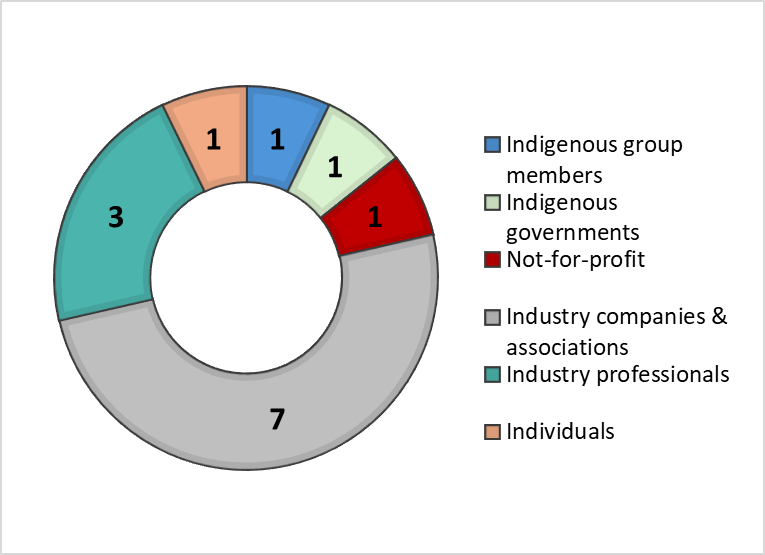
A total number of 14 written responses were received through the Let’s Talk Natural Resources Canada platform during the engagement period from December 17, 2025, to January 30, 2026. Responses were received from seven industry companies and associations, three professionals with engineering and regulatory expertise, an Indigenous group member, an Indigenous Government, a not-for-profit organization, and an individual, as shown in Figure 2. A summary of the comments submitted in response to the discussion paper and the questions posed during Phase II engagement are provided in Table 3.
Figure 2: Comments received during Engagement Phase II
Text Version
Donut chart showing responses from Phase 2 Engagement: Industry Companies and Associations = 7, Industry Professionals = 3, Not-for-Profit = 1, Indigenous Group Members = 1, Indigenous Governments = 1, and Individuals = 1.
The responses reflected a wide range of perspectives, including support for the DO Regulations, detailed feedback and recommendations, as well as broader comments related to climate change, governmental issues, and the need for enhanced environmental support. Although some of the feedback is considered out of scope in terms of the engagement requested, all respondents' points were included in these analyses to ensure the engagement process was inclusive, and to provide transparency.
Industry companies and associations
A total of seven oil and gas companies, pipeline companies, and industry associations provided feedback on the DO Regulations.
These respondents provided valuable feedback, summarized in Table 3. Some responses indicated that the DO Regulations would improve regulatory certainty and efficiency, accelerate timelines, and enhance Canada’s competitiveness. It was noted that clear, predictable, and timely regulatory processes help energy infrastructure projects meet construction and operational schedules, deliver economic benefits, and support efficient decision-making throughout the project life cycle. Upon reviewing these submissions, several key themes emerged that are outlined below.
Scope of delegation
One area of focus was the scope of delegation and definitions for designated officers. Respondents emphasized that regulatory delegation should be flexible and risk-based, allowing designated officers to handle routine, low-risk matters, while higher impact decisions remain with the Commission. In addition, comments were raised regarding Indigenous rights, noting that matters affecting these rights should remain under the Commission's authority to ensure consistency with consultation obligations.
Specific lists of powers duties and functions (PDFs) for designated officers
Industry participants also emphasized the importance of clearly defining designated officers’ roles and responsibilities by regulation. It was recommended that a formal, activity-based schedule of decisions that designated officers can make and specifying who determines whether a file is handled by a designated officer or the Commission be developed. One comment suggested that this document be co-developed with stakeholders. Respondents indicated that clearly outlining designated officers’ duties and responsibilities in the regulations provides predictability and transparency for all parties.
Timelines, service standards and predictability
In line with the need for predictability, the majority of respondents commented on the need for service standards that would provide estimated timelines for designated officers’ reviews and decisions, as well as the need for notice if a file is being moved to the Commission. A feedback mechanism was also recommended.
Tiered review, escalation rules and appeals
To maintain efficiency, industry participants recommended using a well-defined tiered review process, where designated officers handle most multi-issue or low-risk files, escalating to the Commission only when there are material concerns, formal opposition, or clear public interest questions. Others mentioned that the regulations need to ensure that information-seeking or participation requests alone do not trigger escalation.
Qualifications/training
It was advised that regulations should outline qualifications, training, and governance requirements for designated officers, ensuring that delegated decisions are made by appropriately trained officials.
Industry professionals
Three industry professionals with engineering and regulatory expertise provided feedback on the DO Regulations. Generally, the feedback was positive and constructive. Major themes from the feedback emphasize that delegation must follow clear rules, remain within low-risk boundaries, and include defined technical processes for escalation, oversight, transparency, and alignment with good governance and federal objectives. One professional did not comment on changes but noted that the regulations are unlikely to reduce turn-around times, as they shift administrative responsibilities rather than reducing the overall workload or decision-making effort.
Indigenous group members
Positive feedback was received from an Indigenous group member. The member indicated that no changes were necessary and that the approach would increase efficiency to the approval process. The member also noted that they are satisfied with how the engagement has been handled.
Indigenous governments
Feedback emphasized that decisions affecting Indigenous peoples should remain under the Commission’s authority and be supported by meaningful, ongoing consultation. They noted that even technical or administrative decisions can have significant impacts on Indigenous peoples, highlighting the need for strong Commissioner oversight and clearly defined roles. It was recommended that Designated Officer decisions remain subject to Commission review and appeal, that participation criteria for a matter to return to the Commission be unambiguous, and that delegated authorities be limited and well-defined. They also raised concerns that CEO-appointed Designated Officers could weaken Commission independence and heighten conflict-of-interest risks.
Individuals
An individual provided comments without identifying any affiliation with an organization. The comments provided do not provide suggestions or feedback regarding the DO Regulations, rather the feedback is situated around broader government issues, climate change, and sustainable natural resources that are beyond the scope of this engagement.
Not-for-profit
Feedback was received from a member of a Not-for-Profit organization centered around animal protection and rights. The member’s comments indicated that designated officers must be independent third parties with no conflicts of interest that could impact their neutrality. More specifically, designated officers should not be affiliated with a petrochemical company or receive any financial compensation from them. In addition to this feedback, the member provided more generalized comments that are beyond the scope of this paper.
Table 3: Summary of comments from Engagement Phase II
Respondent type |
Key takeaways |
|---|---|
Industry companies and associations |
Scope of delegation
Specific lists of PDFs for designated officers
Timelines, service standards and predictability
Tiered review, escalation rules, and appeals
Qualifications/training
|
Industry professionals |
Scope of delegation
Specific lists of PDFs for designated officers
Timelines, service standards and predictability
Escalation rules and commissioner oversight
Qualifications/training
|
Indigenous group members |
Engagement satisfaction and regulatory efficiency
|
Indigenous government |
Commissioner oversight and independence
Scope of delegation
Out of scope comments
|
Individuals |
Out of scope comments
|
Not-for-profit |
Neutrality
Out of scope comments
|
What’s next?
We would like to express our appreciation to those who participated in Phase I and Phase II of early engagement for the DO Regulations under the CERA.
We will continue to assess and consider the input received that aligns with the policy objectives for the proposed regulations. NRCan aims to enhance efficiency by reducing administrative burden and provide greater clarity and transparency, while keeping the flexibility that supports continual improvement. Some of the comments raised may not be addressed in the current project but may be appropriate topics for future amendments or regulations.
The next phase of this project, Phase III, will be drafting the regulations. They will be prepublished in Canada Gazette, Part I for comment in 2026.
If you have any feedback, questions or comments on this report, please contact us at designatedofficer-responsablesdesignes@nrcan-rncan.gc.ca.
Appendix I: DO Regulations – Discussion Paper (2018)
Discussion paper: designated officer regulations
NRCan received submissions from the following participants during Engagement Phase I:
- Alberta Energy (Energy Alberta)
- Alta Link
- BC Agriculture Council (BCAC)
- Canadian Association of Petroleum Producers
- Canadian Electricity Association (Now Electricity Canada)
- Canadian Energy Pipeline Association
- Canadian Federation of Agriculture
- EMPR & OGC - BC
- Enbridge
- Environmental Defence Canada
- Farmers’ Advocacy Office (BC)
- File Hills Qu'Appelle Tribal Council
- Grand Conseil de la Nation Waban-Aki (GCNWA)
- Hydro Manitoba
- Hydro One
- Hydro Québec
- Imperial Oil Ltd
- Individual with no affiliation provided
- Inuvialuit Regional Corporation
- Métis Nation of Alberta (Region 3)
- Métis Nation of British Columbia (MNBC)
- Nalcor
- NEB Board Members and Modernization Implementation Committee
- Pembina Institute
- PowerexCorp
- Professionals with engineering and regulatory expertise
- Saskpowers
- Southern Chiefs Organization
- Teleconferences
- TransCanada (TC Energy)
- UPA - L'Union des producteurs agricoles
Appendix II: DO Regulations – Policy Discussion Paper (2025)
NRCan received submissions from the following participants during Engagement Phase II:
- Animal Defence and Anti Vivisection Society of British Columbia
- Canadian Association of Petroleum Producers (CAPP)
- Enbridge
- Energy Connections Canada
- Individual with no affiliation provided
- NorthRiver Midstream Inc.
- Nunatsiavut Government Member
- Plains Midstream Canada ULC
- Professionals with engineering and regulatory expertise
- TC Energy
- Trans Mountain Canada Inc.
- Trondek Hwechin Government