
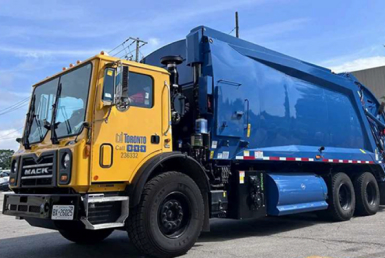
With support from Stream 2 of Natural Resources Canada’s Green Freight Program, the City of Toronto is converting 60 waste collection trucks to a hybrid natural gas-electric system.
Waste collection on Toronto's streets is getting quieter and cleaner – the City is converting 60 natural gas waste collection trucks to operate on a hybrid natural gas-electric system with funding from Stream 2 of Natural Resources Canada’s Green Freight Program.
The advanced hybrid technology combines compressed natural gas with battery electric power and incorporates active stop-start features, which turns off the engine during idle periods and powers auxiliary equipment electrically. As a result, the initiative leads to reduced emissions, lower fuel consumption and decreased noise levels, all while maintaining operational efficiency.
In 2018, the City of Toronto's Fleet Services team, responsible for overseeing more than 5,500 vehicles ranging from light-duty cars to heavy equipment, began investigating strategies to enhance fuel efficiency and reduce emissions while maintaining performance. This initiative culminated in a significant transition from diesel-powered waste collection trucks to compressed natural gas (CNG), a cleaner fuel option that markedly decreases greenhouse gas emissions and lowers nitrogen oxide levels, a major contributor to smog.
In 2021, the City committed to net-zero emissions by 2040, requiring fleet managers to plan long-term for vehicles that stay in service for up to 15 years.
As Canada’s largest city, Toronto’s waste management fleet relies on larger trucks, operates on 10-hour shifts, and tight schedules that outstrip the capabilities of most battery-electric models. Kiran Panchal, Manager of Fleet Management, noted that even small changes to collection schedules can create major logistical challenges. This complexity prompted the City to investigate the potential of CNG-battery-electric hybrid systems.
The expected benefits include:
- quieter operation
- longer operational run time, including 30% battery electric power
- less greenhouse gas and nitrogen oxide emissions
- fuel savings of 15 to 20 percent depending on the weather and route
Hear the change
The number one adjustment for operators has been adapting to the quietness of the hybrid system.
“Our trucks run for eight to 10 hours straight and are typically quite loud, so that’s what operators are accustomed to. With the new hybrid system, it’s much quieter — sometimes so quiet that it sounds like the truck is off,” says Jugal Parikh, City of Toronto Fleet Services Division Engineer.
It took a while for operators to adjust to the change, but they’re comfortable with it now. In fact, one sanitation worker was approached by a resident who inquired if the truck was operational, highlighting just how much surprise the truck’s unusually quiet operation caused.
Working together
Engine repower projects involve replacing the existing vehicle’s engine with an alternative solution to meet desired performance, cost and emissions goals, which requires a tailored approach adapted to the specific needs of each fleet. The City of Toronto worked with Effenco, a company with experience in repowering vehicles in Europe and New York City, to implement this initiative.
Jugal highlighted the significance of initiating the process with a pilot project to thoroughly evaluate new technology before committing to larger investments. The City of Toronto began by retrofitting one truck, monitoring its performance in service and listening to operator feedback. Based on the success of that pilot, and with support from Stream 2 of the Green Freight Program, Toronto is now on its way to retrofitting 60 additional trucks; nine trucks are already operational, with the remaining 51 to be rolled out over the next 15 months.
While Stream 2 of the Green Freight Program is not accepting new applications, Natural Resources Canada continues to offer free resources for more efficient fleets through the SmartDriver training program and the SmartWay benchmarking program.