

Details
- Publication date
- Author(s)
Natural Resources Canada - ISBN
978-1-100-01198-1 - Catalogue number
M4-307/2026E-PDF
November 2026
Table of contents
Executive Summary
Canada’s future prosperity depends on affordable, reliable, abundant, and clean electricity. Demand for electricity is expected to double by 2050 as Canada grows, modernizes industry, strengthens energy security, and attracts major new investments.
In an increasingly uncertain world, access to electricity is becoming a source of economic strength, resilience, and national sovereignty. The countries that deliver on this promise will be best positioned to attract investment, create jobs, and raise living standards.
To capture this opportunity, Canada needs to expand significantly its electricity system while maintaining reliability and affordability for Canadians.
In May, we started this process by outlining our objectives to double Canada’s electricity grid by 2050 and accelerate electrification. Now, we are taking the next step – moving from strategy to action. Powering Canada Strong is the Government of Canada’s plan to build the electricity system needed to support a more competitive, productive, and sovereign economy. This plan is the cornerstone of the Government’s agenda to Build Canada Strong, and mastering clean electricity is foundational to Canada’s climate competitiveness.
To drive this transformation, the Government of Canada is investing $115 billion in electrification through 2041-42, including $52 billion in new commitments through Budget 2026. The Powering Canada Strong action plan is organized around four priorities:
1. Build – Creating the conditions to get projects built
Canada must rapidly increase electricity generation, storage, and transmission capacity to meet future demand and support economic growth.
The Government will:
- Extend the Clean Technology and Clean Electricity Investment Tax Credits to 2040, providing long-term certainty for new generation and transmission projects.
- Invest nearly $4 billion in electricity infrastructure, renewable energy, and grid modernization projects across Canada.
- Strengthen Canada’s nuclear sector through investments in research, workforce development, supply chains, and regulatory capacity.
- Upgrade critical energy infrastructure in northern and remote communities.
- Support Indigenous-led, northern, and remote energy projects that improve reliability, affordability, and energy independence.
2. Connect – Linking electricity infrastructure across the country
A stronger and more interconnected electricity system will allow provinces and territories to share clean, affordable power, enhance reliability, and improve resilience during extreme weather events.
The Government will:
- Expand support for major transmission infrastructure, including high-voltage transmission lines.
- Accelerate strategic intra-provincial transmission projects and electricity interties.
- Support project planning, cost-sharing arrangements, and regulatory coordination across jurisdictions.
- Work with provinces and territories to advance priority projects that strengthen energy security and create jobs.
3. Make – Supporting a strong domestic industrial base
Canada has an opportunity to become a global leader in the technologies and equipment needed to power the economy of the future – and building more of this capacity in Canada will strengthen supply chain resilience, support good jobs, and improve competitiveness.
The Government will:
- Introduce domestic content incentives to encourage the use of Canadian-made electricity technologies and components.
- Support domestic manufacturing, critical supply chains, and battery and grid equipment production.
- Invest in innovation and emerging technologies, including advanced energy systems and digital infrastructure.
- Position Canadian firms to compete in growing global markets for clean energy and electricity solutions.
4. Train – Developing the workforce needed for growth
Labour shortages are a significant constraint on Canada's ability to build new infrastructure at the required pace.
Key actions include:
- Recruiting and training tens of thousands of additional skilled trades workers.
- Expanding apprenticeship and workforce development programs.
- Supporting Indigenous training and employment opportunities.
- Improving workforce planning and labour mobility across jurisdictions.
Looking Ahead
Meeting the challenge of doubling electricity demand by 2050 will require sustained leadership and unprecedented investment. It will also require a relentless focus on affordability. Canadians should benefit from this transition through lower energy costs, greater energy security, and more choices in how they power their homes, businesses, and vehicles.
The opportunity is significant. A larger electricity system could add $3 trillion to Canada's economy, create 1.6 million jobs, and generate $5 in economic benefits for every $1 invested by 2050.
Through the four pillars of Build, Connect, Make, and Train, Powering Canada Strong sets out a practical plan to expand Canada's electricity system, strengthen our industrial base, create good jobs, and keep electricity affordable and reliable for Canadians. By acting now, Canada can secure its place as a leading energy superpower and build a stronger, more prosperous future for generations to come.
1. Powering Canada's Future
In May, we launched Powering Canada Strong: A National Strategy for an Electrified Canadian Economy. It outlined an objective to double Canada’s electricity grid by 2050 and accelerate electrification to support economic competitiveness and energy sovereignty, address climate change, and build a more sustainable, affordable, and prosperous future.
Electrifying our economy drives industrial transformation
Doubling the grid comes with enormous opportunities for domestic manufacturing. Building the essential equipment for the Canadian electricity system (including transformers, batteries, turbines, and more) will unlock economic activity and create new jobs for Canadians. Estimates show that over the next 10 years, there could be as much as $100 billion in manufacturing opportunities for batteries, wind, and solar technologies alone.Footnote 1
As a whole, a larger electricity system could add $3 trillion to Canada’s economy, create 1.6 million jobs, and deliver $5 in benefits for each $1 invested by 2050.Footnote 2
In line with the Strategy, the Government of Canada invited broad input on its priorities.
- Powering a more prosperous Canada: Access to affordable, reliable electricity is a new global currency, allowing nations to attract investment, secure energy supply, strengthen domestic business and manufacturing, and create jobs. As such, the nations that master electricity and electrify their economies will shape the 21st century. Affordable, reliable electricity attracts private investment, drives competitiveness, and helps Canadian businesses expand, creating high-quality jobs here at home.
- Supporting affordability and choice: Expanded electricity access will help households and businesses electrify, lowering the price they pay for energy as compared to fuels. Canadians will benefit from expanded electricity systems that support more electric vehicles and heat pumps, which help lower household energy costs and overall cost-of-living.
- Strengthening energy security and sovereignty by supplying and controlling our own energy: Canadian households and businesses are feeling squeezed by prices that are dictated by global pressures. Expanding our electricity system will help us meet our own energy needs, supporting The Plan for a Stronger Canada, our first national security strategy, released October 29, 2026. It will also support resilience and energy sovereignty in Northern and remote areas. We will be less reliant on global fuel markets, while creating jobs and supporting economic growth at home.
- Accelerating climate action through electrification: Economy-wide electrification of vehicles, buildings, and equipment has the potential to reduce emissions by as much as five times more than what the electricity sector itself emits today – putting it at the heart of Canada’s path to net zero. Over the last 25 years, emissions from electricity systems across Canada have gone down 50 percent, and today, nearly 80 percent of our grid is clean. Most importantly, this transition was accomplished while also increasing total generating capacity. This demonstrates reducing emissions does not mean compromising reliability for consumers, and companies around the world are choosing to invest in Canada because they know they can rely on a clean power supply.
- Expanding opportunities for Indigenous communities: Indigenous Peoples can and are benefitting as project owners, proponents, partners, investors, and long-term beneficiaries as we grow our electricity system. In the North, many Indigenous communities are leading clean electricity projects that reduce reliance on diesel – lowering energy costs and creating economic opportunities for communities.
Electricity is integral to Canada’s energy security, affordability, and competitiveness; we know that the nations that master electricity will lead in the 21st century.
Clean electricity is foundational to Canada’s climate competitiveness
By building a clean, reliable and affordable electricity system, we are not only saving Canadians money but also building a stronger, cleaner economy. While electricity itself is only a small share of Canada’s emissions, its ability to displace higher cost, higher-emitting energy presents a much larger emissions reduction opportunity.
The Government’s Climate Competitiveness Plan is built on four priorities:
- Building clean, reliable, affordable electricity supply (i.e., non-emitting generation and transmission) to power growth, strengthen energy security, and enable broad electrification.
- Switching our transportation, buildings, industry, and agriculture to electric technologies (e.g., heat pumps, electric vehicles) to reduce energy costs and support economic growth.
- Transforming energy efficiency in homes, buildings, and industry – doing more with less energy – to reduce emissions, lower energy costs, and improve competitiveness.
- Innovating by developing and scaling emerging, clean technologies, to close Canada’s emissions gap and grow competitive clean industries.
2. What We Heard
Since the Strategy’s launch, we have engaged with provinces and territories, utilities, industry, Indigenous partners, labour, and others. Natural Resources Canada received over 200 written submissions and held over 60 meetings and roundtables to inform the federal approach in Budget 2026 as well as ongoing implementation. These conversations reinforced that Canadians want the federal government to support provinces and territories and those that build and operate the electricity system to build the grid that Canada needs. Input was broad in nature, touching not only on federal efforts, but also on actions that provincial and territorial governments and other actors would need to take.
Through the course of these broad consultations, we have drawn a number of important conclusions:
- Affordability is the most significant barrier to investments in system growth. Unsustainable electricity rate increases add to cost-of-living concerns and make it harder for businesses to compete.
- Grid readiness and modernization are critical. Upgrading grid infrastructure, alongside measures that make more efficient use of existing capacity, is foundational to enable electrification, manage demand, and reduce the need for more costly system expansion.
- Federal support should scale to match the challenge. While respondents generally viewed existing tools positively, they noted that the system expansions needed to meet the demands of mass electrification would require greater levels of support.
- First Nations, Inuit, and Métis participation: Distinctions-based sessions with First Nations, Inuit, and Métis engagement participants called for early and meaningful participation, including through equity ownership and Indigenous-led development of electricity projects. Community-scale supports were also viewed as critical, including clean energy solutions to reduce diesel reliance. Participants emphasized challenges navigating federal programs and players, and the need for accessible, distinctions-based, and stackable funding.
- Supply chains: Limited manufacturing capacity, long lead times for equipment, and rising prices are increasing project costs and uncertainty. Respondents called for coordinated procurement of key components across jurisdictions, greater targeted support for domestic manufacturing in strategic technologies, federal coordination and engagement (e.g., a national supply chain roadmap), and trusted-partner arrangements for goods that Canada cannot make at scale.
- Workforce: Labour shortages risk delaying projects and increasing their costs. Recommendations to address this included improving labour and contractor mobility, labour market information, programming and resources for Indigenous workers, and addressing training needs in and beyond the skilled trades (e.g., nuclear, engineering, and artificial intelligence (AI)).
- Policy and regulatory uncertainty: We heard the need for clarity about how federal priorities intersect (e.g., support for AI data centres and electrification) to facilitate investment decisions. There is also a need for clarity on the Clean Electricity Regulations. We also heard interest in extension, eligibility changes, and/or administrative streamlining of federal Clean Economy investment tax credits (ITCs) to enable longer-term planning.
Addressing barriers, managing rate impacts, and accelerating growth
Investments in electricity are by their nature very long term. Often projects need to be paid for by one generation, while many of the benefits continue to flow to future generations. This creates pressure on ratepayers today to fund the infrastructure of tomorrow. These affordability concerns prompted calls for targeted federal support in key areas:
- Early-stage project development to help move projects from concept to construction, including for Indigenous proponents.
- Strategic, long-life projects that have high near-term rate impacts and clear national benefits (e.g., offshore wind, transmission, nuclear, and large hydro).
- Smaller projects (e.g., below 5 megawatts (MW)), viewed by many as a key enabler of accelerated electrification and economic development, critical to ensuring benefits accrue in every region of Canada, including rural areas.
- Grid readiness and modernization, including transmission and distribution expansion and upgrades, distributed energy resources, and demand-side management.
- Tailored support for northern and smaller jurisdictions where high electricity prices and limited capacity to spread costs can make necessary investments especially difficult to fund.
This action plan outlines how we will work to roll out actions and investments over the coming year and beyond, consistent with the commitments in Budget 2026.
3. Taking Action
Major economies are moving quickly to position their electricity systems as enablers of economic competitiveness, energy security, and climate action. The public response to the National Electricity Strategy confirmed strong consensus among partners and stakeholders that the electricity sector is fundamental to a prosperous future.
Canada is entering this critical moment with a strong competitiveness advantage: a reliable, low-cost, low-emissions electricity system that ranks among the most affordable in the world, with abundant, affordable natural resources to help generate additional power. This achievement, built over decades, reflects the leadership and sustained investments of provinces and territories, utilities, generators, system operators, and ratepayers. This foundation must now be both protected and strengthened in the face of rising demand and a more complex global environment. Recognizing that a stronger, more resilient grid will in turn strengthen Canada’s overall energy security, the task facing Canadians will be to carry these advantages forward. This means scaling the electricity system to meet the country’s growing needs, while preserving affordability for businesses and households. We know that bold action must be taken now.
As announced in Budget 2026, we will move forward based on four strategic priorities:
The Pillars of our Plan
Build
Build ambitious infrastructure that spurs electrification and secures and doubles our grid.
Connect
Connect Canada’s grids from east to west, improving reliability and ensuring Canadians benefit from our power first.
Make
Invest in sovereign supply chains and capabilities to make what we need to power our grid at home.
Train
Train, attract, and retain the talent Canada needs to build, operate and modernize the electricity system.
Building on commitments to nation-building projects and jobs for Canadians
Action is already underway on major nation-building electricity projects. Recent federal announcements have included:
- Churchill Falls Generating Station upgrades, the Gull Island project, Labrador onshore wind project and related transmission, including to support development of the Labrador Trough (up to $10 billion in federal financial support and investment)
- Darlington New Nuclear (federal support includes $2 billion in Canada Growth Fund equity and $970 million Canada Infrastructure Bank (CIB) financing, in addition to a $715 million Indigenous loan guarantee jointly backed by Canada and Ontario)
- Five priority interties announced: Prince Edward Island–New Brunswick Interconnection Expansion (federal support of $5.9 million for predevelopment), British Columbia–Yukon Grid Connect (federal support of $40 million for predevelopment), Alberta–British Columbia Intertie, Alberta–Saskatchewan Intertie, and Saskatchewan–Manitoba Intertie Expansion
- Iqaluit Nukkiksautiit Hydro Project ($6 million to support front-end engineering and design work)
- North Coast Transmission Line (federal support of $3.9 billion for Phases 1 and 2, and $140 million CIB early works loan)
- Taltson Hydro Expansion (federal support of $48 million for predevelopment)
- Mactaquac Life Achievement Project (federal support of $219 million via CIB predevelopment loan)
- Wind West offshore wind, in partnership with Nova Scotia (federal support of $107 million for development)
Multiple transformative strategies referred to the Major Projects Office also focus on electricity:
- Atlantic Energy Strategy
- Labrador Trough Clean Power, Critical Minerals and Infrastructure Corridor
- Northwest Critical Conservation Corridor
- Transmission InterConnect Investment Strategy
Together, new and existing federal, provincial, and territorial investments will create economic opportunities and thousands of jobs for Canadians, strengthen regional connections and collaboration, and advance economic reconciliation.
The entire effort is underpinned by a focus on affordability. Governments can address electricity costs with targeted investments, financial supports, and regulatory policies that facilitate the generation and transmission of more new power – especially clean power. Striking the right balance makes sure federal investment reduces risk and total cost, spreads costs over time, protects ratepayers, and maximizes economic benefits across Canada.
Taking Action Across the Electricity System
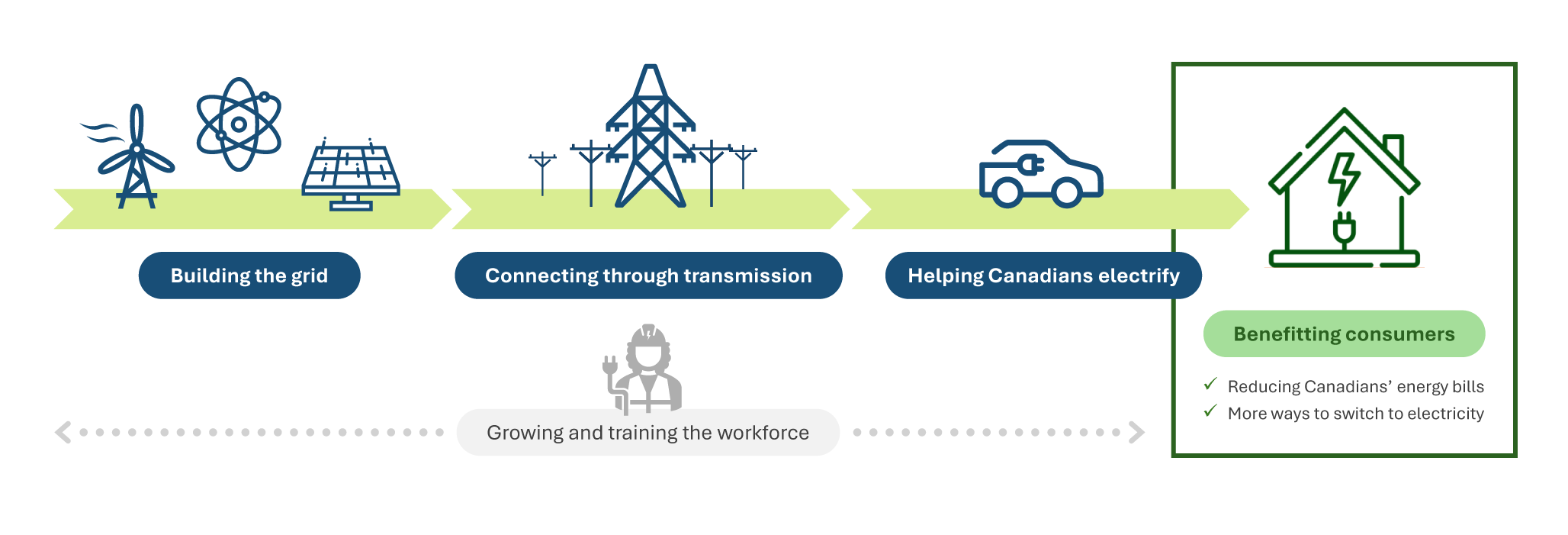
Taking Action Across the Electricity System – Text version
A process chart showing three phases of the electricity system:
- Building the grid
- Connecting through transmission
- Helping Canadian electrify
These phases are supported by an underlying process of growing and training the workforce.
The process chart outcome shows how consumers benefit by:
- Reducing Canadians’ energy bills
- More ways to switch to electricity
Budget 2026 is Powering Canada Strong
Budget 2026 is investing $52 billion in bold and ambitious measures to expand Canada’s electricity system, support investment in clean technologies, attract private capital, and provide greater certainty for businesses.
Taking into account previous announcements, that brings total funding dedicated towards electrification to over $115 billion from now to 2041-42. These actions will create jobs, strengthen energy security, and ensure Canada remains competitive as the global economy evolves.
Build
We are creating the conditions to get projects built. As electricity demand is expected to grow significantly, we are investing in new generation and transmission infrastructure to meet future needs.
Federal actions to BUILD the electricity system of tomorrow:
- Providing certainty for longer-term projects by proposing to extend the 30-percent Clean Technology and 15-percent Clean Electricity investment tax credits (ITCs) to the end of 2040, which is expected to cost $38.5 billion.
- This includes the proposed expansion of the Clean Electricity ITC to high voltage intra-provincial electricity transmission.
- Delivering more reliable power as electricity demand grows by committing $4 billion to support electricity infrastructure expansion, renewable energy, and priority electricity sector projects across Canada, including new funding for the Smart Renewables and Electrification Pathways Program. This is in addition to the $4.5 billion that has already been committed to this program.
- Strengthening Canada’s nuclear research, supply chains, workforce, and regulatory capacity by committing a total of $6.5 billion (new and existing) in financial support.
- Upgrading and strengthening critical northern energy infrastructure and capacity ($1 billion) to support the Mayo Hydro Facility and Atlin Hydro Expansion projects, and a range of other projects in Canada’s North.
- Supporting integration of clean energy technologies (a total of $1.3 billion) to expand clean energy in rural, remote, and northern communities.
- Working with interested provinces and territories to develop and implement new and novel approaches to financing the largest and most transformational electricity sector projects.
The federal government is also continuing to enable Indigenous participation, including through the Indigenous Loan Guarantee Program (ILGP) and the CIB. For example, the ILGP will provide a loan guarantee of over $350 million to allow seven First Nations in Ontario to own a significant minority interest in the Darlington New Nuclear Project - the largest Indigenous loan guarantee ever issued in Canada. The size of the ILGP was doubled from $5 billion to $10 billion in 2025.
Canada has the resources and expertise to become an energy superpower, but that potential depends on having the electricity infrastructure to turn those advantages into real economic opportunities.
Building more electricity generation and transmission is an important starting point to ensure we have enough power to meet growing demand and move electricity between regions. These investments are an essential foundation for a larger electricity system to connect new homes, businesses, and industries.
The benefits of the electricity build-out must reach Canadians across the country. Northern and remote communities often face high energy costs, aging infrastructure, and costly emergency repairs. Moving away from short-term fixes toward investments in more reliable, resilient energy systems builds local capacity and creates opportunities for communities to lead and benefit from electricity projects and related economic development.
Financing the build while protecting affordability for consumers
Supporting electricity development is investing in Canada’s future. Hydro dams, nuclear reactors, and large transmission projects are examples of infrastructure that may be built by one generation but also benefit future generations. We will work with jurisdictions to support nation-building projects while keeping the interests of ratepayers and taxpayers top of mind. Recovering costs entirely through electricity rates puts pressure on bills today. Innovative financing can help get major projects built while sharing the cost burden over time.
That’s why, over the coming months, we will work with provinces and territories to develop new and novel approaches to financing the largest and most transformational electricity sector projects in order to limit the impact on electricity bills.
Indigenous Peoples have an important role in developing electricity infrastructure as project proponents, owners, investors and partners. Establishing strong partnerships is foundational to delivering transformative infrastructure. This is exemplified by new electricity procurements in Manitoba, British Columbia, Nova Scotia, and New Brunswick that have mandated or incentivized Indigenous ownership in electricity generation. Our actions will help support Indigenous capacity to inform decision-making and increase meaningful participation and leadership in electricity projects, as well as facilitating access to capital so more Indigenous communities and businesses can own and advance electricity projects.
Building Canada’s electricity system is about more than constructing infrastructure. It is about making sure Canada has abundant, reliable electricity so that businesses can grow and Canada can seize the economic and climate opportunities ahead.
Supercharging the electricity build-out through tax incentives
The Clean Economy ITCs are expected to provide tens of billions in support to the electricity sector, which is complemented by strategic financing and targeted programming.
In September, Canada announced the Productivity Mega Deduction, which will provide immediate expensing for a broad range of assets, including assets used in the electricity sector. Budget 2026 also proposes to extend the Clean Technology and Clean Electricity ITCs to the end of 2040 and expand eligibility for the Clean Electricity ITC to the highest voltage intra-provincial transmission lines in each province.
This financing and tax incentive approach will supercharge construction of our electricity system.
Delivering on the Nuclear Energy Strategy
Canada’s first-ever Nuclear Energy Strategy, released in June 2026, is a key part of this action plan, including its ambitions to strategically finance and advance nation-building projects, strengthen supply chains, enhance energy security, and enable workforce growth. Investments to-date, including from Budget 2026, total $6.5 billion. The Nuclear Energy Strategy emphasizes that nuclear energy is an essential element of a modern clean grid. It outlines the actions the federal government will take to leverage Canada’s long-standing nuclear expertise and workforce, abundant uranium resources, and sovereign capabilities, in order to grow clean, baseload power, and create jobs and economic opportunities for Canadians at home and abroad. It builds on a number of recent milestones:
- Ongoing construction of the first grid-scale small modular reactor in the G7;
- Ontario completing significant refurbishments of its existing nuclear fleet, ahead of schedule and under budget;
- Ontario and Saskatchewan signalling the potential to collectively install over 17 gigawatts of new nuclear power by 2050;
- New Brunswick and Alberta actively studying the role that new nuclear builds could play in those provinces;
- Canadian CANDU reactors being considered for export by a number of countries;
- Cameco signing a $2.6 billion uranium deal with India;
- two new uranium mines under construction for the first time in over 20 years;
- the Department of National Defence assessing the potential for a Canadian-controlled microreactor that could provide heat and electricity to remote and northern facilities and operations; and
- making the Canadian Nuclear Safety Commission the responsible authority for conducting impact assessments for all applicable nuclear projects.
Connect
We are connecting electricity infrastructure across provinces and territories to make the most efficient use of our diverse energy resources while improving reliability, affordability, and energy security for Canadians.
Federal actions to CONNECT our country:
- Encouraging more investment in transmission across the country by:
- Extending to 2040 existing Clean Electricity ITC support for qualified interprovincial transmission equipment.
- Expanding eligibility for the Clean Electricity ITC to include high voltage intra-provincial electricity transmission lines in each province.
- Leveraging CIB’s $20 billion allocation for clean energy to support transmission projects, such as the Wasoqonatl Transmission Line to which it has committed $285 million.
- Supporting robust cost-benefit analysis of proposed interties and cross-border cost-allocation discussions, informed by the Federal-Provincial-Territorial Electricity Working Group.
We are accelerating priority intertie and transmission projects by mobilizing the Major Projects Office and working with provincial and territorial governments.
Canada's electricity system consists of multiple, segregated grids that are governed and planned independently and that generally trade more with the United States than one another. The federal government has moved decisively to build one, connected economy, catalyse billions in investment, and secure the Arctic. The electricity grid is an obvious next step. Building on existing federal supports for interties, we are responding with additional historic investments in transmission to support high voltage transmission projects in each province and territory.
In summer 2026, Canada’s First Ministers directed their Energy Ministers to work together on implementing electricity interties. Canada’s Premiers agreed that they would work with relevant partners to continue to advance strategic projects that support enhanced connectivity and complete their respective intertie projects, recognising fairly priced electricity is an important driver for long-term economic growth. First Ministers also agreed to complete pre-development work on their respective intertie projects by July 2027.
Canadians will see the benefits of these projects through tens of thousands of jobs and billions added to the domestic economy. With more electricity trade between jurisdictions, Canadians will have more energy security, electricity reliability, and protection from blackouts and brownouts during extreme weather events.
More transmission can help attract large industrial projects by making sure there is enough electricity to meet their needs. It will also help integrate new electricity generation (from wind and solar to battery storage and new hydro and nuclear). This means opportunities like critical mineral development and advanced manufacturing will grow – and so will jobs along with them.
Canada is blessed with abundant energy resources and expert utilities and workers who can turn those resources into action. We should be leveraging these advantages to support a unified Canada from coast to coast to coast, reduce our dependence on fuel imports, and ensure all Canadians have access to reliable, Canadian energy no matter where they live and work.
Connecting for ratepayer savings
The CIB has committed $285 million to the Wasoqonatl Transmission Line, a 160-kilometre, 345 kilovolt intertie linking Nova Scotia and New Brunswick. This support will result in $200 million in net present value savings to Nova Scotia electricity customers. The line will improve the reliability of interprovincial power grids by providing a second major intertie connection between the two provinces. It will also maintain system stability as Nova Scotia expands renewable energy production.
Indigenous leadership and participation in major transmission infrastructure
Strong partnerships strengthen project certainty, improve access to capital, ensure projects reflect community priorities, and create lasting economic benefits. As an example, the Wataynikaneyap Power Transmission System, connecting remote communities in Northwest Ontario, is majority-owned by a partnership of 24 First Nations, showing Indigenous leadership in action.
Indigenous participation and ownership are increasingly becoming the norm. For example, in 2022, Hydro One launched its Equity Partnership Model through which Ontario First Nations are offered a 50-percent equity stake in all new large scale transmission projects valued at over $100 million. This new business model gives First Nations participation in project governance and decision-making, along with long-term revenues.
Make
We are supporting a strong domestic industrial base capable of supplying the materials, equipment, and technologies for building electricity infrastructure.
Federal actions to MAKE manufacturing and electricity solutions right here in Canada:
- Build Canadian by using Canadian materials, suppliers, and technologies to strengthen domestic supply chains. The Government will conduct targeted consultations to determine the scope and parameters of a domestic content bonus of up to 10 percentage points under the Clean Technology investment tax credit and up to 5 percentage points under the Clean Electricity investment tax credits. This will support the use of Canadian industrial products in the projects needed to double Canada’s production and transmission of electricity.
- Support the deployment of emerging electricity technologies: $6 billion to help secure Canada’s place as leader in using technology to expand electricity generation for residential and industrial growth.
We will also:
- Continue to leverage the Strategic Response Fund to support domestic manufacturing of electricity grid components and battery materials production.
- Innovate to advance the next generation of made-in-Canada electricity technologies. For example, the Energy Innovation Program supports innovators developing advanced materials, batteries, and smart grid solutions that strengthen grid reliability, affordability, and resilience.
Solid oxide fuel cells
Solid oxide fuel cells (SOFCs) can provide efficient, reliable power to help meet the needs of growing data centres and other energy-intensive industries. Greater access to power could support the expansion of digital infrastructure in Canada, strengthening data sovereignty. SOFCs also use relatively little water, produce very low levels of conventional air pollutants, and create opportunities to build Canadian expertise in an emerging energy technology.
An electricity strategy is also an industrial strategy. Building out our electricity system will require large volumes of specialized manufactured components and clean technologies. This includes physical components (such as transformers, cables, batteries, semiconductors, control panels, and generators) and digital and smart technologies (such as sensors, smart meters, digital control systems, and AI). Many critical components are in short supply. Right now, Canada’s electricity sector is highly import dependent, particularly on the United States. Our strategy will increase our industrial capacity at home, whether through new battery production in Quebec and British Columbia, or the well-established nuclear energy supply chain in Ontario.
We will continue to make federal investments to enable this build-out, creating jobs, new export opportunities, GDP growth, and new markets for our best-in-class Canadian products and resources, from mining to steel and aluminum. As we continue to support manufacturing at home, Canadian companies will more easily be able to enter the market and commercialize technology, facilitating competition in global markets now and over the long-term.
We also need to make sure that industries looking to build in Canada have the electricity they need today, without negatively impacting consumers’ bills. Our electricity systems are being tapped by historic levels of interested businesses who want to build and locate in Canada, including AI, which is scaling at speed. That is why we are taking action to enable electricity-intensive projects like data centres, while making sure that they are governed by Responsible Data Centre Development Principles, including to not negatively impact ratepayers.
Strategic electricity component manufacturing in London, Ontario
Hitachi Energy is investing in Canada’s first electrical-grade pressboard manufacturing facility. The state-of-the-art facility will turn wood fibre into up to 20,000 tonnes annually of electrical-grade pressboard and laminated insulation materials for high-voltage transformers. Transformers help transmit power over long distances, distribute power for industries, and stabilize the grid. The federal government’s investment of $30 million is strengthening Canada’s domestic supply chain capabilities while supporting and growing high-quality manufacturing jobs. Hitachi is growing their Canadian workforce by over 500, with more than 100 workers at its London facility.
Commercializing battery technologies
Nano One Materials Corporation is aiming to deliver the first North American scale up of their simplified, low waste lithium iron phosphate production method, enabling domestic production of a key battery component for stationary energy storage and electric vehicles. The federal government’s investment of over $9 million is helping to expedite commercialization and ultimately strengthen Canada’s mid-stream battery value chain.
Train
We are investing in workforce training, apprenticeships, and partnerships with colleges, Indigenous communities, unions, and industry. These actions will help address labour shortages, accelerate project delivery, and ensure Canadians have the skills needed to support nation-building energy projects.
Federal actions to TRAIN Canadians for good electricity jobs:
- Implementing Team Canada Strong: $8 billion across sectors including electricity. This effort will recruit, train, and hire 80,000 to 100,000 new Red Seal trades workers by 2030-2031.
- Enabling collaboration between workforce actors through the recently created Energy and Electricity Workforce Alliance, led by Electricity Human Resources Canada, with support from the Energy Council of Canada, and the Canadian Renewable Energy Association.
- Connecting Indigenous Peoples with job opportunities created by major projects, including through $260 million for the Partnerships for Indigenous Workforce Readiness Fund as announced in October 2026.
With new industry comes new jobs. Scaling infrastructure and meeting manufacturing and installation needs will require a strong pipeline of skilled engineers, tradespeople, and apprentices. With the rise in electrification across the country, employment in the electricity sector has already grown significantly, exceeding 110,000 workers in 2022. But we are nowhere near the growth ceiling, with 28,000 new workers needed just by 2028.Footnote 3
Over 80 percent of employers in the electricity sector identified finding skilled talent as the most pressing constraint on their outlook over the next five years,Footnote 3 far surpassing concerns such as inflation, regulatory requirements, and interest rates. Without a deliberate focus on building this workforce now, we risk project bottlenecks. If we seize this opportunity, we can catalyze new skilled, well-paying jobs in every region of Canada, at a time when Canadian workers and employers are facing uncertainties driven by tariffs, skills shortages, supply chain disruptions, and rapid changes in technology.
We are also:
- Supporting availability of labour market data for electricity and related sectors, including through major labour market information projects funded by the Sectoral Workforce Solutions Program. This includes related projects led by Electricity Human Resources Canada, the Canada Green Building Council, and ECO Canada.
- Supporting electricity-related training and workforce development projects through programming such as the recently launched Sectoral Workforce Innovation Fund, Canadian Apprenticeship Strategy, the Indigenous Skills and Employment Training Program, and other programming, as well as investments through the Labour Market Development Agreements and Workforce Development Agreements.
We are committed to making sure the buildout benefits workers across Canada. Under Team Canada Strong, the Build Canada Apprenticeship Service will launch later this fall. This initiative will encourage small and medium-sized employers to hire first year apprentices in Red Seal trades, including through a financial incentive of up to $10,000.
Hydro-Québec’s Strategy for Economic Reconciliation and Workforce Advancement with First Nations and Inuit
In 2024, Hydro-Québec released its Strategy for Economic Reconciliation and to Strengthen Relations with First Nations and Inuit, which includes important measures to building a long-term Indigenous workforce, in addition to ownership and partnership opportunities. For example, Nipiu Énergie is a wind turbine operation service company owned and operated by the Ilnu First Nation of Mashteuiatsh. It is an example of how Indigenous participation in the energy sector expands from project-specific jobs and equity ownership to established Indigenous businesses and expertise that operates across the sector.
4. Keeping costs affordable
Working with provinces, territories, and utilities, we are ensuring that doubling our grid never means compromising affordability.
Federal actions helping Canadians electrify and reduce energy bills:
- Accelerating home retrofits and energy efficiency upgrades through the One Million Home Retrofits initiative (over $2 billion), in addition to the existing Canada Greener Homes Affordability Program that provides no-cost, bill reducing home energy upgrades to low- to median-income homeowners and tenants, saving Canadians more than $1 billion per year.
- Supporting the adoption of energy efficiency and energy management solutions by industrial facilities to help maximize energy performance and enhance competitiveness, including for SMEs ($400 million).
- Making electric vehicles (EVs) more affordable ($2.3 billion) and supporting charging infrastructure ($635 million), bolstered by stronger Light-Duty Vehicle emission standards.
- Working with interested provinces and territories to develop and implement new and novel approaches to financing the largest and most transformational electricity sector projects to help maintain affordability.
- Modernizing the Energy Efficiency Act (Bill S-4) so that it will continue to drive energy and cost savings.
While a larger grid will generate and transport more electricity, we also need the tools to help Canadians make the switch to electricity. Electrification itself is an affordability measure. As our economy and daily lives become more electrified, total energy costs are expected to decline for most Canadian households by 2050.
Heat pump adoption will lower household energy costs for those using oil, propane, or inefficient electric resistance heating, like electric furnaces or baseboards – all while providing air conditioning for hot Canadian summers. In the transportation sector, 40 per cent of global car sales are projected to be electric within five years – and electric vehicles have cheaper operating, energy and maintenance costs.
Energy efficiency upgrades for homes and industry can also help manage energy demand and reduce pressure on the electricity system. Demand-side management is a complement to supply build out, playing important roles in reducing costs and unlocking system capacity. Gaining more capacity from the infrastructure we already have sets us up for a win-win, enhancing energy security and competitiveness while making our electricity dollars go further.
Electrification and your “energy wallet”
A household’s “energy wallet” can be thought of as combined payments for gasoline, natural gas, heating oil, propane, and electricity. In the future, the “electricity” slice of the pie will get much bigger, but for most, the entire pie will get smaller because households will be relying on more efficient forms of energy.
Conceptual “energy wallet” of a typical Canadian household in 2050
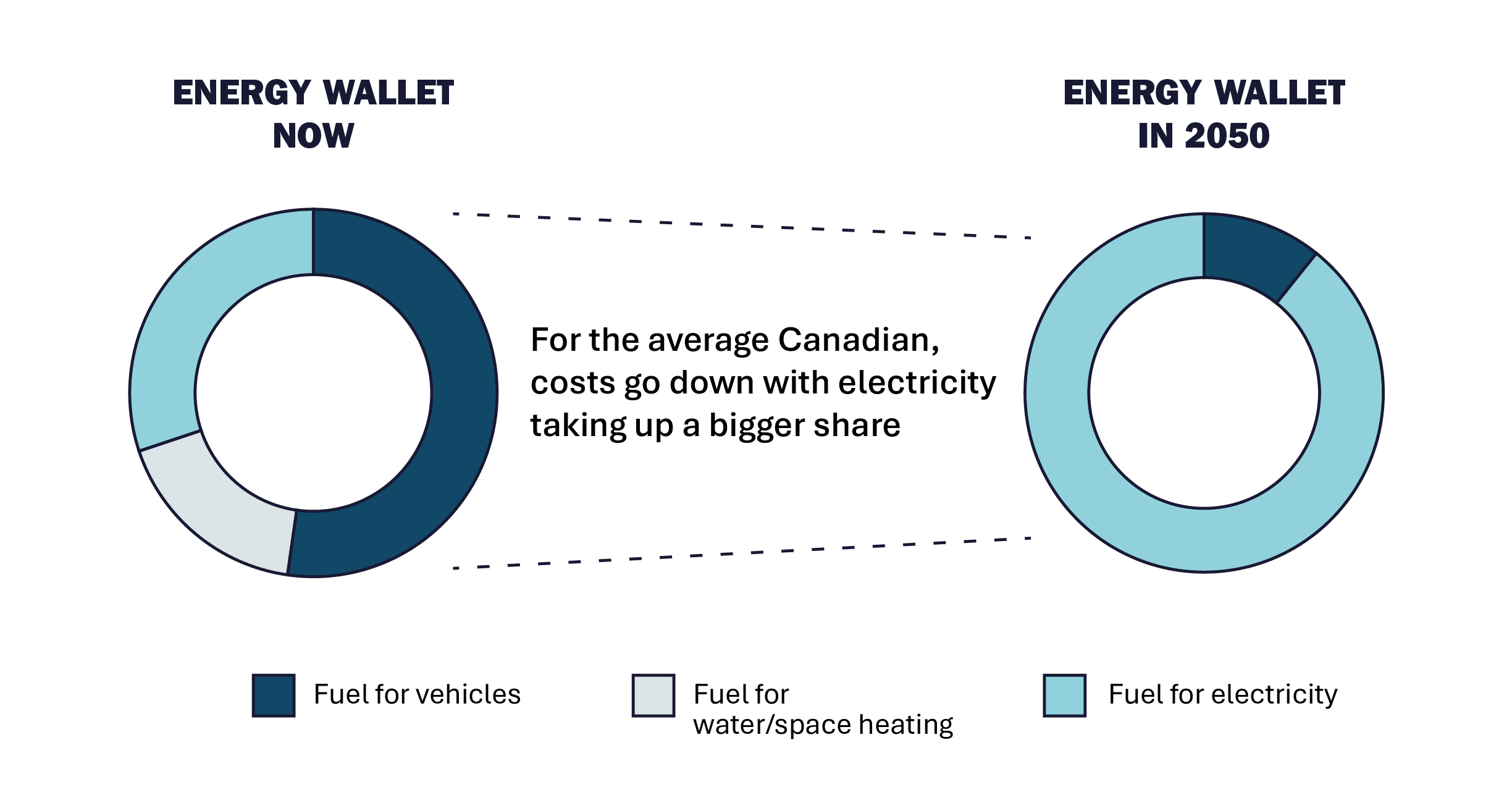
Conceptual depiction of changes to the “energy wallet” of a typical Canadian household, adapted from 2024 Canada Electricity Advisory Council: Final report
Energy wallet – Text version
The figure has two doughnut charts showing the share of spending of an average Canadian on energy. Expenses include:
- Fuel for vehicles (dark blue)
- Fuel for Water/Space Heating (light blue), and
- Electricity (turquoise).
The left chart shows a current energy wallet, with fuel for vehicles at 52%, electricity at 30%, and water/space heating fuel at 18%.
The right chart is a conceptual 2050 energy wallet: For average Canadians costs go down, with electricity taking up a bigger share. This chart shows electricity at 89% and fuel for vehicles at 11% and has a smaller overall size.
5. Next Steps
Federal collaboration with provinces and territories, who hold jurisdiction over the grid, will be ongoing. We continue to engage through existing channels such as First Ministers and Premiers’ Meetings, the Energy and Mines Ministers’ Conference, bilateral discussions, and through new channels to collaborate on and negotiate cost-sharing of transmission interties and other major projects.
Over the next six months we will implement the first phase of the National Electricity Strategy. This includes:
- Calls for proposals and project advancement from renewed and recapitalized programs (e.g., Smart Renewables and Electrification Pathways program, diesel reduction and Indigenous capacity programs);
- Engagement with interested provinces and territories to develop and implement new approaches to financing the largest and most transformational electricity sector projects;
- Engagement on legislative and regulatory amendments to provide a clearer and faster path to get things built, while achieving net-zero emissions by 2050 (e.g., amendments to the Clean Electricity Regulations);
- Ongoing advancement of the Major Projects Office’s Transmission InterConnect Investment Strategy;
- Collaboration to finalize the Federal-Provincial-Territorial Framework on Interties;
- Identification of workforce priorities and industry-led solutions via the Energy and Electricity Workforce Alliance; and
- Launching the first-ever call for bids for offshore wind in Nova Scotia.
Over the medium-term, a second phase will see:
- By July 2027, completion of intertie pre-development work that will connect our country, leverage each other’s strengths, and ensure reliability. This includes negotiation with provinces and territories on cost-sharing of those interties;
- Advancement of investment-ready Indigenous-led and remote clean energy projects, supported through renewed federal diesel reduction programming;
- Priority northern projects validated and underway; and
- Roll-out of supports to plan and train for critical workforce needs, including re-skilling, up-skilling, and increased mobility.