
Project location: CanmetENERGY Ottawa, Ottawa, ON
Timeline: 5 years (2023 to 2028)
Program: Funded by the Program of Energy R&D, Clean Energy for Rural & Remote Communities program, and GEM GeoNorth program
Project Overview and Objectives
Heat Load Modeling and Energy Efficiency Retrofits
A critical part of Canada’s reducing reliance on fossil fuels involves quantifying consumption for heating buildings in Canada’s remote communities. There are many challenges associated with understanding the heating requirements in remote communities, including accurate housing and building stock numbers as well as the performance of building equipment.
To address these uncertainties, CanmetENERGY Ottawa researchers developed a novel procedure that combines building performance simulation (BPS) tool outputs, publicly available data sources, and regression modelling to predict residential and commercial, industrial, and institutional (CII) heating energy.
The comparison of modelled annual energy consumption with empirical, community energy plans underscore the effectiveness of this procedure for most of Canada’s remote communities.
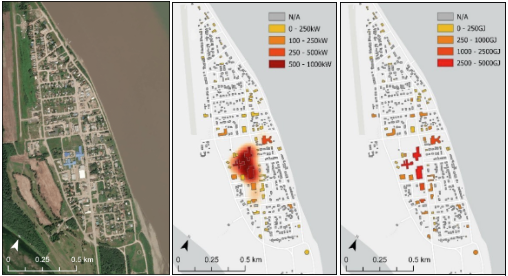
The pictures above show the annual modelled and estimated electrical and heat profiles for a remote Canadian community.
- S. Brown, J. Purdy, G. Richardson, I. Maynard, S. Brideau, and A. Ferguson, “Characterizing heating energy for residential and commercial buildings in Canada’s remote communities,” in eSim, Alberta, Canada: IBPSA-Canada, Jun. 2024. [Online]. Available: https://publications.ibpsa.org/conference/paper/?id=esim2024_166
- Richardson, G., Caesar, G., Purdy, J., Wakim, C. & Kilpatrick, R. (2023). Characterizing building footprints for heat load modelling in remote communities. Natural Resources Canada. https://doi.org/10.4095/332286
Optimization of Integrated Renewable Energy Systems
Integrated renewable energy systems are becoming a promising option for electrification and efficient heating in northern and remote communities. CanmetENERGY Ottawa is conducting research to reduce the costs of electricity production by optimizing integrated energy systems specific to respective geographical locations. Results can support the adoption of the clean energy technologies and the decision-making regarding diesel reduction in northern and remote communities in Canada. A multi-criteria decision framework or decision-making (MCDM) method will be developed based on the criteria including technical, economic, environmental and reliability to assist in analyzing and evaluating a broad range of renewable and bioenergy technology scenarios and their integrated systems.
GEM-Geo North sub-project
GEM-GeoNorth is a continuation of the $200-million Geo-Mapping for Energy and Minerals (GEM) Program. It builds on the GEM Program by continuing to access new frontiers, the underexplored areas in Canada’s North. CanmetENERGY Ottawa works to support the program’s goals through renewable resource assessment studies and technical assessment of renewable energy systems.
Current work includes:
- Development of two key solar irradiance datasets within Canada for the year 2023, including historical timeseries data for the entirety of Canada, and determination of the impact of wildfire smoke on solar irradiance in Canada. This data is crucial for understanding the scale of wildfires in Canada and their impact on photovoltaic potential.
- Assessment of the technical and economic feasibility of high-temperature thermal energy storage (TES) technology for combined heat and power (CHP) in Northern Canada. The TES technology includes a solid-state thermal battery where low-cost, intermittent electricity from wind and solar photovoltaic (PV) systems is used to heat solid blocks to high temperatures (up to 1,500 °C). Heat is delivered on demand to both a district heating network and steam power plant in a CHP configuration. The study will examine the optimal size of the thermal storage to enable reduced operation of oil and biomass-fired furnaces and diesel generators when the TES system is sufficiently charged. The suitability of the thermal storage for specific communities' needs will be evaluated based on the investment payback period.
Impact and Innovations
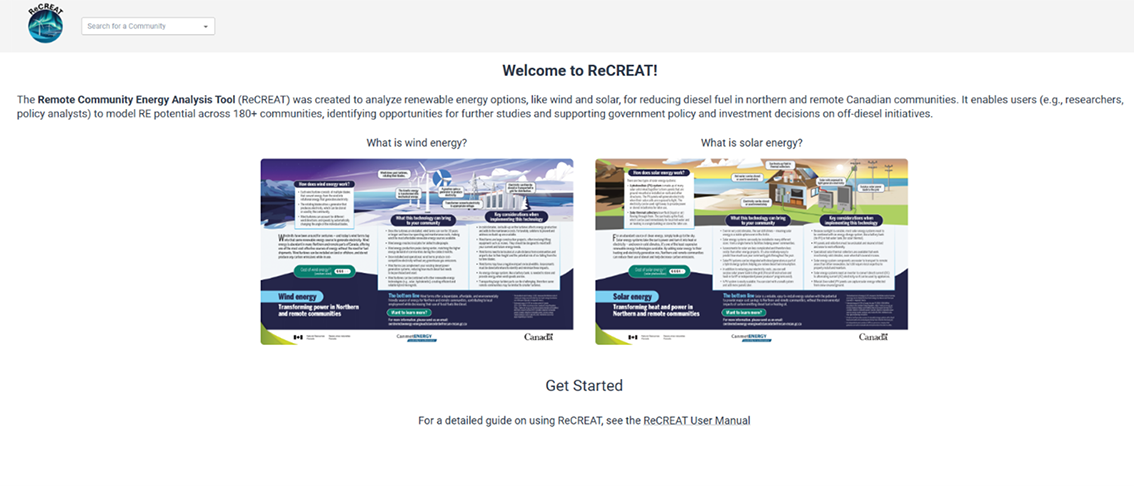
Results and Outcomes
In addition to conducting research that supports the deployment of renewable energy in northern communities, knowledge opportunities are key for communities to understand the various renewable energy technologies that exist, how they operate, how they might be of benefit, and more. NRCan has developed summaries of renewable energy technologies including but not limited to solar PV, biomass, wind, hydrokinetic, and geothermal. These summaries will be translated and made available in multiple Indigenous languages:
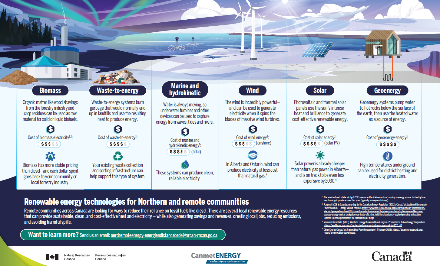
General Renewable Energy Infographic (PDF, 2.5MB)
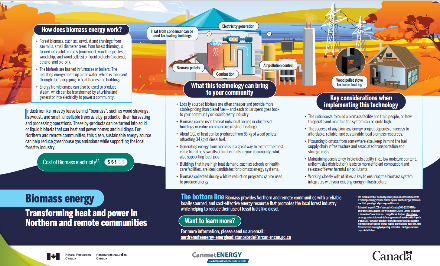
Biomass (PDF, 13.2 MB)
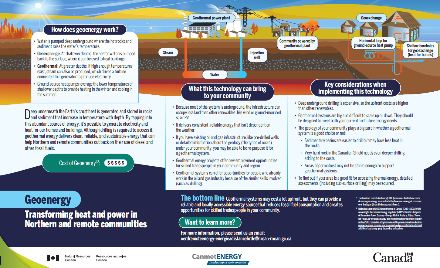
Geothermal energy (PDF, 926 KB)
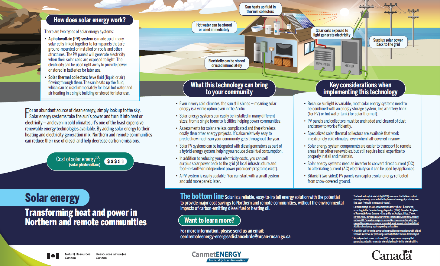
Solar energy (PDF, 1.03 MB)
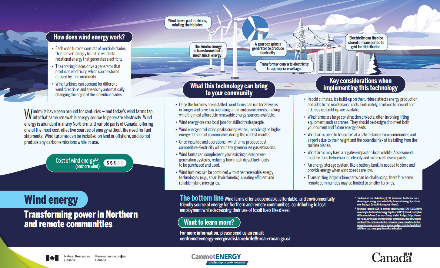
Wind energy (PDF, 759.81 KB)
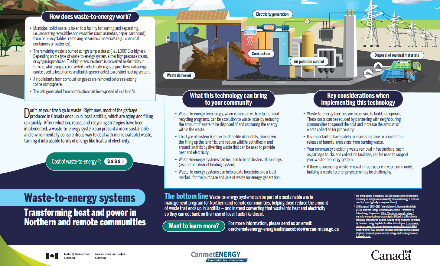
Waste-to-energy (PDF, 15.01 MB)
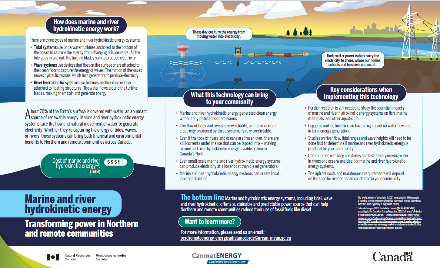
Marine and river hydrokinetic energy (PDF, 395.74 KB)
Contact CanmetENERGY in Ottawa
To learn more about this project, email our Office of Research Partnerships and External Relations.