
Project location: CanmetENERGY Ottawa, Ottawa, ON
Timeline: 5 years (2023-2028)
Program: Funded by the Program of Energy R&D
Decarbonized Communities
Project Overview and Objectives
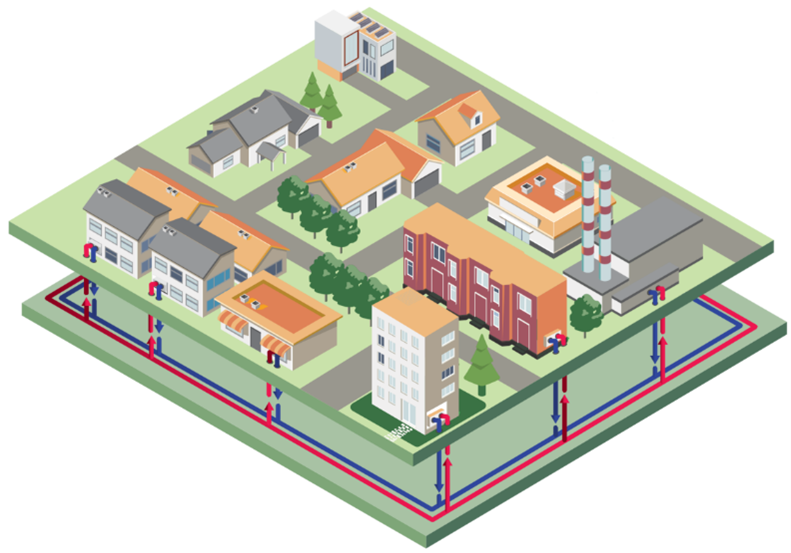
The CanmetENERGY Ottawa Decarbonized Communities project aims to help identify and quantify opportunities for integrating low carbon thermal energy sources and community-scale thermal technologies into existing or new District Energy systems as an alternative and/or complementary pathway to building-level decarbonization.
Community Thermal Energy Technology Assessment
Key activities within the Decarbonized Communities area include modelling and assessment of a variety of community-scale heating & storage technologies for District Energy application in Canada, such as large-scale seasonal thermal energy storage, solar thermal systems, large heat pumps, wastewater heat recovery, and closed-loop geothermal. Technology modelling completed throughout the project will enable comparative impact analysis and techno-economic assessment for decarbonizing existing District Energy systems, and general support of options assessment for new District Energy system developments.
An example modelling analysis summary completed in May 2024 can be found here:
- Kosteniuk, I., Thornton, J., Mesquita, L., Boulter, R., Drake Landing Solar Community: an analysis of different technology scenarios, International Ground Source Heat Pump Association Research Conference, 28-30 May, 2024, DOI: https://doi.org/10.22488/okstate.24.000031
CanmetENERGY Ottawa (CE-O) also supports the national District Energy systems inventory, which is administered and maintained by the Canadian Energy and Emissions Data Centre (CEEDC) at Simon Fraser University.
- CEEDC District Energy in Canada 2023 Report
- CEEDC District Energy Systems Online database
Community Waste Heat Source Assessment
Additional project tasks are focused specifically on assessing opportunities for utilizing urban waste heat sources for District Energy systems. This includes development and application of methodologies to identify and quantify thermal energy sources such as wastewater in sanitary sewage systems, as well as heat rejected from building cooling and refrigeration systems in facilities such as data centers, arenas, and supermarkets. The aim is to eventually support the creation of map-based data outputs that could be used by stakeholders to help assess the feasibility of capturing and utilizing the waste heat for low carbon District Energy applications.
International Energy Agency Technology Collaboration Programme Support
CanmetENERGY Ottawa actively participates in international research through the International Energy Agency (IEA) Technology Collaboration Programmes (TCP). Resulting outputs from IEA TCP research projects provide key information, tools, references and overall leverage for CanmetENERGY community technology R&D activities.
The Decarbonized Communities project supports participation on the Executive Committees of two IEA TCPs:


Low Carbon University Campus Energy Storage
Project Overview and Objectives
The Low Carbon University Campus Energy Storage project is aimed at evaluating a new approach for identifying suitable aquifers for large-scale seasonal thermal energy storage applications and assessing the techno-economic potential of integrating large-scale underground seasonal storage as an example for a large electricity consumer in Ontario. By incorporating inter-seasonal thermal storage, university campuses could avoid adding to provincial grid peaks during hot or cold weather.
Impact and Innovations
The project will contribute to the development of large-scale thermal energy storage in Canada via three main activities. Using York University’s Keele campus as a test case, CE-O and project partners will:
1) Demonstrate seismic mapping techniques pioneered by NRCan’s Geological Survey of Canada to non-invasively characterize aquifers at a potential cost lower than drilling test wells/boreholes;
2) Evaluate the feasibility of aquifer thermal energy storage to meet heating and cooling needs while avoiding increased electricity demand during peak periods; and
3) Determine the regional potential of implementing ATES across the Greater Toronto Area
The interpretation of the geophysical site investigation data collected under this project is available here:
- Dietiker, B., Pugin, A. J. -M., Crow, H. L., Brewer, K. D. & Russell, H. A. J. (2024). Geophysical data interpretation for the York University ATES site investigation, Ontario. Geological Survey of Canada, Open File, 9076, 31, DOI: https://doi.org/10.4095/332366
Optimization and Analysis of Geoexchange Systems
Project Overview and Objectives
Geoexchange systems have become more and more common in public buildings, as reliable and sustainable systems that have significant contributions towards Canada’s low carbon commitments. Based on building energy modelling, a combination of technologies will be evaluated to identify, through life-cycle analysis, the best technology mix for the site under investigation, considering GHG emissions, levelized cost of heating and electrical peak demand requirements.
Impact and Innovations
The project will inform decisions related to systems procurement and implementation for efficient and resilient energy systems for government buildings by developing configurations and economic analyses of geoexchange systems in combination with non-emitting technologies such as heat pumps, short-term thermal storage, solar thermal collectors, photovoltaic panels and earth to air thermal exchangers.
Modernization & Update of Central Heating Plants – New Energy Efficient & Low Carbon Systems
Project Overview and Objectives
The Modernization of Central Heating Plants project is a simulation-based investigative analysis targeting the modernization of federal government central heating plants to ensure they have the resilience and energy efficiency necessary for reliable and cost-effective operation into the future. Importantly, it assesses central heating plants in climate-diverse locations across Canada to ensure that the analyses are appropriately tailored according to heating requirements and available resources.
The objective of this project is to compare modernized central and decentral heating scenarios that incorporate mature and emerging heating technologies including gas boilers, electric boilers, heat pumps, etc., to demonstrate the technical and economic viability of future heating solutions.
Impact and Innovations
The results obtained through this comparative analysis will help to inform key decision makers involved in the modernization of federal government central heating plants, such that maximum efficiency, cost and resiliency benefits can be realized. The project also assesses and improves awareness of emerging technologies that may play an important future role in heating Canadian buildings.
Greening Government Fund (GGF) / High-Temperature Resilient Renewable Heating Systems (HT-RRHS)
Project Overview and Objectives
The GGF High-Temperature Resilient Renewable Heating Systems (HT-RRHS) project supports technoeconomic analyses of several technology options to achieve at least 70% reduction in carbon emissions from typical Government of Canada (GoC) buildings, with an emphasis on buildings that rely on high-temperature heating distribution systems (80°C-95°C). The main concept consists of the integration of heat pumps and solar-driven borehole thermal energy storage (BTES) systems for a single building or a cluster of buildings.
Impact and Innovations
The solutions developed in this project support the decarbonization of buildings with high-temperature heating systems, as it is the case for most of the facilities at NRCan’s Bells Corners Complex. The proposed HT-RRHS will be analyzed considering six locations across Canada, as well as a case study of the Bells Corners Campus to inform the development of resilient heating systems in the Government of Canada’s building portfolio.
Contact CanmetENERGY in Ottawa
To learn more about this project, email our Office of Research Partnerships and External Relations.
Find out more