
Project location: CanmetENERGY Ottawa, Ottawa, ON
Timeline: 5 years (2023-2028)
Program: Funded by the Program of Energy R&D
Background
Canada is committed to reducing the capital and operating costs of buildings, to reduce building energy use, and to reduce emissions to net-zero emissions by 2050. As of 2023, NRCan estimates that 18% of Canada’s greenhouse gas emissions (GHG) come from residential and commercial buildings and their associated electricity use. Reducing these emissions is important if we want to reach our 2050 goal. New building codes and updated equipment standards are reducing emissions for new buildings. However, as many of today’s buildings will still be standing in 2050, these older buildings will need to be cost effectively retrofitted to reduce emissions, improve energy performance, and reduce operating costs. This project is focused on cost-effectively retrofitting existing commercial buildings to achieve the above objectives.
Project Description
The goal of this project is to determine the cost-effectiveness of building retrofits to minimize GHG from existing commercial and institutional buildings. The results will be provided publicly so policymakers, building owners, building managers, academics, and others can use it when considering their own projects. We also intend to with building owners, portfolio managers, and others involved in building retrofits to better understand their needs and to determine which information will best help them choose retrofit options that reduce emissions from their buildings.
Our Approach
Making Connections
We are in the process of making connections with building owners, portfolio managers, and others responsible for commercial and institutional buildings to:
- Gather information on typical existing buildings in Canada
- Understand what information they consider when deciding what retrofits they will apply to their buildings
- What retrofits they typically consider
Gathering Information
In addition to talking to those involved in building retrofits we are also gathering information on the following topics using private data providers, academic studies, and other sources:
- Characteristics of typical Canadian buildings
- Retrofits typically applied to buildings
- Less common, but effective retrofits to buildings
- Current and forecast utility costs
- GHG emissions associated with manufacturing, transporting, and installing products and materials used in retrofits (embodied GHG)
- The cost of conducting retrofits
- Emissions from electricity and fuel used by buildings
Developing Models
We currently have an analysis tool, called the Building Technology Assessment Platform (BTAP), that we use to create building energy models of new buildings built according to the National Energy Code of Canada for Buildings (NECB). This tool can evaluate the cost-effectiveness of applying different changes to new buildings to reduce their energy consumption and GHG emissions. We plan on expanding BTAP to also look at existing buildings for this project. We plan on using the expanded BTAP to do large numbers of simulations to determine the cost-effectiveness of retrofits to minimize carbon emissions from existing buildings in locations across Canada.
Project Status
There are challenges in obtaining data on the performance of the many different types, sizes and vintages of commercial and institutional buildings in Canada. To accelerate progress, we have developed a machine learning-based tool, which is designed to overcome data limitations and enable users to quickly and easily evaluate retrofit scenarios. Unlike traditional approaches, such as building simulations, this tool requires minimal expertise and provides faster, more efficient results.
ComStock Database and Its Limitations
One of the primary sources of inspiration for this tool is the ComStock database [1], developed by the National Renewable Energy Laboratory (NREL) in the United States. ComStock is an extensive dataset containing detailed information on over 300,000 buildings. It includes calibrated simulation results and incorporates stochastic models that better account for occupant behavior. While this tool addresses many of the data challenges for creating data-driven models, it is geographically limited to the United States. For Canadian buildings, the tool needs to be adapted to account for regional differences and ensure compatibility.
Research Contributions
This new tool aims to overcome the challenges of regional data differences by integrating machine learning with data-matching techniques. The key contributions are as follows:
- Improved data accuracy with matching algorithms
The new tool leverages the ComStock database, alongside Canadian data from the Energy Star Portfolio Manager (ESPM). By using a Euclidean distance-based matching algorithm, the research identifies buildings in the ComStock database that closely match Canadian counterparts. This process addresses the data scarcity issue and ensures accurate inputs for further analysis.
- Scalable retrofit evaluation framework
The new tool uses a distribution-based method to generalize retrofit impacts across a variety of building types, locations, and climate zones. This method provides a robust framework for stakeholders and policymakers to make more informed and data-driven decisions.
- Energy and environmental impact analysis
Key retrofit scenarios, such as transitioning HVAC systems to cleaner fuel sources, are evaluated for their potential to reduce greenhouse gas (GHG) emissions. These findings highlight the significant environmental benefits of adopting specific retrofit measures.
The Retrofit Scenario Development Process
The process for developing retrofit scenarios from raw data is outlined in the figure below. The workflow starts with data collection from two key sources: real user-input data from the ESPM database (specific to Canadian users) and the U.S.-based ComStock database.
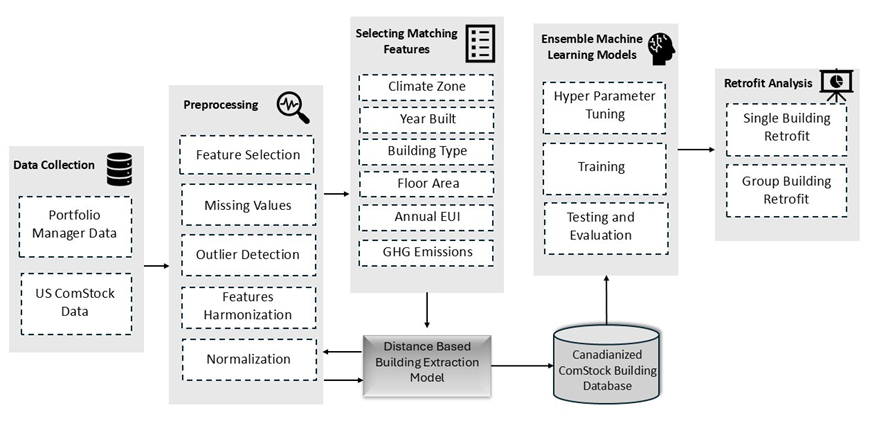
Figure 1. Overall flowchart for developing retrofit scenarios from raw data
Publications
Tool-augmented vs. autonomous LLM agents for building energy model modifications: A comparative study using NECB compliance models. (English only)
This study compares two AI approaches for automating changes to building energy simulation models. The first uses specialized building-energy tools and expert rules, while the second allows the AI to make all changes directly on its own.
Both approaches worked well for simple tasks, such as changing window or lighting settings. However, for a more complex HVAC system upgrade, the tool-assisted approach successfully modified all building models and produced valid simulation results, while the fully autonomous approach failed in every case.
The results show that AI can reliably handle simple model updates on its own, but complex engineering changes still require specialized tools and built-in domain expertise. A hybrid approach, using autonomous AI for simple tasks and expert-guided tools for complex ones, provides the best balance of efficiency and reliability.
Shirzadi, N., Lopez, P., and Stylianou, M. Tool-augmented vs. autonomous LLM agents for building energy model modifications: A comparative study using NECB compliance models. Energy and AI. 2026, 26, 100896. https://doi.org/10.1016/j.egyai.2026.100896
Sharing Information
We plan on sharing the tools and related datasets through public websites and reports.