
Project location: CanmetENERGY Ottawa, Ottawa, ON
Timeline: 5 years (2020-2025)
Program: Funded by the Canadian Forces Housing Agency
CanmetENERGY-Ottawa’s partnership with Canadian Forces Housing Agency supports a sustainable housing portfolio for Armed Forces members
Background
The Canadian Forces Housing Agency (CFHA) provides residential accommodation solutions for Canadian Armed Forces (CAF) members and their families on behalf of the Department of National Defence (DND). To support the quality of life of CAF members, CFHA manages 12,000 dwellings across Canada, and is investing in new apartment construction to ease availability and affordability concerns. CFHA is taking action to improve the housing portfolio’s energy efficiency and reduce GHG emissions by integrating the objectives of the Government of Canada’s Greening Government Strategy into their maintenance, renovation, and construction programs.
CFHA has relied on Natural Resources Canada CanmetENERGY Ottawa (CE-O) expertise to help improve the energy performance and decarbonize its new construction and renovation activities, while improving comfort and reducing energy costs for CAF residents. CE-O researchers have supported CFHA’s planning efforts by benchmarking the carbon intensity of CFHA’s housing portfolio, by developing low-cost strategies for reducing carbon emissions, and by forecasting the rates and costs of renovation needed to meet Canada’s 2050 net zero goals. CFHA also relies on CE-O’s knowledge to develop specifications for low-carbon design and procurement. Finally, CE-O helps CFHA expand its technical capacity in building science and high-performance housing by developing and delivering training curriculums that address the needs of staff.
Results and Outcomes
CE-O developed a forecasting tool to examine emission reduction for CFHA’s stock of housing out to 2050. The tool provides detailed energy, GHG emissions, and cost results by location and housing type. This approach allows for faster analysis of various retrofit scenarios and allows users without knowledge of the underlying tools to carry out their own analysis.
This model shows that CFHA can reduce its carbon emissions by approximately 75% with a mix of envelope measures and switching to heat pumps for space heating and domestic hot water. Those measures will require about 22% more annual capital investments than is currently spent.
CE-O collaborated with CFHA to incorporate these emissions and energy reduction findings measures as cost-effective constructible solutions into an updated version of the CFHA Design Specification.
To support CFHA with the knowledge to effectively implement these energy efficiency and decarbonization solutions, CE-O, in conjunction with Red River College, developed a three-day building science training curriculum for technical staff that can be delivered by external trainers.
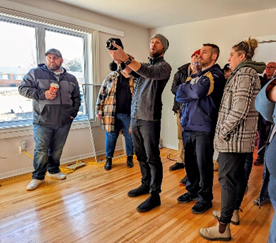
Infrared imaging demonstration as part of Building Science Training Course for CFHA staff (March 2024)
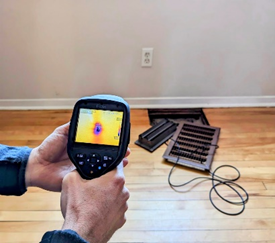
Infrared imaging demonstration as part of Building Science Training Course (March 2024)
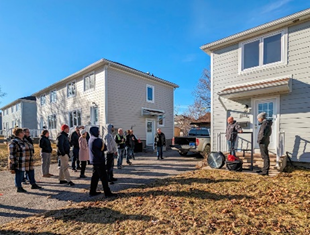
Air-tightness testing demonstration for CFHA staff as part of Building Science Training Course (March 2024)