
Project location: CanmetENERGY Ottawa, Ottawa, ON
Timeline: 5 years (2023-2028)
Program: Funded by the Program of Energy R&D
Background
A particularly intense heat wave hit the province of British Columbia (BC) in 2021 and resulted in 619 deaths. As climate change intensifies, these types of heat waves will be more frequent and intense. For example, climate models show that the unprecedented heat wave seen in British Columbia will become more frequent by the mid-century. Over that same period, southern Ontario is predicted to see a doubling of days with temperatures over 30°C, while Whitehorse is predicted to see a 20-fold increase of those above 30°C days. (Beugin, et al., 2023) Canada is in a particularly dangerous situation when it comes to overheating in buildings:
- Historically, Canadian building codes have focused on winter conditions (keeping occupants warm). Cooling is generally not mandated, and codes have encouraged the use of high gain windows to reach energy targets.
- Canada’s climate is warming at a rate faster than the global average. (Environment and Climate Change Canada, 2019)
On the other end of the spectrum, winter storms that impact electrical grids are becoming more frequent. It is important to understand how to ensure that homes can remain habitable during cold snaps, even without power.
Project description
This project strives to improve understanding of thermal resilience of residential housing in Canada. We hope to use this increased understanding to help implement a more rigorous approach to thermal resilience in the National Building Code of Canada.
Project Activities
Task 1: Review existing research, codes, policies, and standards on overheating that could inform future building codes. Provide recommendations for direction of 2030 NBC code cycle (and beyond), and work required to get there.
Task 2: Quantify the effects of the tiered energy code on overheating resilience of housing in Canada.
Task 3: Evaluate various adaptation strategies for thermal resilience in Canada with a focus on the balance between energy efficiency/carbon emissions, resilience during the heating season, and resilience during the cooling season. Of particular importance is thermal resilience during power outages. Cost considerations will also be considered.
Task 4: Evaluate the uncertainty and key factors for modelling thermal resilience of the housing stock (new and existing) in Canada. Investigate requirements for metrics and methods required for potential tools to be used by industry to evaluate overheating for code compliance.
Task 5: Provide recommendation on how thermal resilience metrics can be incorporated into the NBC. This includes providing guidance on potential requirements for tools to accurately evaluate overheating in residential buildings.
Project Status
As of December 2024:
Tasks 1 and 2 are underway.
Task 1: A group of experts from various government agencies, academia, and industry is working with CanmetENERGY Ottawa researchers on a paper outlining recommendations for the NBC with respect to overheating in residential buildings. The paper will be made public in early 2025.
Task 2: Modelling of tiered building code has started. Preliminary results have been presented at Comfort at the Extremes 2024 (Brideau, Wills, & Brown, 2024). This preliminary work used a single detached archetype (see Figure 1) located in Quebec City with 4 different fenestration-and-door-to-wall area ratios (FDWR). Results showed that energy tiers don’t appear to have a large impact on overheating if natural ventilation is used (Figure 2). In that case, one or two heat waves are responsible for most of the overheating for the year. Additionally, results showed that peak cooling load predictions do not appear to be a good indicator of overheating (Figure 3). This work continues with modelling of other locations across the country and eventually other housing forms (MURBS and attached housing).
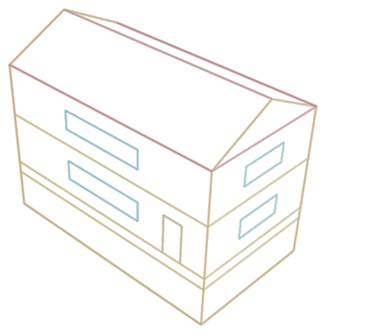
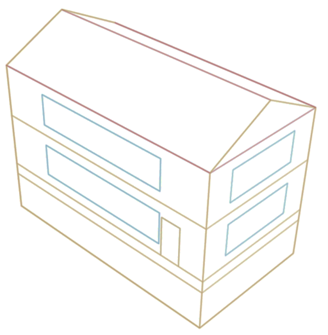
Figure 1 Single detached archetype with low fenestration and high fenestration
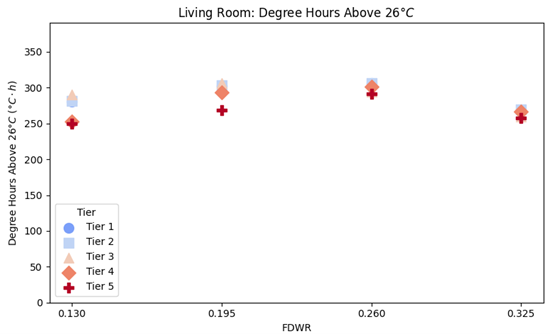
Figure 2 Overheating metrics for living room during cooling season vs FDWR
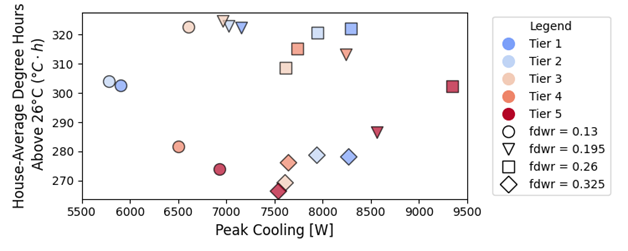
Figure 3 House-Averaged Overheating Degree-Day above 26C (entire cooling season with natural ventilation) vs Peak Cooling
Task 3: The following adaptation strategies have been identified, and we will begin simulations in early 2025:
- Low gain peel and stick films (for retrofits)
- Low gain windows (for new construction)
- Natural ventilation
- Fixed exterior shading
- Operable exterior shading
- High reflectivity roofs
- Varying operable window area/glazed area
- Thermal mass
- Air conditioning backed up by photovoltaics (grid tied, battery backup, or not)
References
Beugin, D., Clark, D., Miller, S., Ness, R., Pelai, R., & Wale, J. (2023). The case for adapting to extreme heat: Cost of the 2021 B.C. heat wave. Ottawa: Canadian Climate Institute.
Brideau, S., Wills, A., & Brown, S. (2024). Effect of New Canadian Tiered Building Codes on Thermal Resilience of Housing. Comfort at the Extremes. Seville. Retrieved from https://tinyurl.com/4nhvvcrn
Environment and Climate Change Canada. (2019, April 2). Canada’s climate is warming twice as fast as global average. Retrieved from https://www.canada.ca/en/environment-climate-change/news/2019/04/canadas-climate-is-warming-twice-as-fast-as-global-average.html
Acknowledgements
We would like to thank the following people for their help with this project:
Nina Dmytrenko, Canada Mortgage and Housing Corporation
Abhishek Gaur, National Research Council Canada
Erin Greco, Natural Resources Canada – Offices of Energy Efficiency
Lili Ji, National Research Council Canada
Aziz Laouadi, National Research Council Canada
Robert Lepage, Climes Group
Liam O’Brien, Carleton University
Marianne Touchie, University of Toronto
Adam Wills, National Research Council Canada