
Integrating low carbon insulation materials into factory-built, scalable assemblies for construction and renovation.
NRCan’s PEER Project (2016-2023) developed and demonstrated prefabricated retrofit solutions by adapting panel designs that already existed for new construction. That project provided industry with market-ready solutions. The Low-Carbon Building Envelopes for Industrialized Construction & Retrofit project considers how carbon-storing materials can be integrated into next-generation building enclosure assemblies for durable, resilient, scalable solutions for Canada’s future buildings and retrofits.
Motivation
This project responds to the following four main challenges:
-
10% of Canada’s GHG emissions result from heating our buildings.
Heating buildings accounted for 67 MtCO2e (10%) of GHG emissions in Canada in 2021 [1]. By retrofitting the older or the more inefficient Canadian houses and buildings to net-zero or passive house insulation levels and airtightness, heating demand can be reduced by 80% or more [2] [3]. All else being equal, reducing heating demand reduces emissions, and makes switching to decarbonized fuel sources more economically and technically viable.
-
2% of Canada’s GHG emissions result from constructing and renovating our buildings.
The embodied carbon (GHGs emitted through the production, manufacturing, and transport of building materials and components, as well as construction and assembly in new and retrofit buildings) associated with new homes and buildings built each year in Canada is estimated to be approximately 11-13 MT of CO2e. By developing carbon-storing building envelopes, new construction and retrofits can act as a carbon-sink instead of a carbon source.
-
Canada is facing an acute shortage of construction trades.
Canada’s Green Building Strategy suggests that 3% of the existing housing and buildings stock needs to be retrofit annually to decarbonize Canada’s built environment by mid-century [4]. That’s about 3x the rate that was achieved under the Greener Homes Grant Program.
Additionally, CMHC predicts that new the rate of new housing supply must increase by 2.5x to address affordability [5].
However, the Canadian construction sector is already facing a dearth of trades and 22% of the workforce is set to retire over the coming decade. This represents a significant loss of skilled labour. BuildForce Canada estimates that almost 500k additional workers will be required to achieve the governments targets.
While other industries have capitalized on digitization, automation and process efficiency to improve productivity, little has changed in Canadian construction practices in decades [6]. Without dramatic improvements in productivity, the skilled labour shortage will be a major barrier to achieving government policy. Novel methods and technologies (offsite construction, design for manufacturing and assembly, robotics, additive manufacturing), are needed to increase productivity and reduce labour demands.
-
Increasingly severe and frequent extreme weather events and power outages pose a threat to our buildings and
infrastructure.
Extraordinary weather events (heat domes, atmospheric rivers, micro-bursts, tornados, hurricanes, wildfires, and floods) are increasingly frequent, putting our housing, and energy supply and distribution systems at risk. To adapt to climate change, building envelopes that improve the thermal, structural and moisture resilience and passive survivability of our buildings are needed.
Vision
The project vision is to collaborate with industry and academia to develop prototype, low-carbon enclosure assemblies suitable for low and mid-rise new construction and retrofit. These assemblies will be constructed with abundant, sustainable, Canadian-grown materials that absorb and effectively store GHG emissions for the life of the building.
Key Project Objectives
To develop and evaluate the next generation of carbon-storing building envelope assemblies and construction systems for new buildings and retrofits that:
- Dramatically reduce heating energy use (80% reduction relative to typical existing building, 30% reduction relative to 2020 NBC levels) and improve structural, thermal and moisture resilience for a changing climate.
- Improve industry’s confidence in novel, low-carbon, carbon storing and carbon-sequestering materials through laboratory testing, and field trials.
- Enable rapid, industrialized construction and renovation that involves less labour and disruptive site-work by prefabricating entire building envelopes, while integrating technology such as high-performance windows and renewable energy cladding.
Project Activities
| Activity | Description | Status and Findings |
|---|---|---|
|
Low carbon materials (LCMs) will be assessed according to criteria, including:
|
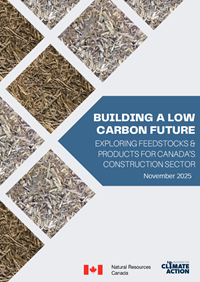 Building A Low Carbon Future: Exploring Feedstocks & Products For Canada’s
Construction Sector Building A Low Carbon Future: Exploring Feedstocks & Products For Canada’s
Construction Sector(PDF, 1.5 MB) Landscape Review of Dynamic LCA Methods |
|
Novel assembly concepts will be developed, prototyped and tested in the lab, including:
|
Schematics, prototype designs and test results expected FY 2027/28 |
|
Field trials will be conducted to gain real-world experience designing, prefabricating and installing the assemblies developed under Activity 2. In-situ performance data will improve understanding of construction impacts, hygrothermal performance, and cost. |
Field trial 1 (LCCR) report expected FY 2024/25 Field trail 2 report expected FY 2027/28 |
|
Methods for designing, prefabricating and constructing the assemblies developed in Activity 2 will be piloted, assessed and refined. The desired end-state for this activity is a fully automated design, compliance review and fabrication process. However, manual design and fabrication workflows will first be developed to enable a gradual industry adoption and scale-up. |
Guidelines available FY 2027/28 |
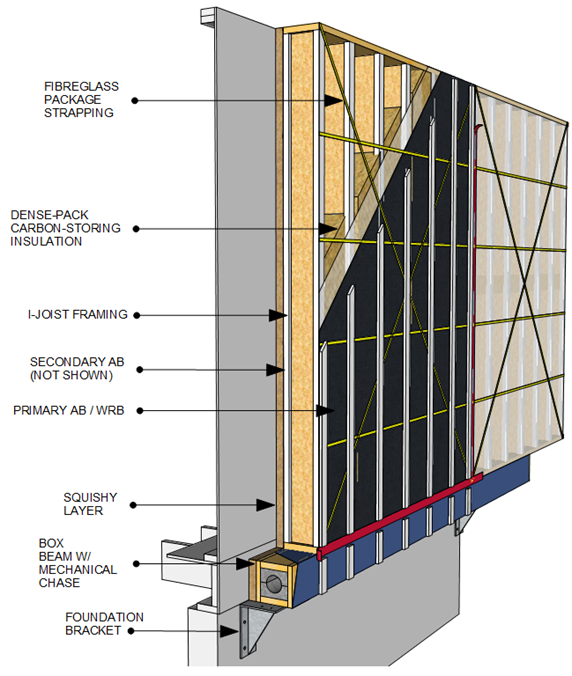
Figure 1: Carbon-storing PEER Panel Design using I-Joist framing members
Partners and Acknowledgments
Canmet is collaborating with Tooketree Passive Homes, Savick, Cold Climate Building, Builders for Climate Action and Carleton University’s Centre for Advanced Building Envelope Research on this project.
Funding is provided by the Office of Energy Research and Development (OERD) under its PERD program. The researchers acknowledge and appreciate OERD’s support.
Contact
For further information, contact Mark Carver, Housing & Buildings R&D, Buildings and Renewables Group, CanmetENERGY: mark.carver@NRCan-RNCan.gc.ca
Publications
B. Belitski, C. Magwood, H. Pope “Landscape Review of Dynamic LCA Methods: Creating a System for Valuation of Temporary Carbon Storage” Natural Resources Canada. Ontario, Canada. 2026.
Conley, B.; Carver, M. Comparison Between Experimental and Simulated Hygrothermal Response of Chopped-Straw- and
Cellulose-Insulated Wood Frame Panels. Buildings 2025, 15, 4017.
https://doi.org/10.3390/buildings15224017
B. Belitski, C. Magwood, H. Pope, “Building A Low Carbon Future: Exploring Feedstocks & Products For
Canada’s Construction Sector” Natural Resources Canada. Ontario, Canada. 2025.
Pope H, Carver M, Armstrong J. Low-Carbon Climate-Resilient Retrofit Pilot: Construction Report. Buildings. 2025;
15(20):3666.
https://doi.org/10.3390/buildings15203666
H Pope, M Carver, B Conley, J Armstrong, "Development and Experimental Design of a Novel, Low-Carbon,
Industrialized, Below-Grade Wall Retrofit Method", St. Louis, BES+ 2025 Building Enclosure Symposium, 2025.
Conley, B., Carver, M. (2024)
Hygrothermal Performance of a Masonry Overcladding Prefabricated Exterior Energy Retrofit in Ottawa.
Proceedings of the 9th International Building Physics Conference. Toronto, Canada.
Conley, B., Carver, M. (2024)
A Hygrothermal Modelling Case Study of a Prefabricated Exterior Energy Retrofit. Proceedings of the 9th
International Building Physics Conference. Toronto, Canada.
Pope, Hamish, "Industrialized Exterior Retrofit Projects: A Review”, Virtual, WSBE24, 2024.
H Pope, M Carver, B Conley, “Carbon-storing Prefabricated Retrofit Panel Designs”, Virtual, WSBE24,
2024.
Natural Resources Canada (2023) Prefabricated Exterior Energy Retrofit (PEER) Guide. Available at:
https://natural-resources.canada.ca/energy-efficiency/data-research-insights-energy-efficiency/housing-innovation/peer-prefabricated-exterior-energy-retrofit/19406
Cat. No. M154-153/2023E-PDF
ISBN 978-0-660-48179-1
Natural Resources Canada (2023)
Deep Retrofit Measurement and Verification Protocol for Residential Buildings. Available at:
https://natural-resources.canada.ca/energy-efficiency/data-research-insights-energy-efficiency/housing-innovation/peer-prefabricated-exterior-energy-retrofit/19406
Cat. No. M154-161/2023E-PDF