
Project location: CanmetENERGY Ottawa, Ottawa, ON
Timeline: 5 years (2023 to 2028)
Program: Program of Energy R&D
Project Overview and Objectives
Energy transition planning in Canada’s remote communities is a federal focus. Nearly three-quarters of Canada’s almost 280 remote communities rely on diesel generators to produce their electricity. Even larger amounts of fossil fuel are used to meet space heating and domestic hot water heating requirements. Reliance on fossil fuels for heat and power contributes to local health and environmental issues. Furthermore, transporting and storing fuels in remote locations is both challenging and expensive.
Reducing fossil fuel reliance in remote communities can be achieved through multiple pathways that include renewable power generation, building envelope retrofits, and mechanical system upgrades. Analyzing the feasibility and impact of various pathways, however, requires an understanding of the current fossil fuel use in Canada’s remote communities. This is a challenging task since the high-resolution data required for effective planning often does not exist or is not publicly accessible.
The overarching objective of this project is to conduct the buildings-level analyses required to support energy transition federal programming and planning for Canada’s remote communities. Work under this project includes establishing data-backed estimates of current fuel consumption quantities and patterns in residential and commercial buildings as well as predicting the cost of implementation and fossil fuel reductions possible with building retrofits and renewable power generation.
Results and Outcomes
This project has established a first-of-its-kind methodology for predicting community-level heating requirements using census data, OpenStreetMap (OSM), and building performance simulation software. Using this methodology, heating energy consumption for the residential and commercial buildings in 139 diesel-dominant communities was established. This database of heating energy predictions has been critical in supporting the progression of technology feasibility work conducted by other NRCan research groups including the Bioheat team and Renewable Heat and Power team. The novel heat load prediction methodology has been documented in this conference paper (Brown et al. 2024) and builds upon earlier work documented in this NRCan publication (Richardson et al. 2023).
Geospatial techniques have been leveraged in this project to create national and community-level maps that act as effective and accessible visuals for resource and technology planning.
Impacts and Innovations
The results of our work will provide information that communities, commercial and military installations, and other stakeholders can use to make informed decisions about developing stable and durable energy systems.
Two main outcomes from the current work will be to understand the potential for deep EGS to meet the heat and power needs for remote communities located in regions with moderate to poor geothermal potential, and the potential for DBHEs to provide affordable heating in areas with good geothermal resources.
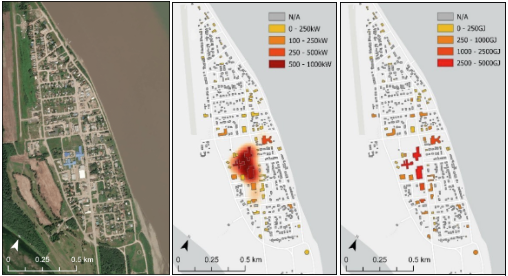
Figure 1: Fort Simpson, NWT. Map of town centre, preliminary peak heating loads for commercial buildings (kW), and total heating loads for commercial buildings (GJ).
Impact and Innovations
This work executed under this project has created the methodologies, databases, and planning tools necessary to support informed decision making by federal organizations that are working with communities to improve existing building infrastructure and achieve fossil fuel reductions.
Future efforts in this project will increase the resolution of energy consumption predictions and consider the resilience and affordability impacts of proposed changes.
Publications
- S. Brown, J. Purdy, G. Richardson, I. Maynard, S. Brideau, and A. Ferguson, “Characterizing heating energy for residential and commercial buildings in Canada’s remote communities,” in eSim, Alberta, Canada: IBPSA-Canada, Jun. 2024. [Online]. Available: https://publications.ibpsa.org/conference/paper/?id=esim2024_166
- Richardson, G., Caesar, G., Purdy, J., Wakim, C. & Kilpatrick, R. (2023). Characterizing building footprints for heat load modelling in remote communities. Natural Resources Canada. https://doi.org/10.4095/332286
Contact CanmetENERGY in Ottawa
To learn more about this project, email our Office of Research Partnerships and External Relations.