
On this page
- At a glance
- From the Minister
- Results – what we achieved
- Spending and human resources
- Supplementary information tables
- Federal tax expenditures
- Corporate information
- Definitions
Copyright information
© His Majesty the King in Right of Canada, as represented by the Minister of Energy and Natural Resources, 2025
Catalogue Number: M2-15E-PDF
ISSN: 2561-1674
Aussi disponible en français sous le titre : Rapport sur les résultats ministériels 2024-2025
Portions of this report were drafted with the assistance of generative AI tools, under human supervision, to support clarity and consistency.
At a glance
This Departmental Results Report details Natural Resources Canada’s actual accomplishments against the plans, priorities and expected results outlined in its 2024–25 Departmental Plan.
Key priorities
Natural Resources Canada (NRCan) identified the following key priorities for 2024-25:
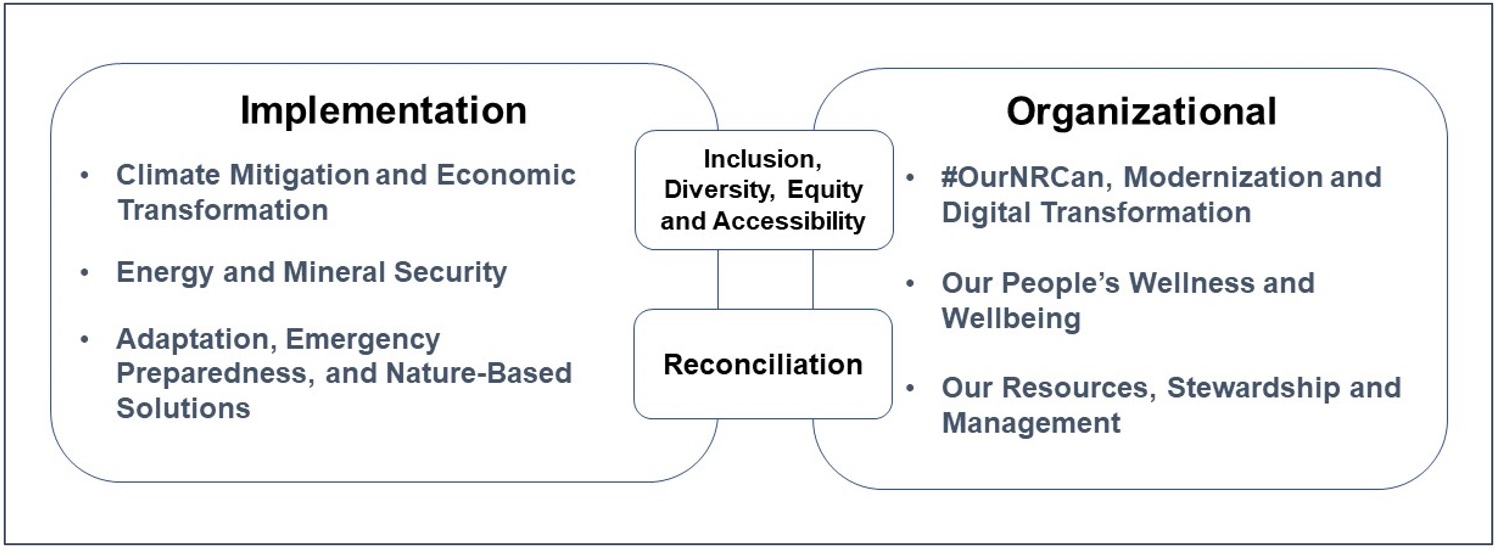
Text version of Figure 1
- Implementation
- Climate Mitigation and Economic Transformation
- Energy and Mineral Security
- Adaptation, Emergency Preparedness, and Nature-Based Solutions
- Inclusion, Diversity, Equity and Accessibility
- Reconciliation
- Organizational
- #OurNRCan, Modernization and Digital Transformation
- Our People’s Wellness and Wellbeing
- Our Resources, Stewardship and Management
NRCan’s Implementation Priorities focused on leveraging Canada’s natural resources to drive sustainable economic growth. These priorities reflect the Department’s broad mandate—spanning clean energy and mineral security, adaptation measures, nature-based solutions, protecting Canadians from hazards, and enhancing the global and domestic competitiveness of Canada’s natural resource sectors.
In the current economic context, competitiveness increasingly depends on market diversification, advancement of major projects, and strengthened internal trade. To attract investments in key sectors and expand the markets for Canada’s energy, critical minerals, and forest products, NRCan supported the development and implementation of investments tax credits, led a suite of forest, critical minerals and energy competitive research and programs and engaged with international partners in Europe, Asia, the Indo-Pacific, emerging markets and through platforms such as the G7, G20, and ASEAN. In-region presence was expanded to ensure direct connection with international partners in government and industry.
Domestically, the Department strengthened initiatives like the Regional Energy and Resource Tables and improved federal-provincial-territorial collaboration, with a focus on how to best work together to advance economic opportunities in energy and resource sectors. This included working to develop strong partnerships with provinces, territories, Indigenous communities, and industry proponents.
The Organizational Priorities focused on modernizing and transforming how NRCan delivers its business and supports its employees. Reconciliation with Indigenous peoples and Inclusion, Diversity, Equity and Accessibility (IDEA) were horizontal priorities that the Department embedded in the design and delivery of its policies and programs.
Highlights for Natural Resources Canada in 2024-25
- Total actual spending (including internal services): $4,419,629,197
- Total full-time equivalent staff (including internal services): 5,887
For complete information on Natural Resources Canada’s total spending and human resources, read the Spending and human resources section of its full Departmental results report.
Summary of results
The following provides a summary of the results the Department achieved in 2024-25 under its main areas of activity, called “core responsibilities.”
Core responsibility 1: Natural Resource Science and Risk Mitigation
Actual spending: $616,951,605
Actual full-time equivalent staff: 1,527
The Department advanced natural resource science, climate change adaptation and the protection of Canadians from natural and human induced hazards through the following examples:
- Strengthening GeoEnergy research on carbon capture, utilization and storage, hydrogen storage, and geothermal energy.
- Refining knowledge and mapping where, when and how geohazards occur across Canada.
- Supporting 295 Arctic projects, including 192 science initiatives and 19 Department of National Defence collaborations through the Polar Continental Shelf Program.
- Publishing over 82,000 datasets from 40+ federal, provincial and territorial contributors to support early planning and help align project proposals with regulatory expectations, improve transparency, and build trust in the regulatory process.
- Issuing 100% timely notifications for hazardous natural events, providing 24/7 earthquake monitoring and space weather updates every 15 minutes, and delivering a Government of Canada system for remote sensing activity.
- Completing 1,378 inspections and issuing 1,792 explosives licenses, resulting in 84% of inspected sites demonstrating regulatory compliance in 2024-25—well above the 70% target.
- Mobilizing 2,113 personnel (including domestic and international firefighting resources, and personnel sent to the U.S.), 23 airtankers, 10 birddog aircraft to fight wildfires, and advancing the development of the WildFireSat mission for real-time emergency response.
- Providing tools and science information to support the management of forest pests and protecting jobs and forest health through delivery of the Spruce Budworm Early Intervention Strategy – Phase III Program which utilizes innovative pest management approaches.
- Releasing Canada’s first Indigenous-led climate assessment report on adaptation, co-developing innovative climate actions for coastal communities and businesses, and delivering tailored resources.
- Advancing national tools for assessing forest vulnerability and growth, and carbon budgets.
- Supporting the planting of over 150 million trees since 2021, with agreements in place or in progress to plant 988 million trees over 10 years and funding for over 70 Indigenous-led tree planting projects.
- Providing Canadians with access to over 175 thousand publications, maps, data and regulatory records about natural resource development activities, enhancing public trust in our regulatory systems.
For more information on Natural Resources Canada’s Natural Resource Science and Risk Mitigation, read the ‘Results – what we achieved” section of its Departmental Results Report.
Core responsibility 2: Innovative and Sustainable Natural Resources Development
Actual spending: $1,242,197,045
Actual full-time equivalent staff: 2,342
The Department promoted sustainable development in energy, forestry, mining and critical minerals through activities such as:
- Investing over $180 million in energy research, development and demonstration projects led by Canadian innovators, including NRCan’s CanmetENERGY and CanmetMATERIALS, to accelerate the development of new energy technologies and solutions.
- Supporting decarbonization projects with major emitters through the Net Zero Accelerator and collaborating on the development of the Pathways Alliance decarbonization project.
- Funding the deployment of electric vehicle chargers and hydrogen refueling stations across Canada and extending the Clean Fuels Fund to March 31, 2030, in support of businesses to invest in building clean fuels capacity.
- Providing $1.77 billion to low-to-median-income homeowners and tenants with no cost home retrofits grants, helping 396,732 homeowners make energy-efficient improvements, and assisting targeted homeowners with the transition from oil heating to electric heat pumps.
- Working with provinces and territories to identify priority projects and initiatives under the Smart Renewables and Electrification Pathways Program and launching competitive intake processes to select eligible Indigenous and utility led projects for funding.
- Facilitating the implementation and refinement of four investment tax credits.
- Releasing Canada’s Hydrogen Strategy Progress Report and Codes and Standards Roadmap.
- Supporting Parliamentary review and eventual Royal Assent of Bill C-49, which modernized the offshore energy regimes in Nova Scotia and Newfoundland and Labrador.
- Supporting the Government’s decision to provide a $200 million federal contribution to the $6 billion Cedar LNG project.
- Developing the Mine Permit Navigator, an online tool offering project-specific guidance and a streamlined approach to federal permitting and expanding mine dust research to support better models and impact assessments.
- Leading the enactment of the Canadian Sustainable Jobs Act, followed by the establishment of a Sustainable Jobs Partnership Council and Sustainable Jobs Secretariat commissioning research to support a more comprehensive body of information on sustainable jobs.
- Advancing the updated CANDU design, supporting site selection for the Nuclear Waste Management Organization’s Deep Geological Repository, and releasing Canada’s first Clean Electricity Strategy.
- Establishing safety and environmental requirements for offshore renewable energy projects.
- Publishing 61 peer-reviewed knowledge products to improve access to national forest data, and developing 26 knowledge products that addressed cumulative effects - forest recovery, land-use planning, and wildlife protection.
For more information on Natural Resources Canada’s Innovative and Sustainable Natural Resources Development, read the ‘Results – what we achieved” section of its Departmental Results Report.
Core responsibility 3: Globally Competitive Natural Resource Sectors
Actual spending: $1,660,417,182
Actual full-time equivalent staff: 640
The Department enabled the competitiveness of Canada’s natural resources domestically and globally, created opportunities for youth employment and strengthened Indigenous involvement in major projects in several areas, including:
- Investing $764 million in 113 projects under the Canadian Critical Minerals Strategy as of March 2025, increasing critical mineral production by 15% in the first year of the strategy and unlocking new mining and processing opportunities, including in Northwest BC for copper.
- Advancing the commercial adoption of critical minerals under the Critical Minerals Research, Development and Demonstration Program and supporting pre-construction, construction, and Indigenous capacity-building and participation in infrastructure projects under the Critical Minerals Infrastructure Fund.
- Driving progress in Canada’s critical minerals and quantum sectors and improving the separation and high-purity recovery of critical metals (under 1% impurities), reducing costs, waste, and emissions.
- Championing critical minerals priorities globally through Canada’s G7 Presidency with a Critical Minerals Action Plan, engaging with key multilateral bodies including the IEA, OECD, and signing a Memorandum of Understanding with Indonesia and a joint statement with Italy on critical minerals cooperation and critical raw materials respectively.
- Completing over 80 international engagements across Asia, the Indo-Pacific and Europe, positioning Canada as a preferred investment destination and supplier of choice for critical minerals, energy, and related technologies.
- Advancing international wildfire prevention, response and recovery through Canada’s G7 Presidency and active engagement with multilateral partners.
- Engaging with GAC and ECCC to advance three Leaders’ initiatives ahead of the G7 Summit, laying the groundwork for Canada’s G7 Presidency and supporting Ukraine, including leading a 28-company delegation to the Rebuild Ukraine Conference.
- Helping Canadian diamond producers access the EU market and reinforcing Canada’s leadership in extractive sector transparency by validating 1,390 reports disclosing \$161 billion in payments to over 1,300 payees across 91 countries.
- Informing Canada’s response to U.S. tariff measures through detailed analysis of impacts of tariffs and countermeasures to natural resources sectors.
- Advancing preparations for the review of the Canada-United States-Mexico Agreement.
- Showcasing Canada’s inclusive energy transition leadership at COP29 and supporting the decarbonization of the global electricity system.
- Strengthening Indigenous participation in oversight of Line 3 and TMX and aligning the Department’s efforts with the UN Declaration Act and UN Declaration Act Action Plan.
- Increasing the economic participation of Indigenous communities and organizations in the development of natural resource projects, including through supporting the launch of the Indigenous Loan Guarantee Program.
- Funding a suite of forest sector competitiveness programs to reduce emissions and waste and showcasing sustainable construction using mass timber in residential buildings.
- Filling critical labour market gaps in the natural resources sector by investing \$15.6M to create 653 green jobs and training opportunities for youth across all provinces and territories, with 78% of participants securing full-time jobs post-program.
- For more information on Natural Resources Canada’s Globally Competitive Natural Resource Sectors, read the ‘Results – what we achieved” section of its Departmental Results Report.
From the Minister
As Canada’s Minister of Energy and Natural Resources, I am proud to present the 2024–25 Departmental Results Report — a reflection of the progress made under the leadership of my predecessor, the Honourable Jonathan Wilkinson, and thanks to the commitment of Natural Resources Canada (NRCan) staff and strong partnerships with Indigenous communities, provinces, territories and industry.
In 2024–25, transformative U.S. trade actions dramatically changed the landscape for Canada’s resource industries, and NRCan played a central role in advancing the country’s response. The department led key initiatives in energy, critical minerals and technology, leveraging Canadian expertise and our strong energy and natural resource sectors to bolster economic security, sovereignty and resilience.
For Canada, these changes also presented opportunities, as our country moved to position itself as a leader in a new world order. From energy to minerals to forestry, NRCan responsibly and sustainably empowered the production of the resources the world needs.
Navigating today’s uncertain international trade waters means building major projects, an area where NRCan has long played a leading role. One example featured in this report is the pivotal role the department played in the Government’s decision to contribute $200 million to the Cedar LNG project through the Strategic Response Fund. This investment enabled the development of Canada’s largest Indigenous majority-owned infrastructure project, which will produce low-carbon LNG by using renewable hydroelectricity to liquify natural gas for export overseas to our allies in Asia.
Beyond that, major projects were also a focus of the Critical Minerals Infrastructure Fund in 2024–25. NRCan announced over $300 million in funding to unlock high-potential mining regions and advance infrastructure that will make developing our resources possible. This includes the development of initiatives like roads and transmission lines that connect remote deposits to markets, while supporting Indigenous partnerships and regional economic development.
To enable these projects, and increase our ability to evaluate and assess them, NRCan scientists were hard at work across the country, as well as at both poles of the Earth. They led expeditions to Antarctica to examine the region’s response to climate change, while continuing to take a leadership role in scientific work in Canada’s North. From the bottom of the Arctic Ocean, where our NRCan team mapped the ocean floor and reinforced our country’s sovereignty, to the heights of the stars, as they leveraged our geoscience and satellite information, science continues to be at the core of our department’s work.
The work of NRCan’s world-leading scientists also extended to emergency response where, in another historic wildfire season, our scientists lent their expertise to fortify community preparedness, forest resilience and climate adaptation across the country.
The department’s work on so many fronts — whether it was environmental assessment, emergency management, critical minerals, energy infrastructure, nuclear innovation or capturing carbon — is crucial to securing Canada’s future in a rapidly changing global environment and laying the foundation for Canada’s continued prosperity.
By supporting Indigenous economic partnerships, new jobs, clean energy investments and expanded global trade, NRCan will continue to grow our economy, deliver sustainable, low-carbon solutions and create jobs across the country.
Thank you to everyone at NRCan and our partners for your vision and dedication to a more sustainable, inclusive and resilient Canada.
The Honourable Tim Hodgson, P.C., M.P.
Minister of Energy and Natural Resources
Results – what we achieved
Core responsibilities and internal services
- Core responsibility 1: Natural Resource Science and Risk Mitigation
- Core responsibility 2: Innovative and Sustainable Natural Resources Development
- Core responsibility 3: Globally Competitive Natural Resource Sectors
- Internal services
Core responsibility 1: Natural Resource Science and Risk Mitigation
In this section
Description
Lead foundational science and share expertise for managing Canada’s natural resources, reducing the impacts of climate change and mitigating risks from natural disasters and explosives.
Quality of life impacts
This core responsibility contributed to the Environment domain of the Quality of Life Framework for Canada, through all of the activities mentioned in the core responsibility description.
NRCan contributed to the Climate change adaptation indicator from the Quality of Life Framework by supporting Canada’s National Adaptation Strategy to increase climate change resiliency in natural resources sectors and communities.
Additionally, NRCan contributed to the Natural disasters and emergencies indicator in the Framework by providing information and data to decision makers to understand and reduce hazards and risk (for example, satellite imagery and near real-time mapping information will enable responses to flooding and other natural disasters.)
Progress on results
This section details the Department’s performance against its targets for each Departmental result under Core responsibility 1: Natural Resource Science and Risk Mitigation
Table 1: Canadians have access to cutting-edge research to inform decisions on the management of natural resources
Table 1 shows the target, the date to achieve the target and the actual result for each indicator under Canadians have access to cutting-edge research to inform decisions on the management of natural resources in the last three fiscal years.
| Departmental Result Indicator | Target | Date to achieve target | Actual Result |
|---|---|---|---|
| Number of times scientific products related to natural resources are accessed by Canadians | At least 320,000 | March 31, 2025 | 2022–23: 327,180Footnote 1 2023–24: 603,558Footnote 2 2024–25: 420,260Footnote 3 |
| Percentage of environmental impact assessments demonstrating use of scientific and technical advice provided by NRCan | 100% | March 31, 2025 | 2022–23: 100% 2023–24: 100% 2024–25: 100% |
| Percentage of science publications authored by NRCan available on Open Access | 50% (SCOPUS data source) 100% (NRCan Open institutional repository date source) |
March 31, 2024 (SCOPUS data source)Footnote 4 March 31, 2025 (NRCan Open institutional repository date source) |
2022–23: Not available 2023–24: Target 1: 58% Target 2: Not ApplicableFootnote 5 2024–25: Target 1:57%Footnote 6 Target 2:100%Footnote 7 |
| Number of times stakeholders acknowledge using NRCan’s scientific and technical products in making their decisions | At least 30,250 | March 31, 2025 | 2022–23: 44,576 2023–24: 42,821 2024–25: 52,129 |
| Number of NRCan agreements that recognize data and/or information derived from an Indigenous Knowledge source and is used to inform NRCan science and/or research | At least 8 | March 31, 2025 | 2022–23:18 2023–24: 20 2024–25: 35 |
| Percentage of foundational geospatial data that is current | At least 80% | March 31, 2025 | 2022–23: 80% 2023–24: 80% 2024–25:80% |
Table 2: Communities and officials have the tools to safeguard Canadians from natural hazards and explosives
Table 2 shows the target, the date to achieve the target and actual result for each indicator under Communities and officials have the tools to safeguard Canadians from natural hazards and explosives in the last three fiscal years.
| Departmental Result Indicator | Target | Date to achieve target | Actual Results |
|---|---|---|---|
| Percentage of hazardous natural events within Canada for which a notification was issued in a timely manner | At least 100% | March 31, 2025 | 2022–23: 100% 2023–24: 100% 2024–25: 100% |
| Percentage of emergency geomatics services provided to Canadians in a timely manner to assist during floods | At least 100% | March 31, 2025 | 2022–23: 100% 2023–24: 100% 2024–25: Not applicableFootnote 8 |
| Percentage uptime of the Canadian Wildland Fire Information System during the wildfire season | At least 97% | March 31, 2025 | 2022–23: 99.5% 2023–24: 99.5% 2024–25:99.9% |
| Percentage of inspections of explosives sites rated safeFootnote 9 | At least 70% | March 31, 2025 | 2022–23: 77% 2023–24: 76% 2024–25: 84% |
Table 3: Communities and industries are adapting to climate change
Table 3 shows the target, the date to achieve the target and actual result for each indicator under Communities and industries are adapting to climate change in the last three fiscal years.
| Departmental Result Indicator | Target | Date to achieve target | Actual Results |
|---|---|---|---|
| Number of times NRCan products and expertise on adaptation are accessed by Canadians | At least 34,000 | March 31, 2025 | 2022–23: 21,841Footnote 10 2023–24: 32,004Footnote 11 2024–25: 21,632Footnote 12 |
| Percentage of Canadian communities and industries that have taken steps to adapt to climate change | At least 65% for communities At least 45% for businesses |
March 31, 2027 | 2022–23: 64% for communities 45% for businesses 2023–24: 64% for communities 45% for businesses 2024–25: 64% for communities and 45% for businessFootnote 13 |
The Results section of the Infographic for Natural Resources Canada on GC Infobase page provides additional information on results and performance related to its program inventory.
Details on results
The following section describes the results for Natural Resource Science and Risk Mitigation in 2024–25 compared with the planned results set out in Natural Resources Canada’s Departmental Plan for the year.
The results highlight progress made in delivering cutting-edge research, safeguarding Canadians from natural hazards and explosives, and helping communities and industries adapt to climate change. The Department’s work spans geospatial data delivery, hazard monitoring, climate adaptation, and land governance, all contributing to informed decision-making and increased resilience across Canada.
Canadians have access to cutting-edge research to inform decisions on the management of natural resources
Results achieved
NRCan advanced scientific research and data accessibility to support decision-making in natural resource management. The Department delivered geospatial products, supported Indigenous land governance, and contributed to environmental assessments and energy transition research.
Geospatial Data and Mapping
NRCan provided foundational geospatial data to support environmental monitoring, infrastructure planning and mapping, and emergency response. NRCan:
- Delivered 56 map products using near-real-time data feeds and satellite imagery through NRCan’s ground stations to support federal, provincial, and territorial responses to natural disasters, including wildland fires in BC, AB, and YT.
- Released new interactive maps on the Atlas of Canada, including Relief Maps, Drainage Areas, and Landcover.
- Digitized 85% of the National Air Photo Library’s holdings (total collection approximately 5.5million photos from 1920s-1990s). This digital transformation combined with AI techniques allows for change detection over land and water spanning over 100 years. Also, in support of Indigenous communities and researchers, made over 1,000 aerial photos from 1927–1992 available for 59 Indian Residential School sites across nine provinces and territories (PTs).
- Continued mapping Canada’s land, water, and infrastructure, producing foundational open data such as digital elevation models and AI-extracted features like roads, buildings, surface water and forested areas.
- Expanded real-time Global Navigation Satellite Systems data for enhanced spatial monitoring by adding eight new sites (in YT, QC, SK, NL and the NT).
Geoscience and Open Data
NRCan conducted research supporting sustainable development and environmental protection. It also developed tools for better access to science and promoted data transparency and better public access, which supported education, planning and research. NRCan:
- Advanced GeoEnergy research in terrestrial and marine environments on carbon capture, utilization and storage (CCUS), hydrogen storage, naturally occurring hydrogen and geothermal energy to support Canada’s energy transition.
- Responded to the Eagle Mine disaster in the Yukon by publishing 31 peer-reviewed articles and 10 open files through the Environmental Geoscience Program. This rapid response helped assess contamination and inform remediation efforts. The program also developed the national scale groundwater climate model to address cases of groundwater contamination.
- Published over 82,000 datasets available on GEO.ca from 40+ federal, provincial and territorial contributors, and integrated 10,000+ datasets using AI for bilingual access on centralized platforms like the Open Government Portal, and the Open Science and Data Platform (OSDP). NRCan also delivered the Federated Open Data Search, a commitment in the 5th National Action Plan for Open Government. These data deliver on Canada’s commitment to Open Government by enabling transparency and accountability and support early planning, help align project proposals with regulatory expectations, improve transparency, and build trust in the regulatory process.
- Delivered two new releases of the OSDP and promoted its use in key sectors, providing all relevant data for federal impact assessment and regulatory processes through a single window, ensuring transparency, enabling public engagement, and increasing trust in decision-making.
- Provided Canadians with access to over 175,000 publications, maps, data and regulatory records about natural resource development activities across Canada via enhancements to the OSDP, helping to enhance public trust in our regulatory systems and to support better decisions.
- Advanced OSDP commitment to climate change and sustainable development by engaging civil society and government through a multi-stakeholder forum and quarterly reporting from January 2022 to December 2024 as part of the 5th National Action Plan for Open Government.
Arctic Collaboration and Science
In support of Canada’s northern research and sovereignty objectives, significant progress was made across multiple Arctic initiatives.
- The Polar Continental Shelf Program supported 295 Arctic projects, coordinating over 5,123 flight hours across more than 50+ aircrafts, 48,578 meals, and 16,971 overnight stays at the Arctic Logistics Hub in Resolute Bay. This included 192 science initiatives, 19 Department of National Defence collaborations, and 84 equipment-only requests.
- The GEM-GeoNorth Program supported 58 individuals across 14 geoscience projects, conducting 16 field trips with full engagement of Indigenous groups. Grants were awarded to three northern academic institutions, and six additional projects advanced geoscience uptake in the North.
- Led the planning and scientific programming for the 14th Arctic Ocean Workshop in St. John’s, NL, bringing together experts from Canada, Denmark/Greenland, Norway, and the U.S. to address legal and scientific issues related to the extended continental shelf.
- Translated Canada’s Addendum to the Executive Summary of the Arctic Ocean submission to the UN into two Inuktitut dialects, a milestone recognized in the 2024-25 Commissioner of Indigenous Languages Report.
Land Management
This section highlights key initiatives undertaken to advance Indigenous-led land management to strengthen land governance capacity, enhance environmental oversight, and modernize and maintain boundaries.
- Initiated the modernization of the Canada’s Lands Surveys Act, including updating terminology and processes, which supported the establishment of the new First Nation Land Governance Registry.
- Published two tailored guides to help First Nations access and use the Canada Lands Survey System and manage land surveys.
- Delivered 24 land descriptions to First Nations for potential use in land codes; 14 of these were ratified and recorded, advancing Indigenous-led land governance.
- Streamlined the environmental impacts assessment technical review procedures and responded to impact assessment requests for 26 projects at different stages of the impact assessment process.
- Completed eight boundary maintenance projects through the International Boundary Commission and modernized the coordinates of boundary monuments.
Communities and officials have the tools to safeguard Canadians from natural hazards and explosives
Results achieved
NRCan protected Canadians from natural and human-caused hazards through monitoring systems, regulatory oversight, and emergency preparedness. The Department also supported wildfire prevention, nuclear safety, and pest management.
Hazard Monitoring and Emergency Preparedness
NRCan strengthened Canada’s ability to detect and respond to natural hazards by delivering or supporting a series of mapping monitoring initiatives and issuing nationwide alerts and updates. NRCan:
- Issued timely notification for 100% of hazardous natural events nationwide.
- Launched the National Earthquake Early Warning System in BC, successfully issuing two public alerts.
- Provided 24/7 earthquake monitoring and nationwide alerts, along with space weather updates every 15 minutes through the Canadian Hazards Information Service.
- Signed 21 agreements to fund 280+ flood mapping projects and over 1,000 individual flood hazard maps, helping communities plan for and mitigate flood risks.
- Developed Earth Observation Derived Status and Trends data to assess landmass changes and support the Impact Assessment Framework. NRCan collaborated with the Canadian Council on Geomatics to review Canada’s spatial data infrastructure using UN criteria and engaged with geospatial data producers and users.
- Added new capabilities to the nuclear response program and continued to contribute to the Comprehensive Nuclear Test Ban Treaty International Monitoring System, meeting or exceeding performance requirements.
- Delivered an end-to-end Government of Canada remote sensing system through the Natural Hazards and Climate Change Geoscience Program to monitor volcanic deformation - the first of its kind in the country. This supports retrofit investments made to protect high risk areas from earthquakes.
Explosives Safety and Regulatory Improvements
Through licensing, inspection and outreach programs, NRCan protected the safety and security of Canadians from the potential dangers of explosives and their restricted components. NRCan:
- Conducted 1,378 inspections and issued 1,792 explosives licences in 2024-25, ensuring compliance with the Explosives Act and the Explosives Regulations, 2013. 84% of inspected sites demonstrated regulatory compliance, surpassing the 70% target. License service standards were also consistently met for how long it takes to issue explosives licenses (30 days for a storage license; 60 days for a manufacturing license).
- Launched a second multi-year regulatory review of the Explosives Regulations, 2013 in May 2024. resulting in omnibus regulatory amendments packages to improve efficiency and risk alignment.
Wildfire and Pest Management
The Department supported wildfire preparedness and response, and pest management by delivering resources, tools, infrastructure and programs to protect forests and community resilience. NRCan:
- Released the Canadian Wildland Fire Prevention and Mitigation Strategy in June 2024 in collaboration with the Canadian Council of Forest Ministers to reduce wildfire risks. The Strategy provides a vision for wildland fire prevention and mitigation, aimed at galvanizing whole-of-society engagement to reduce the adverse impacts of wildfires.
- Improved national forest mapping by producing an updated fuel type layer to support fire behaviour prediction. The data is publicly available through the National Forest Information System and to inform wildfire management and planning.
- Mobilized 2,113 personnel, including international firefighting resources, domestic resources, and personnel sent to the U.S. to fight fires through the Canadian Interagency Forest Fire Centre. 23 air tankers and 10 birddog aircrafts were also mobilized.
- Invested $285 million over five years through the Wildfire Resilient Futures Initiative to enhance community-based wildfire prevention and mitigation, build and mobilize foundation wildland fire knowledge and establish the Wildfire Resilience Consortium of Canada.
- Invested $284 million over five years through the Fighting and Managing Wildfires in a Changing Climate to support community-based wildland firefighting training and the procurement of specialized equipment for Wildfire Agencies.
- Advanced the development of WildFireSat, the first government-owned satellite mission designed to monitor active wildfires in Canada daily, and provide authorities with unprecedented wildfire intelligence in partnership with the Canadian Space Agency, and ECCC.
- Provided tools and information to manage pests such as spruce budworm, emerald ash borer and hemlock woolly adelgid in various forested landscapes. Delivered Phase Three of the Spruce Budworm Early Intervention Strategy program, safeguarding jobs and forest health in Atlantic Canada.
Communities and industries are adapting to climate change
Results achieved
NRCan provided leadership in climate adaptation through research, funding programs, Indigenous-led initiatives, and support for forest and coastal resilience.
Climate Adaptation and Coastal Resilience and Planning
The Department shared research, launched new reports, and funded multiple projects to help communities, businesses, and coastal communities become more resilient. The Department also worked with stakeholders to improve emergency preparedness and planning in areas at risk from natural hazards.
- NRCan led essential science and provided knowledge products to support adaptation and resilience measures including For Our Future: Indigenous Resilience Report, the first Indigenous-led report on Canada’s National Assessment Process. The report explores how and why Canada’s climate is changing, the impacts of these changes and how country is adapting.
- Launched the next series of Canada in a Changing Climate: National Assessment Process reports, engaging with stakeholders to identify and prioritize key climate change issues for Canadians (to be released in 2026).Established the Assessment Advisory Committee to ensure products meet target audience needs.
- Supported the National Adaptation Strategy (NAS) with more monitoring infrastructure for earthquakes, landslides, wildfires, and tsunamis, improving real-time alert capabilities and emergency preparedness in high-risk regions. Advanced key objectives of the NAS Economy and Workers system, linked to the Government of Canada Adaptation Action Plan.
- Strengthened collaborative relationships related to the Climate Change Adaptation Platform, with federal, provincial and territorial governments, as well as Indigenous partners and stakeholders.
- Signed 40 contribution agreements under the Climate Change Adaptation Platform to enhance the climate resilience of communities, businesses and natural resource sectors.
- Signed 21 contribution agreements under the Climate-Resilient Coastal Communities Program, including an Indigenous-led Project Stream to co-develop actions to reduce climate change risks on Canada’s three marine coasts and in the Great Lakes-St. Lawrence region.
- Co-funded the CoastAdapt platform to provide tailored resources for vulnerable coastal communities.
- The Natural Hazards and Climate Change Geoscience Program:
- Published case studies in the eastern Arctic to support planning nearshore and underwater infrastructure, including a deep-water port in Qikiqtarjuaq.
- Developed a method to map subsea permafrost conditions at scale to help prevent infrastructure failures due to degrading permafrost.
- Conducted a geotechnical and tsunami hazard assessment for Kitimat and developed machine learning systems to predict coastal change rates.
Forestry Initiatives
NRCan advanced a series of forest-based climate solutions to increase forest resilience, contribute to global emissions reductions and assist in building Canada’s low-emission economy. NRCan:
- Continued to develop national models and tools through the Forest Climate Change program to assess forest vulnerability, make growth projections, and carry out carbon budgeting.
- Supported the planting of more than 150 million trees since 2021 through the 2 Billion Trees program (2BT). As of March 31, 2025, 2BT had agreements committed or under negotiation to plant 988 million trees over 10 years, representing approximately $2 billion in funding. 2BTalso:
- Secured funding agreements with 11 provinces and territories, advanced funding for mass tree planting and habitat restoration, and launched a national monitoring framework to track climate benefits.
- Funded over 70 Indigenous-led projects as of March 31, 2025, totaling over $450 million committed, and of that funding, $96 million spent.
- Funded 143 projects in 2024-25; 24% of which were urban, and 32% of which were Indigenous ledFootnote 14. In 2024, funded organizations planted across 10 provinces, planting 66.9 million trees representing 240 species at more than 3,400 sites. Projects funded through the program have included habitat restoration; capacity building; support for species at risk; creation and restoration of forest ecosystems on lands damaged by wildfire, pests, and other disturbances; increased carbon capture and the creation of parks and green spaces in and around cities.
Key risks
NRCan faces risks that challenge its ability to lead foundational science and share expertise for managing Canada’s natural resources. These include: keeping up with the rapid pace of science and technological innovation, such as digital transformation and AI applications; responding to more frequent occurrence of natural and human-induced hazards and emergencies; and the increasing impact of climate change on natural resource sectors and the environment.
In response, NRCan has implemented targeted mitigation activities including:
- Collaborating with federal partners and stakeholders to leverage science, innovation, and information-sharing to enhance resilience and mitigate hazards.
- Investing in RD&D projects to promote innovative technologies, while advancing nature-based solutions to respond to pressing environmental challenges.
- Taking steps to protect digital resources, energy infrastructure and critical public safety systems, including deploying automated detection tools, investing in AI, and working to develop a modern Cyber Security Strategy.
Resources required to achieve results
Table 4: Snapshot of resources required for Natural Resource Science and Risk Mitigation
Table 4 provides a summary of the planned and actual spending and full-time equivalents required to achieve results.
| Resource | Planned | Actual |
|---|---|---|
| Spending | 748,201,434 | 616,951,605 |
| Full-time equivalents | 1,465 | 1,527 |
The Finances section of the Infographic for Natural Resources Canada’s on GC Infobase page and the People section of the Infographic for Natural Resources Canada on GC Infobase page provide complete financial and human resources information related to its program inventory.
Related government priorities
This section highlights government priorities that are being addressed through this core responsibility.
Gender-based Analysis Plus
More information on Natural Resources Canada’s contributions to Gender Based Analysis Plus can be found in NRCan’s Gender Based Analysis Plus Supplementary Information Table.
United Nations 2030 Agenda for Sustainable Development and the Sustainable Development Goals
More information on Natural Resources Canada’s contributions to Canada’s Federal Implementation Plan on the 2030 Agenda and the Federal Sustainable Development Strategy can be found in our Departmental Sustainable Development Strategy
Program inventory
Natural Resource Science and Risk Mitigation is supported by the following programs:
- Canadian Geodetic Survey: Spatially Enabling Canada
- Geological Knowledge for Canada’s Onshore and Offshore Land
- Core Geospatial Data
- Canada-US International Boundary Treaty
- Canada Lands Survey System
- Geoscience for Sustainable Development of Natural Resources
- Pest Risk Management
- Forest Climate Change
- Climate Change Adaptation
- Explosives Safety and Security
- Geoscience to Keep Canada Safe
- Wildfire Risk Management
- Polar Continental Shelf program
Additional information related to the program inventory for Natural Resource Science and Risk Mitigation is available on the Results page on GC InfoBase.
Core responsibility 2: Innovative and Sustainable Natural Resources Development
In this section
Description
Lead the transformation to a low-carbon economy by improving the environmental performance of Canada’s natural resource sectors through innovation and sustainable development and use.
Quality of life impacts
This core responsibility contributed to the Environment domain of Quality of Life Framework for Canada, and more specifically, the Ecological integrity and environmental stewardship subdomain, by leading the transformation to a low-carbon economy.
- NRCan contributed to the Greenhouse gas emissions indicator from the Quality of Life Framework by supporting clean technology stakeholders, addressing emerging cleantech needs, and promoting energy efficiency and the responsible use of energy, and economic growth linked to clean technology and innovation.
- Additionally, NRCan oversaw the implementation of measures outlined in Canada’s 2030 Emissions Reduction Plan, focusing on incentives, policies, and tools to ensure confidence in investments for innovation and decarbonization.
Progress on results
This section details the Department’s performance against its targets for each Departmental result under Core responsibility 2: Innovative and Sustainable Natural Resources Development
Table 5: Natural resource sectors are innovative
Table 5 shows the target, the date to achieve the target and the actual result for each indicator under Natural resource sectors are innovative in the last three fiscal years.
| Departmental Result Indicator | Target | Date to achieve target | Actual Result |
|---|---|---|---|
| Percentage of NRCan-funded innovation projects that result in new intellectual property, codes, standards or regulations | At least 5% | March 31, 2025 | 2022-23:100%Footnote 15 2023-24:100 %Footnote 16 2024-25: 100%Footnote 17 |
| Percentage of innovative forest products and decision tools informed by NRCan research that contribute to the environmental sustainability of Canada’s forests | At least 95% | March 31, 2025 | 2022–23:100% 2023–24:100% 2024–25: 100% |
| Percentage of NRCan-funded clean energy innovation projects advancing along the innovation scaleFootnote 18 | At least 50% | March 31, 2025 | 2022–23:69% 2023–24:68% 2024-25: 60% |
| Percentage of innovative mining technologies developed by NRCan that move towards being ready for commercial useFootnote 19 | At least 25% | March 31, 2025 | 2022–23: 80% 2023–24: 96% 2024–25: 10% |
Table 6: Clean technologies and energy efficiencies enhance economic performance
Table 6 shows the target, the date to achieve the target and actual result for each indicator under Clean technologies and energy efficiencies enhance economic performance in the last three fiscal years.
| Departmental Result Indicator | Target | Date to achieve target | Actual Results |
|---|---|---|---|
| Percentage of NRCan-funded clean technology demonstration projects achieving their economic goals | At least 50% | March 31, 2027 | 2022–23: 52% 2023–24: 52% 2024–25: 52% |
| Ratio of partner investment to government spending in NRCan-funded energy innovation projects | 1:1 | March 31, 2025 | 2022–23: 2.5:1 2023–24: 2.6:1 2024–25: 2.3:1 |
| Total annual energy savings resulting from adoption of energy efficiency codes, standards and practices | Annual savings of at least 600 petajoulesFootnote 20 (PJ) | March 31, 2030 | 2022–23: 99.3 PJ 2023–24: 124.2 PJ 2024–25: 139.7 PJ |
Table 7: Canada’s Natural Resources are Sustainable
Table 7 shows the target, the date to achieve the target and actual result for each indicator under Canada’s Natural Resources are sustainable in the last three fiscal years.
| Departmental Result Indicator | Target | Date to achieve target | Actual Results |
|---|---|---|---|
| Percentage of Canadian electricity generated from non-GHG emitting sourcesFootnote 21 | N/A | N/A | 2022–23: 82.4% 2023–24:82.5%Footnote 22 2024–25: 80%Footnote 23 |
| Number of renewable energy projects in remote communities and off-grid industrial operations | At least 100 | March 1, 2027 | 2022–23: 27Footnote 24 2023–24: 40Footnote 25 2024–25: 19Footnote 26 |
| Amount of wood harvested compared to the sustainable supply | Harvest is less than sustainable supply | March 31, 2025 | 2022–23: 141.1 million m3 of harvest versus total wood supply of 215.3 million m3. (SoF 2022 - Data from 2020) 2023–24: 147.3 million m3 of wood was harvested compared to an available wood supply of 215 million m3 in 2021. 2024–25: 129.5 million m3 of wood was harvested compared to an available wood supply of 213.6 million m3 in 2022. |
| Number of charging and refueling stations under development or completed | Electric Vehicle charging stations = 84,500 Natural gas refueling stations = 22 Hydrogen refueling stations = 45 |
March 31,2029 (Electric Vehicle charging stations) March 31, 2024 (Natural gas refueling stations) March 31, 2029 (Hydrogen refueling stations) |
2022–23:
2023–24:
2024–25:
|
| Reduction in greenhouse gas emissions resulting from NRCan-funded clean technology demonstrations | Clean Growth Program: Between 0.3 - 0.7 megatons (Mt) of direct annual GHG reduction, dependent on projects received, success of projects and on-going operation at full production capacity by March 2026 Energy Innovation Program: Between 4.25 Mt of direct annual GHG reductions and a combined total 10-16 Mt of GHG direct and indirect reductions per year by March 2030 |
March 2027 (Clean Growth Program) March 2030 (Energy Innovation Program) |
2022–23:
2023–24:
2024–25:
|
| Percentage of NRCan’s projects on innovation and sustainable development that engage Indigenous communities, organizations or governments | At least 15% | March 31, 2025 | 2022–23: 20% 2023–24: 16.20% 2024–25: 18.19% |
The Results section of the Infographic for Natural Resources Canada on GC Infobase page provides additional information on results and performance related to its program inventory.
Details on results
The following section describes the results for Innovative and Sustainable Natural Resources Development in 2024–25 compared with the planned results set out in Natural Resources Canada’s Departmental Plan for the year.
This section highlights achievements across three result areas: innovation in natural resource sectors, enhanced economic performance through clean technologies and energy efficiency, and the sustainability of Canada’s natural resources. The Department’s efforts reflect a commitment to advancing clean growth, supporting Canada’s net-zero transition, and strengthening partnerships across jurisdictions.
Natural resource sectors are innovative
Results achieved
NRCan advanced innovation in Canada’s natural resource sectors by investing in research, development and demonstration (RD&D), supporting clean technology deployment, and enhancing data and digital tools. These efforts accelerate the commercialization of clean technologies, improve regulatory processes, and strengthen Canada’s global competitiveness.
Advancing Clean Energy and Technology Innovation
NRCan invested in a wide range of RD&D projects to support the development and deployment of clean energy technologies that reduce emissions, improve energy efficiency, and support the transition to a low-carbon economy. NRCan:
- Invested over $180 million in 352 energy RD&D projects led by Canadian innovators, including $82 million in support for 153 R&D projects at labs and research centers across federal departments, accelerating the development of technologies and solutions in key priority areas such as battery innovation, transportation, smart grids, and energy-efficient buildings.
- Launched four new funding calls under the Energy Innovation Program (EIP) in renewable energy, mining decarbonization, clean fuels and national energy systems modelling.
- Demonstrated strong stakeholder engagement, with every $1 of NRCan’s funding leveraging $2.30 in contributors funds, exceeding the target of 1:1. Projects continued to advance technologies towards commercial readiness, with 60% of projects advancing one or more levels along the technology readiness scale, surpassing the 50% target.
- Supported proponents filed over 510 patents or other intellectual property rights, developed over 706 technical reports and publications, created 266 platforms and tools, and influenced 129 codes, standards and regulations, advancing critical knowledge.
- Published its Strategic Approach to Battery Innovation, which provides frameworks for determining the value of investments in battery innovation in recognition of the economic opportunities posed by battery innovation, performance and supply chains for Canada.
- Developed comprehensive Earth Observation Derived Status and Trends data describing changes in the Canadian landmass to support and speed up assessments of major projects in the Impact Assessment Framework.
- Collaborated with the Canadian Council on Geomatics and other stakeholders to review Canada’s spatial data infrastructure using UN criteria and engaged with geospatial data producers and users.
- Supported 318 cleantech innovators and adopters through the Clean Growth Hub’s single-window service, advancing clean technology across Canada in partnership with 17 federal departments and agencies. Since 2018, the Clean Growth Hub has served over 3,100 clients across all cleantech subsectors.
- Advanced the collection and sharing of socio-economic data to measure Canada’s clean economy and cleantech sector through the Clean Technology Data Strategy. The new provincial cleantech profiles under the strategy were released, offering tailored regional insights to inform program and policy design.
- Advanced projects through the Net Zero Accelerator that decarbonize large carbon emitters and grew clean technologies to accelerate Canada’s industrial transformation.
- Supported the Government’s decision to provide a $200 million federal contribution to the $6 billion Cedar LNG project under the Strategic Innovation Fund to enable development of the low-emissions intensity project that will be Canada’s largest Indigenous majority-owned infrastructure project, using clean, renewable hydroelectricity to liquefy natural gas for delivery to overseas markets.
- Collaborated with Transport Canada and AB and BC to develop and implement a joint workplan to evaluate the feasibility of the transit of ammonia by rail from AB and BC for marine exports, with regular engagements with industry.
- Worked with provincial and territorial governments to address the near-term competitiveness challenges facing Canada’s biofuel sector and to develop a longer-term vision for its growth.
Clean technologies and energy efficiencies enhance economic performance
Results achieved
The Department supported Canada’s clean energy transition by improving energy efficiency, reducing emissions, fostering the creation of sustainable jobs and enhancing affordability and reliability. These efforts contributed to economic competitiveness, and climate resilience.
Energy Efficiency for Homes and Industry
NRCan implemented programs to help Canadians and businesses reduce energy use and costs while improving affordability and comfort for Canadians.
- The Energy Efficiency Regulations saved 5,511 petajoules since 1995—enough to power every Canadian home for nearly four years. These regulations helped reduce energy use and costs for consumers, industry and businesses, freeing up electricity grid capacity.
- Launched in July 2024, the Canada Green Buildings Strategy set out the Government’s next steps for more energy efficiency and affordable homes and buildings.
- The Canada Greener Homes Grant helped homeowners make energy-efficient improvements to their homes guided by an EnerGuide evaluation. $1.77 billion in grants have been issued to 396,732 households, and 38 contributions agreements have been signed for Indigenous communities-scale home retrofit projects.
- The Oil to Heat Pump Affordability program assisted low- to median-income homeowners transition from oil heating to electric heat pumps through upfront grants without requiring an EnerGuide evaluation: currently, 22,147 applicants received grants with $235 million issued.
- The industrial energy efficiency programming, which includes the recently launched Green Industrial Facilities and Manufacturing Program, has disbursed $14 million since 2017 and committed $92 million in cost-shared financial assistance for projects that help the industrial sector save energy and remain competitive.
- The Codes Acceleration Fund funded 32 projects including one supporting Indigenous communities, and reviewed 38 new proposals.
- The Deep Retrofit Accelerator Initiative funded 13 retrofit accelerators, including two for Indigenous communities, and reviewed 63 new proposals for capacity-building projects.
- The ENERGY STAR Canada family transformed the way Canadians use energy, creating benefits such as lower energy costs, improved comfort and health, higher home resale values, and a reduced impact on the environment.
- The Clean Fuels Fund launched its second Request for Proposals in February 2025, to support new or expanded clean fuel production, including feasibility and Front-End Engineering and Design studies. Applications will be accepted through the 2026 fiscal year. The fund was extended to March 31, 2030, supporting businesses that invest in building clean fuel capacity and increasing the clean fuels production capacity from by 61% since 2021 – well above the 10% target.
- The Zero Emission Vehicle Infrastructure Program launched a Request for Proposals, closing September 2024, with 681 applications and 224 projects selected for funding, targeting public electric vehicle infrastructure projects along transportation corridors, communities, and private places such as workplaces, existing multi-unit residential buildings, and for fleet vehicles. The program also funds hydrogen refueling stations across Canada.
Investing in Greener Neighbourhoods
NRCan’s Greener Neighbourhoods Pilot Program (GNPP) invested in the demonstration of aggregated deep energy retrofits with two community housing providers, City Housing Hamilton and the City of St. John’s. Both providers will retrofit portfolios of 100 housing units each to reduce energy use by a minimum of 50% and GHG emissions by at least 80% while creating heathier and more comfortable spaces for tenants. Six Market Development Teams also continued developing local retrofit economies and roadmaps to enable deeper energy retrofits at scale in regional markets, including Yukon, Saskatchewan, Ontario, Quebec, and Atlantic Canada.
Carbon Management and Investment Tax Credits
NRCan advanced several carbon management initiatives and provided expert guidance to support the implementation of clean technology investment tax credits. NRCan:
- Invested in carbon capture, utilization, and storage (CCUS), including front-end engineering and design studies and RD&D projects, such as new capture and utilization processes, building CO2 storage hubs and advancing offshore carbon dioxide capture and storage knowledge.
- From 2022 to 2025, NRCan funded 99 new CCUS projects, that have generated over $168M of external investment or a leverage ratio of 1.40 for every NRCan dollar.
- For example, under the Budget 2021 Commitment, NRCan funded the Front-End Engineering and Design Studies for the Pathways projects, including the 450km pipeline for CCS hub infrastructure in Alberta.
- Preliminary results show that CCUS projects are on track to meet or surpass the performance targets. CCUS projects are generating and sharing new scientific knowledge, with 10 patents or IP having been filed, informed the development of 7 codes and standards, and resulted in over 100 peer review publication and technical reports, and have supported 194 jobs (job years of employment) in 2024-25.
- Worked with partners to create the National CCUS Assessment Framework, supporting software for strategic planning of CO2 capture/removal, transport and storage infrastructure. This tool is being used by Canadian governments and industry to better understand the costs, GHG reductions, and increases in heat and electricity requirements for different CCUS and CO2 removal scenarios.
- Collaborated with the governments of BC, NS and NL on shared priorities to advance and enable opportunities for CCUS industry development through the Regional Energy and Resource Tables
- Helped launch the joint Clean Energy Ministerial and Mission Innovation Gigatonne by 2030 Campaign, which aims to advance the Carbon Management Challenge goal and increase awareness of carbon management within the global clean energy community.
- Collaborated with Finance Canada, Privy Council Office and the Canada Growth Fund to develop options on the Pathways Alliance decarbonization project, based on engagements with industry and Alberta, providing expertise to Finance Canada and Canada Revenue Agency (CRA) for launching the CCUS-Investment Tax Credit (ITC) in June 2024.
- Worked with Finance Canada and the CRA to launch the Clean Hydrogen ITC and implemented legislated technical administrative role with CRA for launching the Clean Technology ITC.
- Continued to provide expertise and advice to Finance Canada related to refining proposed legislation for the Clean Electricity ITC and proposed amendments to the Clean Technology, CCUS, Clean Hydrogen and Clean Technology Manufacturing ITCs to expand their scope and applicability.
- Released the Progress Report on the Hydrogen Strategy for Canada and the Hydrogen Codes and Standards Roadmap and advanced offshore priorities in the Atlantic, including publishing an intentions paper on offshore CO2 storage in the sub-seabed.
Mining Innovation and Critical Minerals
Critical minerals are the building blocks for the green and digital economy, presenting a generational opportunity for Canada in exploration, research, extraction, processing, downstream product manufacturing and recycling. NRCan is committed to seizing this opportunity in ways that benefit every region across the country. The Department:
- Developed the Mine Permit Navigator, an online tool for receiving project-specific guidance on federal permits as the regulatory system evolves.
- Expanded fugitive mine dust research to new sites in the Abitibi region and Nunavut. The research has demonstrated that alternative dust monitoring devices improve our understanding of mine dust composition and dispersion around active and inactive mine sites, advancing best practices related to mine dust monitoring, mine dust predictive models, and cumulative impact research, all of which are components within the impact assessment process and evaluated by decision makers.
- Continued to develop a process flowsheet to recover scandium and rare earth elements from Canadian coal ash to develop a new domestic supply. The Department also developed a new process residue to reduce the use of ordinary Portland cement, which will significantly reduce the carbon footprint of cement production.
- Continued to develop a process to produce commercial-grade lithium oxide for electric vehicle (EV) batteries. This R&D supports domestic supply, strengthens Canada’s role in the global battery supply chain, and improves flotation performance at low temperatures, enhancing lithium recovery and economic returns for Canadian producers.
- Improved the separation and high-purity recovery of critical metals (less than 1% unwanted materials), lowering costs, improving flexibility, and reducing waste and emissions. This research turns mining and industrial waste into a valuable resource, recovering battery metals using clean and efficient technologies.
- Continued to develop secondary mineral processing in Canada by re-processing mine waste and recycling of post-consumer waste.
- Expanded stakeholder engagement toward international partners under the Canadian Critical Minerals Strategy’s Global Partnership Initiative, including with the International Organization for Standardization of which CanmetMINING is active in research or collaborative discussions with 9 countries and the European Union.
- Advocated for Canadian interests in international codes and standards, particularly around supply chain traceability, environmental and social governance, and trade, through representation on domestic and international standard committees for rare earth elements, lithium and specialty metals like nickel and cobalt.
Clean Energy Policy and Collaboration
The Department provided leadership in clean energy policy and intergovernmental and stakeholder collaboration. These efforts ensured alignment across jurisdictions and supported the creation of sustainable jobs. NRCan:
- Supported ECCC in setting the 2035 GHG emissions target of 45-50% below 2005 levels and co-chaired Climate Plan Implementation committees, tasked with overseeing measures under Canada’s 2030 Emissions Reduction Plan.
- Spearheaded the enactment of the Canadian Sustainable Jobs Act in June 2024, followed by the establishment of a Sustainable Jobs Partnership Council and Sustainable Jobs Secretariat, and commissioned research to support a more comprehensive information pool on sustainable.
- Established partnerships with individual provinces and territories through the Regional Energy and Resource Tables (Regional Tables), in collaboration with Indigenous partners and with input from key stakeholders to advance low-carbon opportunities in the energy and resource sector. Bilateral collaborative mechanisms under the rubric of the Regional Tables’ initiative were undertaken with 12 provinces and territories, including, in some jurisdictions, with Indigenous partners and key regional stakeholders.
- Created frameworks with jurisdictions that opted to collaborate via Regional Tables or other mechanisms to advance work aligned with their priorities. In 2024-25, collaboration frameworks for pursuing decarbonization were published in Nova Scotia and Prince Edward Island in collaboration with Indigenous partners.
- Advanced intergovernmental dialogue and provincial-territorial partnerships on clean energy transition, decarbonization efforts, and sustainable resource development through data-driven analytics, leveraging regional models to assess economic, financial, and supply chain considerations for shared priorities.
- Released the BC Regional Table One-Year Progress Report, highlighting the unprecedented collaboration between the Government of Canada, the province and the First Nations Leadership Council. The report outlines progress in critical minerals, electrification, clean fuels, forestry, carbon management, and regulatory efficiency, with a strong focus on Indigenous economic inclusion and sustainable job creation.
- Implemented a modernized Portfolio Management Framework and chaired five Portfolio Agency Head meetings to strengthen policy coordination and engagement.
Safe Nuclear Energy and Clean Electricity
NRCan supported nuclear innovation and clean electricity development to meet net-zero goals. These efforts included funding, policy development, and stakeholder engagement. NRCan:
- Approved 165 deployment and capacity building projects under the Smart Renewables and Electrification Pathways Program (SREP). These projects will add over 2,763 megawatts of new renewable energy generation capacity to the Canadian electrical grid, leading to annual GHG emission reductions of 3.1 Mt/year. SREP launched calls for proposals for utility-supported and Indigenous-led clean energy projects, and collaborated with PTs to identify regional priority electricity projects that reduce fossil fuel reliance and strengthen the grid.
- Funded 15 projects under the Enabling Small Modular Reactors program, including one Indigenous-led project, with proponents in ON, NB, QC, AB and SK, enabling collaboration between Canada’s nuclear industry stakeholders, advancing knowledge and understanding of SMR waste, SMR manufacturing, and fuel supply chains.
- Advanced discussions with provinces and territories, Indigenous partners, industry, and other key stakeholders through the Nuclear Energy Leadership Table (NELT) to align on nuclear energy priorities for Canada.
- Announced a preliminary financing agreement for the development of a new CANDU design and supported the Nuclear Waste Management Organization (NWMO) with the site selection for the Deep Geological Repository.
- Held the Department’s first annual oversight meeting with the Radioactive Waste Collaboration Committee in January 2025, with representatives from major utilities, the NWMO and Atomic Energy of Canada, to advance long-term waste management and disposal plans and activities under the Integrated Strategy for Radioactive Waste (ISRW).
- Administered Electricity Predevelopment Program resources to support predevelopment activities in fossil fuel-based electricity dependent jurisdictions, particularly to support new nuclear energy developments.
- Convened negotiations and provided predevelopment funding for the NS-NB Reliability Intertie, which successfully reached financial close in March 2025. This transmission project is key to NS’ coal phase-out agenda and will improve the reliability of interprovincial power grids and support the integration of more renewable energy sources.
- Provided a federal loan guarantee to reduce the cost of refinancing the Maritime Link transmission line, mitigating impacts for NS ratepayers.
- Released Canada’s first Clean Electricity Strategy and supported the Canada Electricity Advisory Council’s work, producing a June 2024 report.
- Assisted the development of the Wah-ila-toos Indigenous Council’s landmark report, Kinship and Prosperity.
Offshore Renewable Energy and Transmission Infrastructure
The Department supported predevelopment and regulatory work for offshore and transmission projects. These efforts aimed to unlock renewable energy potential and improve grid reliability.
- Received Royal Assent for Bill C-49, an Act to amend the Canada-NL Atlantic Accord Implementation Act and the Canada-NS Petroleum Resources Accord Implementation Act. The Canada-NS version of the bill came into force on January 31, 2025, and the Canada-NL version came into force on June 2, 2025. This legislation will help unlock offshore renewable energy, to generate thousands of jobs while attracting billions in investment and creating new economic opportunities.
- Established the safety and environmental protection requirements for offshore renewable energy projects with the coming into force of the Canada Offshore Renewable Energy Regulations in December 2024; and advanced work to mirror the regulations in the Canada-NS and Canada-NL offshore areas.
- Launched the Offshore Wind Predevelopment Program in spring 2024 to support data collection, studies, and engagement activities to de-risk offshore wind development.
- Negotiated an agreement with PTs energy and mining ministers at the Prospectors and Developers Association of Canada Conference 2025 to advance regulatory cooperation in order to accelerate resource development in the aftermath of the U.S. imposing tariffs on Canada.
Leveraging Wind Power and Battery Storage
The Lhu’ààn Mân N’tsi Project is an Indigenous-led demonstration of wind power and battery storage in the Kluane First Nation in Yukon Territory. The project uses energy storage to increase the use of wind power generation, displacing over 300 thousand litres of diesel annually (52% of the diesel power plant’s prior fuel use) and generating economic benefits for local residents while supporting energy security.
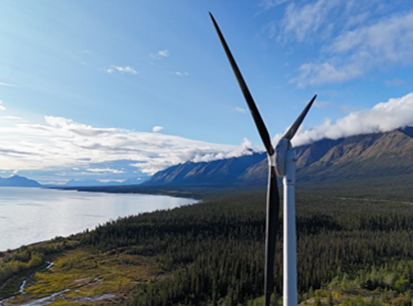
A wind turbine overlooks Kluane Lake as part of the Lhu’ààn Mân N’tsi Project
Photo credit: Kluane First Nation
Canada’s Natural Resources are sustainable
Results achieved
NRCan continued to enhance the sustainability of Canada’s natural resources by improving forest data, supporting ecosystem health, and integrating Indigenous knowledge into environmental stewardship.
Forest Monitoring, Cumulative Effects and Fibre Solutions
- Published 61 peer-reviewed knowledge products, improving access to national forest data and understanding of how forest management affects ecosystem services. These tools will help connect forest soil conditions with the benefits forests provide.
- Advanced satellite-based forest inventory methods and tools to track forest recovery after wildfires. These methods supported national reporting and improved understanding of forest trends.
- Developed 26 knowledge products that addressed forest recovery, land-use planning, and wildlife protection under the Cumulative Effects Program.
- Integrated Indigenous collaboration in seven projects focused on caribou habitat and land-use impacts. These efforts supported environmental stewardship and reduced unintended consequences from development.
- Supported 35 diverse projects to drive innovation in the forest sector through the Fibre Solutions program. Key areas of focus included improving fibre traceability, boosting forest productivity, and accelerating digital transformation. The program also enabled robust knowledge exchange through 149 technology transfer activities and the creation of 94 knowledge and technology transfer products, engaging stakeholders across Canada and globally. These collective efforts played a vital role in advancing the bioeconomy and modernizing forest management practices.
Key risks
The Department’s ability to lead innovative and sustainable natural resource development, and to position Canada as a leader in clean energy is influenced by factors such as the impacts of a rapidly changing climate; the effectiveness of engagement with external partners and allies; alignment with the work of federal partners; and the ability to successfully navigate varied regulatory regimes across jurisdictions.
To mitigate these risks, NRCan:
- Continued to strengthen internal and external partnerships, collaborating with provinces and territories and Indigenous partners through fora like the annual Energy and Mining Ministers’ Conference, the Canadian Council of Forest Ministers, and the Regional Tables to advance clean growth opportunities through coordinated action by identifying shared priorities, working through key issues, and aligning resources, timelines and regulatory and permitting processes.
- Helped navigate evolving relations with close economic partners, ensuring innovation and key program operations continue to support sustainable resource development and use.
- Continued collaboration with government departments to advance federal initiatives aimed at greening the Canadian economy and supporting Canada’s 2025 G7 Presidency.
- Provided consistent policy and funding support to enable the development of inclusive, cutting-edge initiatives that drive net-zero transition and climate objectives—creating jobs and paving the way for an equitable, innovative, and sustainable economy.
Resources required to achieve results
Table 8: Snapshot of resources required for Innovative and Sustainable Natural Resources Development
Table 8 provides a summary of the planned and actual spending and full-time equivalents required to achieve results.
| Resource | Planned | Actual |
|---|---|---|
| Spending | 2,470,316,561 | 2,292,187,099 |
| Full-time equivalents | 2,181 | 2,342 |
The Finances section of the Infographic for Natural Resources Canada on GC Infobase page and the People section of the Infographic for Natural Resources Canada on GC Infobase page provide complete financial and human resources information related to its program inventory.
Related government priorities
This section highlights government priorities that are being addressed through this core responsibility.
Gender-based Analysis Plus
More information on Natural Resources Canada’s contributions to Gender Based Analysis Plus can be found in NRCan’s Gender Based Analysis Plus Supplementary Information Table.
United Nations 2030 Agenda for Sustainable Development and the Sustainable Development
More information on Natural Resources Canada’s contributions to Canada’s Federal Implementation Plan on the 2030 Agenda and the Federal Sustainable Development Strategy can be found in our Departmental Sustainable Development Strategy.
Innovation
NRCan continued to drive innovation through digital transformation, AI, and advanced research to improve operational efficiency and scientific accuracy. The Department made progress on AI by contributing energy and technical expertise to review the proposed Canadian AI compute projects, as part of an ISED-led working group. NRCan also collected data on AI use among Canadian clean technology firms, as part of the Clean Technology Data Strategy.
Digital Accelerator
The Digital Accelerator, through AI and machine learning, improved data access and environmental monitoring.
- Completed six projects, including water feature extraction and flood risk mapping using images from the RADARSAT Constellation Mission, and assessing long-term water quality trends and climate change hot spots in Canadian watersheds.
- Conducted Open Science and Data Platform and Clean Growth Hub updates which improved client experience and data accessibility.
- Co-organized an AI-Quantum Workshop and multiple Community of Practice events, Co-led the Public Service Data/AI Challenge, gaining recognition for digital leadership. The winning project improved data availability for the Canada Greener Homes initiative.
- Initiated an internal assessment to identify AI opportunities related to operational efficiency and productivity.
Program inventory
Innovative and Sustainable Natural Resources Development is supported by the following programs:
- Energy Innovation and Clean Technology
- Green Mining Innovation
- Fibre Solutions
- Sustainable Forest Management
- Cumulative Effects
- Lower Carbon Transportation
- Electricity Resources
- Energy Efficiency
- Energy and Climate Change Policy
- Innovative Geospatial Solutions
Additional information related to the program inventory for Innovative and Sustainable Natural Resources Development is available on the Results page on GC InfoBase.
Core responsibility 3: Globally Competitive Natural Resource Sectors
In this section
Description
Advance and promote market access, inclusiveness and competitiveness for Canada’s natural resource sectors, in support of jobs and economic growth
Quality of life impacts
This core responsibility contributed to the Good governance and Environment domains of the Quality of Life Framework for Canada, and more specifically, the Democracy and institutions, and Ecological integrity and environmental stewardship subdomains, by advancing and promoting market access, inclusiveness and competitiveness for Canada’s natural resource sectors.
- NRCan contributed to the Indigenous self-determination indicator within the Quality of Life Framework by supporting access to equitable and consistent benefits for Indigenous groups from natural resources development. This included facilitating Indigenous equity ownership in major natural resource projects and increasing the economic participation of Indigenous communities and organizations in the development of natural resource projects. NRCan advocated for Indigenous participation and partnerships, aiming to foster stronger and more economically resilient communities. These efforts aligned with reconciliation priorities and Canada's net-zero objectives.
- NRCan contributed to the Greenhouse gas emissions indicator within the Quality of Life Framework. This involved supporting the transition to a net-zero future and aligning with the Canadian Critical Minerals Strategy, which enhanced the resilience of critical minerals supply chains, thereby contributing significantly to global efforts to reduce greenhouse gas emissions.
Progress on results
This section details the Department’s performance against its targets for each Departmental result under Core responsibility 3: Globally Competitive Natural Resource Sectors
Table 9: Access to new and priority markets for Canada’s natural resources is enhanced
Table 9 shows the target, the date to achieve the target and the actual result for each indicator under Access to new and priority markets for Canada’s natural resources is enhanced in the last three fiscal years.
| Departmental Result Indicator | Target | Date to achieve target | Actual Result |
|---|---|---|---|
| Canada’s share of U.S. and global imports of natural resources |
26.4% (U.S.) 1.3% (global imports) |
March 31, 2025 |
2022–23: 30.0% (U.S.) 1.5% (global imports) 2023–24: 29.2% (U.S.) 1.5% (global imports) 2024-25: 29.1% (US) 1.8% (global |
| Increase in value of assets abroad owned by Canadian natural resource companies | At least $238 billion | September 30, 2025 |
2022–23: Not availableFootnote 32 2023–24: Not availableFootnote 33 2024-25: Not availableFootnote 34 |
| Number of NRCan international engagements that support the development or expansion of trade and investment in natural resources | At least 40 | March 31, 2025 |
2022-23: 87 2023-24: 91 2024-25: 85 |
Table 10: Canadians are engaged in the future of the new and inclusive resource economy
Table 10 shows the target, the date to achieve the target and actual result for each indicator under Canadians are engaged in the future of the new and inclusive resource economy in the last three fiscal years.
| Departmental Result Indicator | Target | Date to achieve target | Actual Results |
|---|---|---|---|
| Number of joint products developed in collaboration with provinces and territories and released to Canadians | At least 12 | March 31, 2025 |
2022-23: 32 2023-24: 26 2024-25: 75Footnote 35 |
| Percentage of NRCan’s projects that support participation of Indigenous communities, organizations or governments in Canada’s natural resource economy | At least 40% | March 31, 2025 |
2022-23: 63% 2023-24: 65% 2024-25: 52% |
Table 11: Enhanced competitiveness of Canada’s natural resource sectors
Table 11 shows the target, the date to achieve the target and actual result for each indicator under Enhanced competitiveness of Canada’s natural resource sectors in the last three fiscal years.
| Departmental Result Indicator | Target | Date to achieve target | Actual Results |
|---|---|---|---|
| Economic value of anticipated natural resource projects supported by analysis and solutions | At least $54.5 billion | March 31, 2025 |
2022–23: $38.9 billion 2023–24: $51.7 billion 2024-25: $64.5 billion |
| Number of times NRCan’s economic and investment data are accessed | At least 500,000 | March 31, 2025 |
2022–23:491,381 2023–24: 343,696Footnote 36 2024-25: 219,950Footnote 37 |
The Results section of the Infographic for Natural Resources Canada on GC Infobase page provides additional information on results and performance related to its program inventory.
Details on results
The following section describes the results for Globally Competitive Natural Resource Sectors in 2024–25 compared with the planned results set out in Natural Resources Canada’s Departmental Plan for the year.
Enhanced competitiveness of Canada’s natural resource sectors
Results achieved
This section outlines NRCan’s efforts to strengthen Canada’s critical minerals value chains, promote transparency, support the forest sector amid global challenges, enhance employment equity and support youth employment.
Critical Minerals Development and Investment
The Department advanced Canada’s leadership in critical minerals through strategic funding and project development, focused on critical mineral value chains.
- Announced $764 million as of March 2025 for 113 projects under the Canadian Critical Minerals Strategy. In the first year of the Strategy, Canada saw a 15% increase in the domestic production of critical minerals. Several projects were identified focused on opening important mineral regions (such as Northwest BC for copper) as well as processing opportunities.
- Allocated $303 million for 31 projects and $1.5 million for 18 Indigenous grants (part of the overall totals) through the Critical Minerals Infrastructure Fund for pre-construction, construction, and Indigenous capacity-building and participation in infrastructure projects.
- Announced $81.3 million in investments, including $58.8 million for 10 projects (part of the overall totals) under the Critical Minerals Research, Development and Demonstration Program to advance the commercial adoption of critical mineral processing operations and technologies, reduce energy and carbon intensity, and improve resource optimization and waste reduction through circular economy principles.
- Partnered with the Saskatchewan Research Council to advance a domestic R&D initiative to strengthen Canada’s capacity to process locally mined critical minerals.
- Advanced research and innovation initiatives, driving progress in Canada’s critical minerals and quantum sectors, supporting sustainable development, exploration effectiveness, and cutting-edge technologies.
- Through the Critical Minerals Geoscience and Data Initiative, 58 R&D activities and 18 contribution agreements signed with PTs supported responsible critical mineral development, resulting in over 180 scientific deliverables, including six national-scale mineral potential datasets and a new geological map compilation to promote and accelerate responsible development of critical mineral resources in Canada.
- Through the Targeted Geoscience Initiative, 51 R&D activities, research grants for academic and not-for-profit research organizations—advanced mineral exploration across Canada by applying scientific expertise and emerging technologies. Results also include 17 quantum research products, training on quantum sensors, and the first geological trial of a quantum diamond magnetometer on an uncrewed aircraft.
International Partnerships and Market Access
NRCan built global alliances to support competitiveness and promote Canadian expertise.
- Championed critical minerals priorities in multilateral events, including Canada’s G7 Presidency with a Critical Minerals Action Plan, and engaging with the IEA, OECD, Minerals Security Partnership, Conference on Critical Minerals and Materials, and International Seabed Authority.
- Signed a collaboration agreement with Argentina on critical minerals and mining sustainability to support responsible resource development.
- Initiated work with Ukraine to assess geological data and explore joint projects. The focus was on rare earth elements and titanium, strengthening investment potential.
- Signed a Memorandum of Understanding with Indonesia and a joint statement with Italy on critical minerals cooperation and critical minerals and critical raw materials respectively.
- Hosted a Conference on Critical Materials and Minerals in Ottawa to promote alignment amongst G7 + Australia countries on critical minerals policy and trade.
Extractive Sector Transparency Measures Act
The Department ensured accountability and supported market access through transparency initiatives.
- Worked with the Extractive Sector Transparency Measures Act (ESTMA) and the Extractive Industries Transparency Initiative (EITI) to help Canadian diamond producers access EU markets by implementing the diamond certification program for the G7 ban on Russian diamonds.
- Published new ESTMA substitution determinations for the U.S., U.K., and Switzerland, and amended those for the EU and Quebec.
- Validated over 1,390 ESTMA reports disclosing $161 billion in payments to over 1,300 payees in 91 countries. This reinforced Canada’s leadership in extractive sector transparency.
- Chaired 10 EITI Board Validation Committee meetings.
Forest Sector Competitiveness and Innovation
NRCan supported the forest sector through policy, funding, and innovation to address trade and geopolitical challenges.
- Advocated for Canada’s market access, including engagement on the EU deforestation regulation and softwood lumber discussions with the U.S.
- Drafted a strategy with GAC and ESDC to support forest-reliant communities facing rising softwood lumber duties.
- Produced significant results stemming from the Department’s suite of forest sector competitiveness programs, including, the Forest Innovation Program, Investments in Forest Industry Transformation, Green Construction through Wood, Indigenous Forestry Initiative and the Global Forest Leadership Program (GloFor):
- Allocated $22.7 million in funding to research organizations to facilitate the development of new bio-based projects and technologies to improve the sustainability and productivity in Canada’s forest sector, including innovations in waste management, low/zero emission transportation, and pulp mill effluent treatment.
- Provided $48.5 million to 20 new projects, totaling $330.9 million in innovation investments to diversify the forest sector with value-added products, including a first-of-its-kind biomass-fueled supercritical CO₂ turbine system that converts forest residue and sawmill waste into electricity, biochar, and renewable heat.
- Provided $17.3 million to 24 projects, totaling $720.6 million in investments to support innovative wood building solutions, capacity building, and improved codes and standards for wood-based construction. A funded project includes the construction of a 3-storey school in the Treaty 6 Territory of the Métis Nation (SK) that will demonstrate the use of mass timber for educational facilities using both new and reclaimed mass timber as the primary building material.
- Funded Indigenous-led projects on revegetation of ancestral lands that have been severely impacted by recent wildfires, as well as local fuel mitigation and timber processing for ecological benefit, revenue, and community safety.
- Funded practical, industry-led research on technical requirements affecting offshore exports, including conformance of strength properties of some Canadian structural lumber with Japanese product standards, and opportunities for meeting current UK building standards and phytosanitary requirements.
- Funded participation in the development of international technical standards that affect Canadian solid biofuel exports, such as standards for facilities that do physical and mechanical testing of wood pellets, and standards for safe handling and storage of wood pellets.
- Supported international forest-related projects and co-led an action area of the Forest and Climate Leaders’ Partnership to promote Canada’s sustainable forest management credentials and wood innovation.
- Advanced international wildland fire management, including support for the FAO Global Fire Management Hub and global response to requests for wildland fire assistance.
Building Skilled Natural Resources Work Force
NRCan invested $15.6million to de-risk hiring youth in green jobs through the Science and Technology Internship Program – Green Jobs.
- Created 653 green jobs and training opportunities for youth aged 15-30 in the natural resources sector, surpassing the target of 480.Footnote 38 Jobs were created across all provinces and territories, with 17% of youth coming from Northern, rural, and remote communities.
- Enabled employers across the natural resources sector to hire youth, with about 79% of placements in the clean technology sector and 43% of employers were small and medium-sized enterprises.
- Attached youth to the labour market, with 78% of participants employed/self-employed after participating in the program and 13% returned to school.
- Increased the participation of youth from employment equity groups. Of the 653 green jobs and training opportunities created, 81% of youth were from at least one employment equity group, including: 51% women, 28% Indigenous youth, 27% racialized youth, 14% youth with disabilities.
Access to new and priority markets for Canada’s natural resources is enhanced
Results achieved
Results highlight NRCan’s efforts to expand Canada’s global trade presence and support the transition to a net-zero economy. The Department exceeded its engagement targets and led multiple international initiatives to promote Canadian energy, forest products, critical minerals, and clean technologies.
Economic Security and North American Relations
The Department addressed trade risks and informed the ongoing evolution of Canada-U.S. relations through the advancement of strategic analysis and engagement.
- In the aftermath of the US tariffs, negotiated an agreement involving PTs Ministers of Energy and Mines to advance regulatory cooperation, remove duplication, and focus on building projects quickly.
- Informing Canada’s response to U.S. tariff measures through details analysis of tariffs and countermeasures to natural resources sectors.
- Supported the Canada-U.S. Relations Cabinet Committee, informing the development of trade measures to respond to American tariffs, providing data and analysis on markets dynamics, risks and opportunities, and engaging stakeholders.
- Facilitated ministerial missions to Washington and cross-border industry engagement, helping shape discussions with the new U.S. administration and informing public and media discourse.
- Advanced preparations for the upcoming review of the Canada-United States-Mexico Agreement, ensuring robust and well informed Departmental positioning.
Strategic Missions and Partnerships
The Department engaged globally to boost trade and investments in natural resources and position Canada as a top supplier of critical minerals, energy, forest products, and clean technologies.
- Over 80 international engagements were completed, more than double the target of 40, positioning Canada as a preferred investment destination and supplier of choice for critical minerals, energy, and related technologies. These engagements supported the development and expansion of trade and investment in natural resources, and included activities such as bilateral visits to enhance international collaboration, as well as participation in various multilateral fora where the Department works to ensure that Canada’s priorities are reflected in discussions and outcomes.
- Trade missions were conducted across Asia, the Indo-Pacific, Europe, and emerging markets, positioning Canada as a preferred supplier of forest products, critical minerals, energy, and innovative clean technologies, technologies, helping diversify trade relationships.
Leadership in Energy Transition and Multilateral Engagements
The Department supported Canada’s climate commitments and international leadership through multilateral forums, domestic policy alignment, and advanced key policy initiatives through targeted participation and coordination. NRCan:
- Showcased Canada’s leadership of an inclusive energy transition at COP29 and contributed to Canada’s positioning and endorsement of three key COP29 Presidency energy pledges.
- Collaborated with ECCC to set the 2035 greenhouse gas emissions target under the Canadian Net-Zero Emissions Accountability Act and Canada’s Biennial Transparency Report. NRCan also supported responses to the 2024 CESD audit under the Net-Zero Emissions Accountability Act, providing transparency on NRCan’s decarbonization policies and programs.
- Partnered with the International Energy Agency (IEA) and the International Renewable Energy Agency to support global electricity system decarbonization.
- Launched the NRCan Technical Assistance Partnership (TAP), a five-year initiative to deliver developing country focused solutions that will help partner institutions establish policies, systems and technology solutions that are more just, resilient, and responsive to challenges around sustainable natural resources management and climate change.
- Led Canadian participation in CERAWEEK 2025, developing relationships with key industry players, and promoting Canadian energy to a largely U.S. audience.
- Led Canadian delegations to the International Atomic Energy Agency (IAEA) General Conference, participated in Canada’s delegation to the IAEA’s Eighth Review Meeting of the Joint Convention on the Safety of Spent Fuel Management and on the Safety of Radioactive Waste Management, and participated in the OECD Nuclear Energy Agency’s Roadmaps to New Nuclear conference.
- Engaged with GAC and ECCC to advance three leaders’ initiatives ahead of G7 Summit and supported engagements through roundtables with industry, provinces and territories, and core Deputy Minister groups.
- Initiated work by the IEA to develop a novel mapping tool to identify areas of overlap between renewable projects, critical mineral mining, and biodiversity hotspots / conservation priorities to support efficient and effective policy development to meet global targets for energy, climate, and biodiversity.
- Demonstrated support for Ukraine through diplomatic and industry engagements, expertise in programming to assist in evolving energy needs and opportunities, including leading a 28-company delegation to the Rebuild Ukraine Conference in Poland. NRCan coordinated provincial engagement and facilitated donations and knowledge sharing to support Ukraine’s energy reconstruction.
- Collaborated with two Korean government labs under the Indo-Pacific Strategy on low-carbon energy technologies that support trade diversification.
Canadians are engaged in the future of the new and inclusive resource economy
Results achieved
NRCan advanced a more inclusive and sustainable resource economy. The Department also strengthened Indigenous engagement and economic participation in natural resource projects through funding, partnerships, and international collaboration.
Indigenous Reconciliation and Regulatory Coordination (Nòkwewashk)
NRCan supported Indigenous participation in resource development, expanded economic opportunities, promoted international engagement, and advanced reconciliation by upholding the UN Declaration on the Rights of Indigenous Peoples Act.
Supporting Regulatory Processes
The Department supported regulatory reviews and Indigenous engagement for major projects, reinforcing Canada’s commitment to inclusive and coordinated resource development.
- NRCan supported the Canada Energy Regulator’s (CER) hearings for the Taylor to Gordondale Pipeline and Sunrise Expansion projects through participation in the Federal Review Team.
- As federal lead on the trilateral Regulatory Coordination, Indigenous Engagement, and Economic Inclusion Working Group, monitored regulatory processes and the Indigenous engagement approach for the Pathways Alliances’ proposed carbon capture and storage project, and engaged directly with impacted Indigenous groups.
Indigenous Economic Inclusion
NRCan advanced Indigenous economic participation in resource development through targeted funding, inclusive engagement, and support for Indigenous-led clean energy and infrastructure initiatives.
- Supported the Canada Indigenous Loan Guarantee Corporation, a subsidiary of the Canada Development Investment Corporation (CDEV), in launching the Indigenous Loan Guarantee Program (ILGP), with up to $5B in loan guarantees, first announced in December 2024 through the Fall Economic Statement. The ILGP was subsequently doubled to $10billion in March 2025 and expanded to include infrastructure, trade, and transportation projects.
- Launched Investment Analysis and Due Diligence capacity funding (up to $11.4 million) to support Indigenous groups making informed investment decisions about equity ownership opportunities and worked closely with CDEV to launch the ILGP portal and to process the program’s first loan guarantee.
- Released a “What We Heard” report reflecting engagements on the National Benefits-Sharing Framework from 2023 to 2024 involving more than 130 Indigenous organizations, PTs, and stakeholder groups.
- Launched Clean Fuels Fund 2.0 with a stream for Indigenous-led projects. The first intake of the program is funding 10 agreements with Indigenous-led companies worth almost $55 million.
- Led the preparation of a GIC decision package for the Northern Pipeline Agency, enabling TC Energy to complete a shareholders’ agreement supporting Indigenous economic development.
- Delivered $29.7 million in funding for Indigenous participation in resource projects via the Indigenous Advisory and Monitoring Committees (IMAC) and the Indigenous Natural Resource Partnerships program.
Indigenous Advisory and Monitoring Committees
The Department maintained Indigenous leadership in oversight, capacity development, and policy engagement for major energy projects through renewed support.
- In collaboration with Indigenous partners and the CER, supported IMAC for the Trans Mountain Expansion Project and the Enbridge Line 3 Replacement Project by obtaining $44 million in funding to renew both IAMCs for three years, which includes $10.5 million in annual Grants and Contributions funding to support the continued Indigenous inclusion in project oversight, direct support for community capacity through training, and the provision of advice to government to include Indigenous priorities and perspectives in federal policy initiatives.
Regional Energy and Resource Tables
NRCan strengthened Indigenous engagement in energy and resource planning through new regional tables, capacity-building agreements, and collaborative partnerships across PTs.
- Launched the Nunavut Regional Table in May 2024, in which Inuit partners are taking a leading role in shaping discussions from the outset.
- Engaged in various capacities with 31 Indigenous nations, governments, and organizations through the Regional Energy and Resource Tables. Twenty-four agreements were established with Indigenous groups in 2024-25 to enhance capacity and support their participation in the initiative, totaling $2.9 million across 10 provinces and territories.
International and Events
NRCan promoted Indigenous economic and energy leadership by facilitating participation in international trade missions and co-hosting a global workshop on equitable energy transitions for Indigenous, rural, and remote communities.
- Facilitated Indigenous business participation in international trade and investment missions to key markets, to increase investor confidence, promote Indigenous partnerships, and attract investment in Indigenous-owned companies, workers, and communities.
- Co-hosted an Asia Pacific Economic Cooperation (APEC) Energy Working Group workshop in Lima on creating fair energy transitions in Indigenous, rural, and remote communities. Two Indigenous representatives participated to showcase effective approaches, lessons learned, and emerging opportunities related to Indigenous engagement for energy transition and sustainable growth.
Indigenous Natural Resources Partnerships Program
The Department strengthened Indigenous participation in natural resource development by funding capacity-building agreements that supported training, employment, and business opportunities across multiple regions and sectors.
- In 2024-25, established 11 contribution agreements and provided $19.3 million in capacity development funding for Indigenous participation in natural resource projects, that:
- Aided in securing a three-year drilling contract in Ontario, representing a significant revenue-generating opportunity for two First Nations.
- Supported training and employment opportunities in the critical mineral sector for Nunavummiut and Inuit Nunangat.
- Supported an Alberta-based environmental-related Indigenous organization in developing an educational information series for Indigenous communities to actively participate in the critical minerals supply chain by building foundational knowledge, increasing community interest in critical minerals careers, partnerships with industry, and business opportunities.
Implementation of the UN Declaration on the Rights of Indigenous Peoples Act
NRCan advanced Indigenous inclusion in resource development by engaging with partners, promoting safety and equity for Indigenous communities, and supporting Indigenous languages and cultural representation.
- Led an engagement session with Indigenous partners to seek input on potential options on consultation and cooperation with Indigenous peoples as it relates to the implementation of the UN Declaration Act Action Plan measure 32 (i.e. the measure on developing guidance on engaging with Indigenous peoples on natural resources projects to obtain free, prior and informed consent).
- Engaged with Indigenous, industry and federal partners on the development of a strategy addressing MMIWG2S+ Calls for Justice on Resource Development and UN Declaration Act Action Plan Measure 12 to increase safety and equitable benefits while mitigating harm towards Indigenous women, girls, and 2SLGBTQIA+ people in resource development.
- Promoted Indigenous languages and cultures by appointing a new Inuit Advisor to the Geographical Names Board of Canada, and by updating ISO standards to better reflect the diversity of Indigenous languages.
Key risks
One of the biggest challenges to Canadian natural resource sectors is the uncertainty surrounding commodity demand and prices, in the context of a global economic slowdown and ongoing geopolitical uncertainty and conflict. Other risks include addressing increasing labour and skills shortages in the natural resources sector, maintaining energy security as well as effectively ensuring inclusiveness within and competitiveness of Canada’s natural resources industries through shifting geopolitical dynamics and the evolution of the global economy.
In response, NRCan has implemented mitigation strategies including:
- Proactively navigating and implementing international and domestic regulatory efficiency frameworks to enhance competitiveness.
- Continuing engagements with and integration of domestic partners in the management of Canada’s resources with a view to advancing reconciliation with Indigenous peoples and ensuring that all Canadians stand to benefit from Canada’s natural wealth.
- Taking steps to further advance Canada’s reputation as an attractive economy for sustainable investment and supporting economic recovery through engagement and trade missions with like-minded countries.
- Forming dedicated task forces to monitor ongoing conflict in various regions and providing expert advice to manage relationships.
- Promoting energy security and affordability by preserving critical supply chains and advancing the development and implementation of, efficient clean technologies.
- Modernizing IT systems for the protection of data assets and to reduce vulnerability to cyberattacks.
NRCan continues to focus on ongoing, coordinated, and effective risk management to reliably support Canadian natural resource sectors, promote domestic and international market access, and to secure Canada’s position as a leader in sustainable natural resource development.
Resources required to achieve results
Table 12: Snapshot of resources required for Globally Competitive Natural Resource Sectors
Table 12 provides a summary of the planned and actual spending and full-time equivalents required to achieve results.
| Resource | Planned | Actual |
|---|---|---|
| Spending | 2,110,187,295 | 1,272,759,815 |
| Full-time equivalents | 618 | 640 |
The Finances section of the Infographic for Natural Resources Canada on GC Infobase page and the People section of the Infographic for Natural Resources Canada on GC Infobase page provide complete financial and human resources information related to its program inventory.
Related government priorities
This section highlights government priorities that are being addressed through this core responsibility.
Gender-based Analysis Plus
More information on Natural Resources Canada’s contributions to Gender Based Analysis Plus can be found in NRCan’s Gender Based Analysis Plus Supplementary Information Table.
United Nations 2030 Agenda for Sustainable Development and the Sustainable Development Goals
More information on Natural Resources Canada’s contributions to Canada’s Federal Implementation Plan on the 2030 Agenda and the Federal Sustainable Development Strategy can be found in our Departmental Sustainable Development Strategy.
Program inventory
Globally Competitive Natural Resource Sectors is supported by the following programs:
- Forest Sector Competitiveness
- Provision of Federal Leadership in the Minerals and Metals Sector
- Energy Safety and Security, and Petroleum Resources
- Statutory Offshore Payments
- Indigenous Reconciliation and Regulatory Coordination (Nòkwewashk)
- Youth Employment and Skills Strategy - Science and Technology Internship Program (Green Jobs)
Additional information related to the program inventory for Globally Competitive Natural Resource Sectors is available on the Results page on GC InfoBase.
Internal services
In this section
Description
Internal services refer to the activities and resources that support a Department in its work to meet its corporate obligations and deliver its programs. The 10 categories of internal services are:
- Management and Oversight Services
- Communications Services
- Legal Services
- Human Resources Management
- Financial Management
- Information Management
- Information Technology
- Real Property
- Materiel
- Acquisitions
Progress on results
This section presents details on how the Department performed to achieve results and meet targets for internal services.
1) #OurNRCan, Modernization & Digital Transformation
NRCan continued to modernize its workspaces and digital services to support a hybrid work environment and improve service delivery. Key efforts included upgrading physical and digital infrastructure, enhancing user experience through feedback-driven improvements, and aligning with government-wide digital strategies. The Department also strengthened procurement practices and streamlined HR and pay systems.
Hybrid Workspaces
- Hosted 15+ sessions for 2,300 employees to provide a platform for feedback and address key concerns related to hybrid work. A Hybrid Work Toolkit for managers was also launched.
- Improved the digital accommodation process, enhancing efficiency, accessibility employee engagement and well-being. Training and learning events were adapted to shift from virtual only to hybrid meetings. Fully modernized physical workplaces, supporting 90%+ unassigned desk sharing environment in administrative-based office environments, aligned with Public Services and Procurement Canada (PSPC) standards.
- Achieved a reduction in office space use to achieve 11.3 m2 per FTE, on target to achieve 9.0 m2 per FTE five years ahead of 2034 target.
Digital and HR Transformation
- Implemented the Government of Canada's Digital Ambition and progressed with a service management program to improve user experience and address user needs. 63% of those services have used client feedback to improve the service, an increase of 41% compared to FY 2021-22.
- Monitored and adjusted network capacity with Shared Services Canada and ensured work offices had modern equipment. Provided IT equipment for onsite concierge service, modernized A/V equipment in collaboration spaces, and leveraged office presence to increase laptops and mobile evergreen replacement.
- Continued to enable new M365 functionalities to improve user-experience of the hybrid model and continued implementation of SharePoint Online.
- Maintained support for the Directive on Digital Talent by using the TBS IT Talent management pool to hire, streamlining procurement for the Accommodation Centre of Expertise (ACE)/Technology Accessibility Centre (TAC), managing training sessions and adopting the GC Workplace Accessibility Passport.
- Reimagined pay, leave and benefits support by providing employees and managers with a clear place to go for pay-related issues, delivered information sessions for employees, and launched a one-on-one support service for those experiencing major life changes.
- Achieved an average of 85% timeliness rate in HR to Pay transactions (target is 80%).
Procurement and Oversight
- Supported procurement and integrated new measures into NRCan’s operations, internal controls and Departmental delegations of authority.
- Established a Contract Review Board to oversee transactions and trends, recommendations and/or direction on Departmental contracting requirements, ensuring compliance with regulations and best practices.
- Established annual spending limits for professional services to ensure the department managed and/or reduced spending and worked with OGDs – including TBS’ Office of the Comptroller General of Canada and PSPC – to respond to and address instructions to enhance government-wide procurement rules and practices.
- Bolstered NRCan processes and practices to comply with policy instruments, implemented contracting suspensions and terminations transparently and fairly, and responded to all information and document requests (e.g., motions to produce papers).
2) Our People’s Wellness and Wellbeing
The Department prioritized employee wellness by promoting mental health and diversity, equity, and inclusion. Initiatives focused on creating a safe, respectful, and accessible workplace, advancing reconciliation with Indigenous peoples, and supporting diverse communities through targeted programs and training.
Mental Health and Wellbeing
- Supported the NRCan Mental Health and Wellness Strategy 2024-2026 to address key risk factors and promote psychological health, creating a safe and inclusive workplace.
- Implemented security initiatives to support employees’ physical and mental well-being, including threat-reporting mechanisms, working alone protocols, and emergency planning that reflects diverse needs.
- Integrated employee physical and mental health into the Department’s corporate risk assessment exercise to address issues like discrimination and racism, creating a culture that prioritizes inclusivity.
- Encouraged the Scents in the Workplace Working Group to organize meetings aimed at addressing scent-related concerns.
- Provided access to the Ombuds Office as a neutral, confidential resource for resolving conflicts, facilitating communication, and supporting fair outcomes among employees.
Equity and Inclusion
- Conducted bilateral meetings with each Employment Equity Network to identify barriers and discuss mitigation strategies. Provided administrative support to all networks, with continued engagement and dedicated support for the Indigenous Employee Network.
- Developed a comprehensive Positive Space Training program to foster 2SLGBTQIA+ education and allyship.
- Completed an internal audit of Inclusion, Diversity, Equity and Accessibility (IDEA) to improve Departmental implementation and integration of the IDEA principles.
- Completed the Self-Assessment on the Implementation of the Forward Direction of the Call to Action (2024) as per the Clerk’s Call to Action on Anti-Racism, Equity, and Inclusion.
- Partnered with TBS to offer a language training pilot for six Black employees, grounded in the GC Action Plan to Support Black Public Servants and the Call to Action.
- Launched a Department-wide Sponsorship Program to support career development and advancement for equity-seeking employees, with an expected first cohort of 5 -8 participants.
- Addressed key management recommendations from the early 2024 Employment Equity Horizontal Audit on the employment of racialized individuals in management and executive roles.
- Completed the Annual Report on the Operation of the Canadian Multiculturalism Act 2023-2024 that highlights how NRCan combats racism, hate and discrimination and promotes multiculturalism.
- Developed and launched the Inclusive Science Self-assessment tool to help scientists set goals and measure progress in integrating IDEA, GBA Plus, and Indigenous knowledge systems into program documents and research practice. NRCan’s cabinet documents included a GBA Plus annex identifying programs’ barriers and mitigation strategies.
- Created an internal article series called Voices of Science, in support of commitments under NRCan’s Charter for Gender Equality, focused on the future of NRCan science from women researchers’ point of view.
Reconciliation and Indigenous Engagement
- Delivered a successful calendar of events and cultural competency training at the Circle of Nations, continuing to create new opportunities to learn about Indigenous ways of knowing, doing and being including:
- 62 distinctions-based, Elder-led teachings, resulting in the participation of 3,925 public servants across federal departments and agencies;
- 12 unique Indigenous Teachings, including Indigenous language, in-person medicine walk, Métis Culture Teaching, Indigenous connection to Trees, and Reconciliation; and
- 4 Indigenous Ceremonies, including Sacred Fire Ceremony, Drum Awakening Ceremony, Sharing Circle in recognition of the National Day of Truth and Reconciliation, Potlatch Ceremony and Awakening of the Medicines.
- Launched the Pathways to Reconciliation Action Plan, aligned with the goals of the Truth and Reconciliation Commission’s Calls to Action, MMIWG2S+ Calls for Justice, and Many Voices One Mind recommendations. NRCan’s Pathways reflects the contributions of nearly 400 employees, wisdom of Elders in residence, and external partners. On National Indigenous Peoples Day approximately 1,000 NRCan officials participated in a hybrid signing of the Pathways to Reconciliation Action Plan by the senior management team.
- Developed the Curriculum on Braiding Diverse Systems of Knowledge, a set of learning resources for NRCan officials involved in Science and Technology activities that involve Indigenous Peoples and territories.
- Revised the Policy on Ethics for Science and Technology Activities Involving Indigenous Peoples and Territories. This policy aims to support NRCan employees in maintaining the highest standards of ethical conduct when conducting science and technologies activities that involve Indigenous peoples or take place on Indigenous territories.
- Developed the Curriculum on Braiding Diverse Systems of Knowledge, a set of learning resources for NRCan officials involved in S&T activities that involve Indigenous Peoples and territories.
Accessibility
- Developed the NRCan Accessibility Action Plan Annual Progress Report, following the lead of the Accessible Canada Act.
- The Employment Equity and Accessibility Action Plan’s 2nd progress report was developed to reflect on successes, identify areas for improvement, and align with emerging public service priorities, including fostering a diverse workforce and an inclusive, accessible, respectful, and supportive work environment.
- Launched the interdepartmental Accessibility in Federal Science Laboratories Community of Practice in collaboration with Terra Canada to discuss science and accessibility.
- Supported the Inclusive Science and Accessible Laboratories pilot to retrofit NRCan labs for people with diverse abilities with the goal of making the Laurentian Forestry Centre lab 100% accessible by 2025-26.
3) Our Resources, Stewardship & Management
In 2024-25, NRCan reinforced governance, cybersecurity, and infrastructure management. Achievements include the revised Values and Ethics Code, enhanced cyber resilience, improved IT oversight, and optimized facility use.
Values and Ethics
- Updated for the first time since 2012 the revised Values and Ethics Code following consultation with employees. Training was provided based on the revised Code and the Code was used in discussions with the Department in town halls, senior leadership meetings, and Departmental agendas.
- Delivered information sessions to tailored audiences, providing tools to model ethical behavior and embed values-based leadership. Employees and managers increased proactive engagement with the Department’s Center of Expertise in Values and Ethics (V&E) and added V&E discussions to regular agendas.
- Demonstrated leadership in values and ethics by hosting an interdepartmental panel at the V&E Symposium on advancing science in the public service and organizing a regional science-focused V&E discussion at the Atlantic Forestry Centre.
Cyber Security and Safety
- Updated the Cyber Security Strategy (implementation is ongoing). This strategy equips the Department to effectively manage cyber risks, fortify defenses against cyber-attacks, enhance cyber event detection capabilities, mitigate the impact of security incidents, and foster the growth of cyber security skills, knowledge, and cultural awareness within NRCan.
- Reduced phishing risk through innovative, behaviorally informed cybersecurity initiatives. Real-time simulations and interactive training improved users’ ability to recognize and respond to sophisticated phishing attempts.
- Developed and began implementing security measures for NRCan assets, data, and critical operations, while aligning with GC security policy instruments and threat intelligence.
- Strengthened major incident coordination role in Departmental 24/7 IT service and improved oversight management for incidents such as major system crashes, cybersecurity threats, or network outages.
- Centralized enterprise IT governance to enhance the visibility and oversight for IT-related needs and investments to support science and innovation and initiated the realignment of IT resources to bring consistency to IT and cyber security.
- Enabled reporting, protection and enforcement of Crown intellectual property (IP) rights through improvements to lifecycle management of IP assets, such as upgrades to the IP data system.
- Secured a signed agreement with Shared Services Canada for 24/7 support for its Critical Business Application Systems, ensuring better response times to minimize the downtime of critical public safety systems.
Facility Planning
- Supported the completion of the TerraCanada automated laboratory facility at the NRC facility in Mississauga and the NRCan facility at McMaster Innovation Park in Hamilton.
- Co-chaired the DM Oversight Committee In collaboration with Labs Canada and advanced facility planning for the TerraCanada National Capital Area Complex, reducing planned requirements by at least 30% and creating modern lab spaces by NRCan scientists.
- Created a laboratory asset database and lifecycle management framework to track and share internally science asset meta data concerning asset health, operating costs, forward plans and others.
- Reviewed all national property holdings and submitted a comprehensive package to PSPC to support the Federal Public Lands for Housing Initiative. A Memorandum of Understanding was finalized with Canada Lands Company to advance pre-disposal activities on the Booth Street complex in support of high-density residential and affordable housing.
Resources required to achieve results
Table 13: Resources required to achieve results for internal services this year
Table 13 provides a summary of the planned and actual spending and full-time equivalents required to achieve results.
| Resource | Planned | Actual |
|---|---|---|
| Spending | 222,434,663 | 237,730,678 |
| Full-time equivalents | 1,487 | 1,378 |
The Finances section of the Infographic for Natural Resources Canada on GC Infobase and the People section of the Infographic for Natural Resources Canada on GC Infobase provide complete financial and human resources information related to its program inventory.
Contracts awarded to Indigenous businesses
Government of Canada departments are required to award at least 5% of the total value of contracts to Indigenous businesses every year.
Natural Resources Canada results for 2024-25:
Table 14: Total value of contracts awarded to Indigenous businessesFootnote *
As shown in Table 14, Natural Resources Canada awarded 8% of the total value of all contracts to Indigenous businesses for the fiscal year.
| Contracting performance indicators | 2024-25 Results |
|---|---|
| Total value of contracts awarded to Indigenous businessesFootnote ** (A) | $12,977,032 |
| Total value of contracts awarded to Indigenous and non-Indigenous businesses (B) | $159,953,160 |
| Value of exceptions approved by deputy head (C) | NRCan had no deputy head approved exceptions |
| Proportion of contracts awarded to Indigenous businesses [A / (B−C) × 100] | 8% |
For fiscal year 2024-25, NRCan will have awarded an estimated 8% of its procurement budget to Indigenous-owned businesses. In fiscal years 2022-2023 and 2023-2024, NRCan implemented a strategy of tendering multi-year information management and information technology contracts for professional services that were leveraged throughout the Department. Indigenous businesses were successful and were awarded contracts. Given that there are now enough multi-year contracts to meet the Department’s needs, no new multi-year contracts for information management and information technology are planned. As such, the value of anticipated contracts awarded to Indigenous businesses after FY 2023-2024 is expected to return to historic levels, estimated between 5% and 10% of the total procurement budget.
In its 2025-26 Departmental Plan, Natural Resources Canada estimated that it would award 5% of the total value of its contracts to Indigenous businesses by the end of 2024-25.
Spending and human resources
In this section
Spending
This section presents an overview of the Department's actual and planned expenditures from 2022-23 to 2027-28.
Graph 1: Actual spending by core responsibility in 2024-25
Graph 1 presents how much the Department spent in 2024-25 to carry out core responsibilities and internal services.
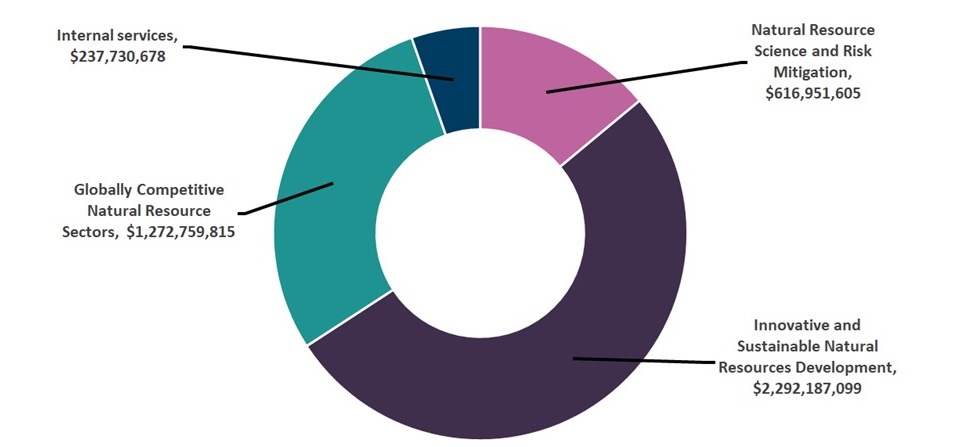
Text version of Graph 1
Graph 1 includes the following information in a pie chart
| Core responsibilities and internal services | 2024-25 actual spending |
|---|---|
| Natural Resource Science and Risk Mitigation | $ 616,951,605 |
| Innovative and Sustainable Natural Resources Development | $ 2,292,187,099 |
| Globally Competitive Natural Resource Sectors | $ 1,272,759,815 |
| Internal services | $ 237,730,678 |
| Total | $ 4,419,629,197 |
Analysis of actual spending by core responsibility
Natural Resource Science and Risk Mitigation (14%) – provides leadership in foundational science and shares expertise for managing Canada’s natural resources, reducing the impacts of climate change and mitigating risks from natural disasters and explosives. Planned spending within this core responsibility will support programs such as: Growing Canada’s Forests (2 Billion Trees), Fighting and Managing Wildfire in a Changing Climate, Flood Hazard Identification and Mapping, United Nations Commission on Limits of Continental Shelf and many more.
Innovative and Sustainable Natural Resources Development (52%) – provides leadership in the transformation to a low-carbon economy by improving the environmental performance of Canada’s natural resource sectors through innovation and sustainable development and use. Planned spending within this core responsibility will support programs such as: Greener Homes, Oil to Heat Pump Affordability, Smart Renewable Electrification Pathways, Zero Emission Vehicle Infrastructure, Clean Fuels Funds and many more.
Globally Competitive Natural Resource Sectors (29%) – supports the advancement and promotion of market access, inclusiveness and competitiveness for Canada’s natural resource sectors, in support of jobs and economic growth. Also includes statutory payments for offshore petroleum. Planned spending within this core responsibility will support programs such as: Newfoundland Offshore Petroleum Resource Board, Investments in Forest Industry Transformation, Critical Minerals Infrastructure Fund, Forest Innovation, Indigenous Natural Resources Partnership and many more.
Internal services (5%) – supports the abovementioned Departmental mandates, help meets corporate obligations and ensure effective and efficient delivery of programs.
Refocusing Government Spending
In Budget 2023, the government committed to reducing spending by $14.1 billion over five years, starting in 2023-24, and by $4.1 billion annually after that.
As part of meeting this commitment, Natural Resources Canada identified the following spending reductions.
- 2024-25: $ 58,388,000
- 2025-26: $ 86,998,000
- 2026-27 and after: $ 126,157,000
During 2024-25, Natural Resources Canada worked to realize these reductions through the following measures:
- Aligning its grants and contributions programs to ensure Canada’s natural resources sectors continue to contribute efficiently to the economy and improve the quality of life for all Canadians by making program adjustments based on scientific data and performance results, achieved outcomes and/or complementary solutions; and
- Reducing spending on consulting, other professional services, and travel, and eligible program spending by leveraging alternative remote solutions, streamlined processes, modernized tools and work environments, and advanced digital transformation to equip the Department in adapting and evolving to meet the needs and expectations of Canadians and the country.
Budgetary performance summary
Table 15: Actual three-year spending on core responsibilities and internal services (dollars)
Table 15 shows the money that Natural Resources Canada spent in each of the past three years on its core responsibilities and on internal services.
| Core responsibilities and internal services | 2024–25 Main Estimates | 2024–25 total authorities available for use | Actual spending over three years (authorities used) |
|---|---|---|---|
| Natural Resources Science and Risk Mitigation | $748,201,434 | $742,235,686 |
|
| Innovative and Sustainable Natural Resources Development | $2,470,316,561 | $2,731,951,617 |
|
| Globally Competitive Natural Resource Sectors | $2,110,187,295 | $1,362,974,567 |
|
| Subtotal | $5,328,705,290 | $4,837,161,870 |
|
| Internal services | $222,434,663 | $279,738,614 |
|
| Total | $5,551,139,953 | $5,116,900,484 |
|
Analysis of the past three years of spending
The budgetary performance summary table above provides for the following:
- Main Estimates for 2024-25;
- Total authorities available for use in 2024-25, reflecting the authorities received including in-year funding as reported in the Public Accounts of Canada; and
- Actual expenditures from 2022-23 to 2024-25, as reported in the Public Accounts of Canada.
Actual spending for 2023-24 was $3,467 million, a year-over-year increase of $926 million (36%) from 2022-23 actual spending. This increase is mainly due to:
- Incremental spending of $723M in grants and contributions for programs aimed at Green Homes (including Oil to Heat Pumps), Clean Fuels Fund (CFF), Smart Renewable Electrification Pathways (SREP), Zero Emissions Vehicle Infrastructure Program (ZEVIP), 2 Billion Trees (2BT) and Electricity Pre-Development Program. These programs experience increased spending as they mature in the program lifecycle, more contributions agreements are signed and as applicants continue to seek reimbursement for eligible expenses.
- Increase of $182M in Statutory Vote, specifically attributed to the Newfoundland Offshore Petroleum Resource Revenue Fund. The fund recorded an increase in royalty payments, as well as increased forfeitures of security deposits for exploration and drilling activities.
- NRCan serves as an intermediary, facilitating the flow through of applicable funds to the Province of Newfoundland.
These increases in spending were partially offset by reduced spending due to:
- Sunset of programs such as Emissions Reduction Fund (Vote 10), Expanding Market Opportunities and Mountain Pine Beetle.
- Reduced funding profile for NRCan’s Investment in Forest Industry Transformation (IFIT) Program, Indigenous Advisory and Monitoring Committee (IAMC), Green Infrastructure and Green Construction through Wood (GC Wood).
Actual spending for 2024-25 was $4,420 million, a year-over-year increase of $953 million (27%) from 2023-24 actual spending. The increase is mainly due to:
- Incremental spending of $610M in grants and contributions for programs aimed at Greener Homes (including Oil to Heat Pumps), Electricity Pre-development Program (EPP), 2 Billion Trees (2BT) and Energy Efficiency. These programs experienced increased spending as they mature within their program lifecycle, additional contribution agreements are signed, and as applicants continue to seek reimbursement for eligible expenses.
- Increase of $348M in Statutory Vote, specifically attributed to the Newfoundland Offshore Petroleum Resource Revenue Fund. The fund recorded an increase in royalty payments and Corporate Income Tax as a result of increased production levels at the Hibernia and Hebron offshore oil fields. NRCAN serves as an intermediary, facilitating the flow through of applicable funds to the Province of Newfoundland.
These increases in spending were partially offset by reduced spending due to:
- Reduced funding profile for NRCan’s Investment in Smart Renewable Electrification Pathways (SREP), Zero Emission Vehicle Infrastructure Program (ZEVIP) and Clean Fuels Fund (CFF).
The decrease of $434 million between planned spending of $5,551 million and total authorities of $5,117 million in 2024-25 is primarily attributed to the $757 million decrease tied to the Newfoundland Offshore Petroleum Resource Revenue Fund. Statutory payment obligations under these accords tend to fluctuate significantly as they are largely driven by oil and gas prices, production levels and anticipated corporate income taxes related to offshore operations.
This decrease is partially offset by in-year funding received for the capitalization of Greener Homes, Smart Renewable Electrification Pathways, Indigenous Advisory Monitoring Committee, as well as several other programs.
Of the $5,117 million total authorities in 2024-25, NRCan spent $4,420 million. The $697 million in unspent funding is primarily driven by several programs that encountered challenges due to ongoing disruption in downstream supply chains, impacting labour and infrastructure requirements, lower than expected uptake by Provinces and Territories, and demand driven nature of some projects which affects timing of reimbursement requests from applicants. To mitigate the impact on program delivery, a significant amount of the unspent funding will be requested for reprofile or carried forward into future years to ensure that funding will continue to be available to support the projects.
The Finances section of the Infographic for Natural Resources Canada on GC Infobase offers more financial information from previous years.
Table 16: Planned three-year spending on core responsibilities and internal services (dollars)
Table 16 shows Natural Resources Canada’s planned spending for each of the next three years on its core responsibilities and on internal services.
| Core responsibilities and internal services | 2025–26 planned spending | 2026–27 planned spending | 2027–28 planned spending |
|---|---|---|---|
| Natural Resource Science and Risk Mitigation | 855,321,641 | 828,620,374 | 679,436,872 |
| Innovative and Sustainable Natural Resources Development | 2,202,528,619 | 1,666,971,122 | 1,242,197,045 |
| Globally Competitive Natural Resource Sectors | 1,863,212,231 | 1,682,099,432 | 1,660,417,182 |
| Subtotal | 4,921,062,491 | 4,177,690,928 | 3,582,051,099 |
| Internal services | 211,514,900 | 199,050,006 | 175,959,122 |
| Total | 5,132,577,391 | 4,376,740,934 | 3,758,010,221 |
Analysis of the next three years of spending
The overall decrease of $1.37 billion from 2025-26 to 2027-28 mainly reflects the planned sunsetting of programs.
The Finances section of the Infographic for Natural Resources Canada on GC Infobase offers more detailed financial information related to future years.
Funding
This section provides an overview of the Department's voted and statutory funding for its core responsibilities and for internal services. Consult the Government of Canada budgets and expenditures for further information on funding authorities.
Graph 2: Approved funding (statutory and voted) over a six-year period
Graph 2 summarizes the Department's approved voted and statutory funding from 2022-23 to 2027-28.
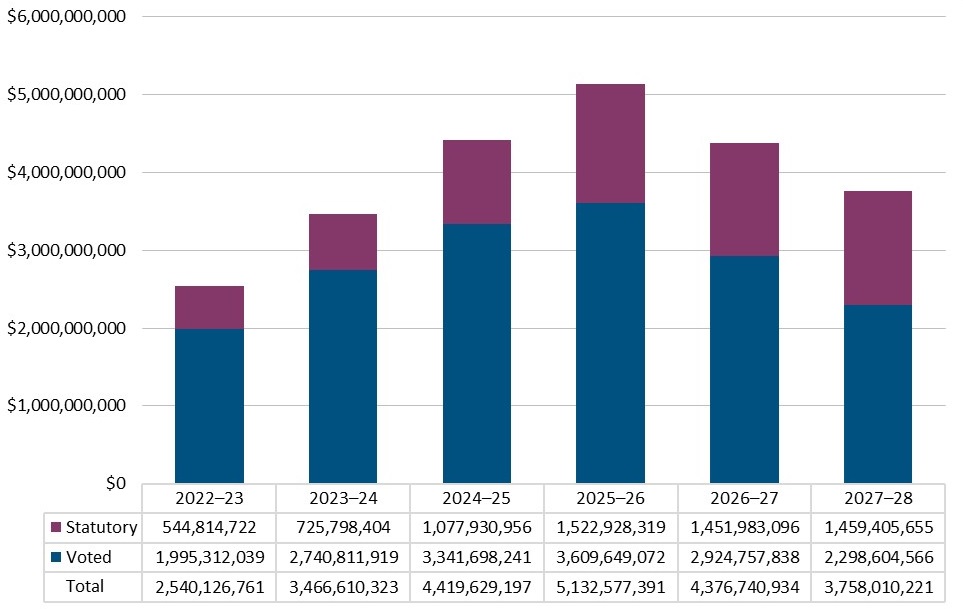
Note: NRCan’s program expenditures include salaries, non-salary costs, capital, grants and contributions to deliver programs and statutory items.
Text version of graph 2
Graph 2 includes the following information in a bar graph:
| Fiscal year | Statutory | Voted | Total |
|---|---|---|---|
| 2022-23 | 544,814,722 | 1,995,312,039 | 2,540,126,761 |
| 2023-24 | 725,798,404 | 2,740,811,919 | 3,466,610,323 |
| 2024-25 | 1,077,930,956 | 3,341,698,241 | 4,419,629,197 |
| 2025-26 | 1,522,928,319 | 3,609,649,072 | 5,132,577,391 |
| 2026-27 | 1,451,983,096 | 2,924,757,838 | 4,376,740,934 |
| 2027-28 | 1,459,405,655 | 2,298,604,566 | 3,758,010,221 |
Analysis of statutory and voted funding over a six-year period
Planned spending in Voted authorities from 2025-26 to 2027-28 is declining due to previously approved reference level changes.
Planned spending in Statutory authorities shows a variation from 2025-26 to 2027-28 mainly due to the Atlantic Offshore Accounts. Statutory payment obligations under these accords are largely driven by oil and gas prices, production levels and anticipated corporate income taxes related to offshore operations. The planned spending is based on the Department's economic modeling forecasts prepared in the fall of 2024.
Consult the Public Accounts of Canada for further information on Natural Resources Canada departmental voted and statutory expenditures.
Financial statement highlights
Please see the NRCan’s consolidated financial statements (Unaudited) for the year ended March 31, 2025.
The highlights presented in this section are drawn from the Department’s consolidated financial statements.
The consolidated financial statements were prepared using the Department’s accounting policies, which are based on Canadian public sector accounting standards resulting in figures that may differ from those provided in other sections of the Departmental Results Report prepared on an expenditure basis. A reconciliation between authorities used on an expenditure basis and the net cost of operations prepared on an accrual basis is set out in Note 3 of the Department’s consolidated financial statements.
Table 17: Condensed Consolidated Statement of Operations (unaudited) for the year ended March 31, 2025 (dollars)
Table 17 summarizes the expenses and revenues for 2024–25 which net to the cost of operations before government funding and transfers.
| Financial information | 2024–25 actual results | 2024–25 planned results | Difference (actual results minus planned) |
|---|---|---|---|
| Total expenses | 4,403,383,588 | 5,071,820,419 | (668,436,831) |
| Total net revenues | 23,813,507 | 25,401,604 | (1,588,097) |
| Net cost of operations before government funding and transfers | 4,379,570,081 | 5,046,418,815 | (666,848,734) |
Analysis of expenses and revenues for 2024-25
The 2024–25 planned results information is provided in NRCan’s Future-Oriented Statement of Operations and Notes 2024–25.
The variance of $666.8 million between the planned and actual net cost of operations before government funding and transfers is mainly attributed to less than planned spending in the following programs: Newfoundland and Labrador Statutory Offshore Accounts and Critical Mineral Infrastructure Fund program.
Table 18 Condensed Consolidated Statement of Operations (unaudited) for 2023-24 and 2024-25 (dollars)
Table 18 summarizes actual expenses and revenues and shows the net cost of operations before government funding and transfers.
| Financial information | 2024–25 actual results | 2023–24 actual results | Difference (2024-25 minus 2023-24) |
|---|---|---|---|
| Total expenses | 4,403,383,588 | 3,493,680,485 | 909,703,103 |
| Total net revenues | 23,813,507 | 23,886,173 | (72,666) |
| Net cost of operations before government funding and transfers | 4,379,570,081 | 3,469,794,312 | 909,775,769 |
Analysis of expenses and revenues for 2024-25
Total NRCan expenses of $4,403.4 million in 2024-25 consist of $3,263 million in transfer payments, mainly related to other levels of government under Globally Competitive Natural Resource Sectors and to Industry under Innovative and Sustainable Natural Resources Development, along with $1,140 million in other operating expenses. The NRCan total net revenues of $24 million in 2024-25 mainly include re-spendable revenues from research; testing and analysis activities; issuance of licenses, permits and certificates under the Explosives Act and Explosives Regulations; revenues associated with the Geomatics Canada Revolving Fund; and revenues from the Environmental Studies Research Fund (ESRF).
The increase of $909.8 million in the net cost of operations before government funding and transfers in 2024-25 is mainly explained by an:
- Increase of $453 million in transfer payments to Industry mainly attributed to Contributions in support of Home retrofits and the Electricity Pre-Development Projects.
- Increase of $419 million in transfer payments to Other levels of government as a result of an overall increase mainly attributed to payments of offshore royalties as well as other programs such as Contributions in Growing Canada’s Forests-2 Billion trees, Contributions in support of Fighting and Managing Wildfires in a changing climate and Contributions in support of Energy Efficiency.
- Increase of $40 million in transfer payments to Non-profit organizations as a result of an increase of $98 million in various programs including Contributions in support of Energy Efficiency, Contributions in support of the Forest Innovation Program, and Contributions for Growing Canada's Forests - 2 Billion Trees. This is offset by a $58 million decrease in Contributions in support of Smart Renewables and Electrification Pathways.
The chart presenting NRCan’s actual expenses by type for 2024-25 is available on the NRCan website.
Table 19 Condensed Consolidated Statement of Financial Position (unaudited) as at March 31, 2025 (dollars)
Table 19 provides a brief snapshot of the amounts the Department owes or must spend (liabilities) and its available resources (assets), which helps to indicate its ability to carry out programs and services.
| Financial information | Actual fiscal year (2024–25) | Previous fiscal year (2023–24) | Difference (2024–25 minus 2023–24) |
|---|---|---|---|
| Total net liabilities | 1,674,375,307 | 1,321,992,699 | 352,382,608 |
| Total net financial assets | 1,560,511,134 | 1,207,196,440 | 353,314,694 |
| Departmental net debt | 113,864,173 | 114,796,259 | (932,086) |
| Total non-financial assets | 361,591,496 | 342,619,330 | 18,972,166 |
| Departmental net financial position | 247,727,323 | 227,823,071 | 19,904,252 |
Analysis of department’s liabilities and assets since last fiscal year
Total NRCan liabilities of $1,674 million include $1, 506 million in accounts payable and accrued liabilities. The overall increase of $352.4 million is mainly attributable to a larger volume of contribution funding leading to an increase in payables at year-end and contribution holdbacks.
Total NRCan net financial assets of $1,560.5 million mainly consist of $1,539 million due from the consolidated revenue fund (CRF), which represents amounts that may be disbursed without further charges to the NRCan authorities.
Total NRCan non-financial assets of $361.6 million mainly consist of $356.6 million of tangible capital assets.
The Departmental net financial position, which is the difference between the total non-financial assets and the Departmental net debt, increased by $20 million. This increase is mainly due to an increase in tangible capital assets.
Human resources
This section presents an overview of the Department’s actual and planned human resources from 2022–23 to 2027–28.
Table 20: Actual human resources for core responsibilities and internal services
Table 20 shows a summary in full-time equivalents of human resources for Natural Resources Canada’s core responsibilities and for its internal services for the previous three fiscal years.
| Core responsibilities and internal services | 2022–23 actual full-time equivalents | 2023–24 actual full-time equivalents | 2024–25 actual full-time equivalents |
|---|---|---|---|
| Natural Resource Science and Risk Mitigation | 1,316 | 1,430 | 1,527 |
| Innovative and Sustainable Natural Resources Development | 1,986 | 2,152 | 2,342 |
| Globally Competitive Natural Resource Sectors | 495 | 613 | 640 |
| Subtotal | 3,797 | 4,195 | 4,509 |
| Internal services | 1,243 | 1,304 | 1,378 |
| Total | 5,040 | 5,499 | 5,887 |
Analysis of human resources for the last three years
Figures reflected from 2022-23 to 2024-25 represent utilized FTEs at year-end.
Increase from 2022-23 to 2024-25 is driven by investments in programs listed above.
Table 21: Human resources planning summary for core responsibilities and internal services
Table 21 shows the planned full-time equivalents for each of Natural Resources Canada’s core responsibilities and for its internal services for the next three years. Human resources for the current fiscal year are forecast based on year to date.
| Core responsibilities and internal services | 2025–26 planned full-time equivalents | 2026–27 planned full-time equivalents | 2027–28 planned full-time equivalents |
|---|---|---|---|
| Natural Resource Science and Risk Mitigation | 1,566 | 1,503 | 1,472 |
| Innovative and Sustainable Natural Resources Development | 2,241 | 2,026 | 1,773 |
| Globally Competitive Natural Resource Sectors | 689 | 625 | 599 |
| Subtotal | 4,496 | 4,154 | 3,844 |
| Internal services | 1,521 | 1,458 | 1,284 |
| Total | 6,017 | 5,612 | 5,128 |
Analysis of human resources for the next three years
For 2025-26 to 2027-28, the figures represent total Planned FTEs to support NRCan approved program activities.
Decrease from 2025-26 to 2027-28 is mostly driven by previously approved reference level changes.
Supplementary information tables
The following supplementary information tables are available on Natural Resources Canada’s website:
- Details on transfer payment programs
- Up-front multi-year funding
- Gender-based Analysis Plus
- Horizontal initiatives
- Response to Parliamentary committees and external audits
- Regulatory and Permitting Efficiency for Clean Growth Projects
Federal tax expenditures
The tax system can be used to achieve public policy objectives through the application of special measures such as low tax rates, exemptions, deductions, deferrals and credits. The Department of Finance Canada publishes cost estimates and projections for these measures each year in the Report on Federal Tax Expenditures. This report also provides detailed background information on tax expenditures, including descriptions, objectives, historical information and references to related federal spending programs as well as evaluations and GBA Plus of tax expenditures.
Corporate information
Departmental profile
Appropriate minister(s): The Honourable Tim Hodgson, P.C., M.P.
Institutional head: Michael Vandergrift
Ministerial portfolio:
- Atomic Energy of Canada Limited;
- Canada Energy Regulator;
- Canadian Nuclear Safety Commission;
- Canada-Newfoundland and Labrador Offshore Petroleum Board;
- Canada-Nova Scotia Offshore Petroleum Board;
- Northern Pipeline Agency; and,
- Energy Supplies Allocation Board (inactive)
Enabling instrument(s):
Year of incorporation / commencement: 1994
Departmental contact information
Natural Resources Canada
580 Booth Street
Ottawa, Ontario
K1A 0E4
Canada
Email: media@nrcan-rncan.gc.ca
Website(s): https://natural-resources.canada.ca/home
Definitions
List of terms
- appropriation (crédit)
- Any authority of Parliament to pay money out of the Consolidated Revenue Fund.
- budgetary expenditures (dépenses budgétaires)
- Operating and capital expenditures; transfer payments to other levels of government, departments or individuals; and payments to Crown corporations.
- core responsibility (responsabilité essentielle)
- An enduring function or role of a department. The departmental results listed for a core responsibility reflect the outcomes that the department seeks to influence or achieve.
- Departmental Plan (plan ministériel)
- A report that outlines the anticipated activities and expected performance of an appropriated department over a 3-year period. Departmental Plans are usually tabled in Parliament in spring.
- departmental priority (priorité)
- A plan, project or activity that a department focuses and reports on during a specific planning period. Priorities represent the most important things to be done or those to be addressed first to help achieve the desired departmental results.
- departmental result (résultat ministériel)
- A high-level outcome related to the core responsibilities of a department.
- departmental result indicator (indicateur de résultat ministériel)
- A quantitative or qualitative measure that assesses progress toward a departmental result.
- departmental results framework (cadre ministériel des résultats)
- A framework that connects the department’s core responsibilities to its departmental results and departmental result indicators.
- Departmental Results Report (rapport sur les résultats ministériels)
- A report outlining a department’s accomplishments against the plans, priorities and expected results set out in the corresponding Departmental Plan.
- Full-time equivalent (équivalent temps plein)
- Measures the person years in a departmental budget. An employee's scheduled hours per week divided by the employer's hours for a full-time workweek calculates a full-time equivalent. For example, an employee who works 20 hours in a 40-hour standard workweek represents a 0.5 full-time equivalent.
- Gender-based Analysis Plus (GBA Plus) (analyse comparative entre les sexes plus [ACS Plus])
- An analytical tool that helps to understand the ways diverse individuals experience policies, programs and other initiatives. Applying GBA Plus to policies, programs and other initiatives helps to identify the different needs of the people affected, the ways to be more responsive and inclusive, and the methods to anticipate and mitigate potential barriers to accessing or benefitting from the initiative. GBA Plus goes beyond biological (sex) and socio-cultural (gender) differences to consider other factors, such as age, disability, education, ethnicity, economic status, geography (including rurality), language, race, religion, and sexual orientation.
- government priorities (priorités pangouvernementales)
- For the purpose of the 2024–25 Departmental Results Report, government priorities are the high-level themes outlining the government’s agenda as announced in the 2021 Speech from the Throne.
- horizontal initiative (initiative horizontale)
- A program, project or other initiative where two or more federal departments receive funding to work collaboratively on a shared outcome usually linked to a government priority, and where the ministers involved agree to designate it as horizontal. Specific reporting requirements apply, including that the lead department must report on combined expenditures and results.
- Indigenous business (entreprise autochtones)
- For the purposes of a Departmental Result Report, this includes any entity that meets the Indigenous Services Canada’s criteria of being owned and operated by Elders, band and tribal councils, registered in the Indigenous Business Directory or registered on a modern treaty beneficiary business list.
- non-budgetary expenditures (dépenses non budgétaires)
- Net outlays and receipts related to loans, investments and advances, which change the composition of the financial assets of the Government of Canada.
- performance (rendement)
- What a department did with its resources to achieve its results, how well those results compare to what the department intended to achieve, and how well lessons learned have been identified.
- performance indicator (indicateur de rendement)
- A qualitative or quantitative measure that assesses progress toward a departmental-level or program-level result, or the expected outputs or outcomes of a program, policy or initiative.
- plan (plan)
- The articulation of strategic choices, which provides information on how a department intends to achieve its priorities and associated results. Generally, a plan will explain the logic behind the strategies chosen and tend to focus on actions that lead to the expected result.
- planned spending (dépenses prévues)
- For Departmental Plans and Departmental Results Reports, planned spending refers to the amounts presented in Main Estimates. Departments must determine their planned spending and be able to defend the financial numbers presented in their Departmental Plans and Departmental Results Reports.
- program (programme)
- An Individual, group, or combination of services and activities managed together within a department and focused on a specific set of outputs, outcomes or service levels.
- program inventory (répertoire des programmes)
- A listing that identifies all the department’s programs and the resources that contribute to delivering on the department’s core responsibilities and achieving its results.
- result (résultat)
- An outcome or output related to the activities of a department, policy, program or initiative.
- statutory expenditures (dépenses législatives)
- Spending approved through legislation passed in Parliament, other than appropriation acts. The legislation sets out the purpose and the terms and conditions of the expenditures.
- target (cible)
- A quantitative or qualitative, measurable goal that a department, program or initiative plans to achieve within a specified time period.
- voted expenditures (dépenses votées)
- Spending approved annually through an appropriation act passed in Parliament. The vote also outlines the conditions that govern the spending.